Lufthansa Revives All Airbus A380s: Why the German Giant Bets on the Superjumbo for Munich Hub
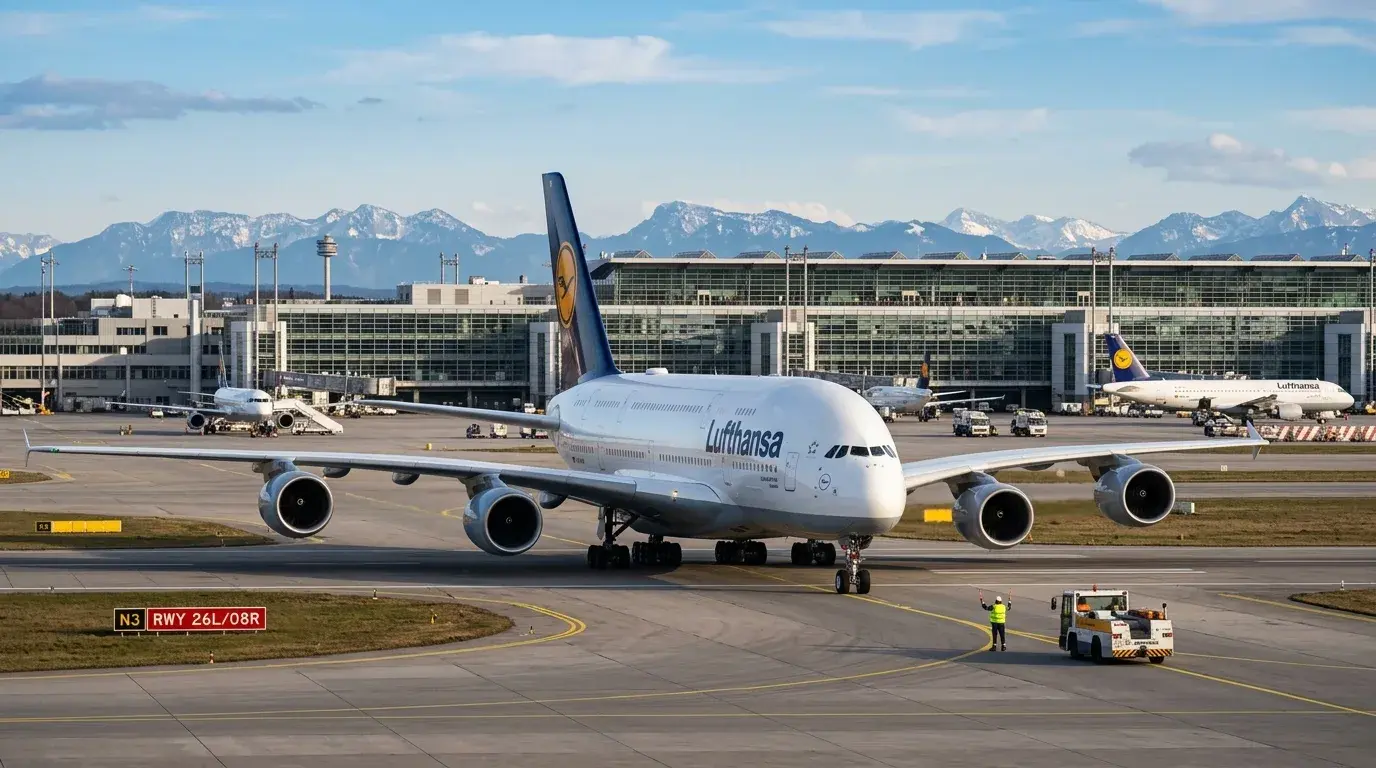
By fully reactivating all eight of its Airbus A380s, Lufthansa is dramatically reshaping its long-haul strategy. Gone are the days when the world’s largest passenger aircraft took off from Frankfurt—welcome to a new era centered on Munich. This decision, announced in June 2026, reflects a bold wager: betting on the Superjumbo to attract high-demand leisure travelers and offset delays in the delivery of new long-haul aircraft.
The choice of Munich as the exclusive base for the A380s is no coincidence. With a capacity of 526 seats, these iconic aircraft meet specific needs on routes with strong seasonal traffic, such as Los Angeles, San Francisco, or Delhi. Bavarian airport authorities have confirmed that Munich Airport has the necessary infrastructure to safely accommodate these giants of the skies.
For travelers, this reactivation means one thing: more available seats on flagship destinations, along with a unique flying experience. Aboard Lufthansa’s A380s, the Business Class has been fully renovated in 2025, now featuring private suites with sliding doors, while Premium Economy, introduced in 2020, appeals to passengers seeking comfort without the price tag of Business Class. The dual benefit is clear: for the airline, which optimizes costs on highly frequented routes, and for passengers, who enjoy a premium product at still-accessible fares.
Why Munich Instead of Frankfurt? The Strategy Behind the Hub Shift
Lufthansa’s decision to concentrate its A380s in Munich is driven by several structural factors. First, Frankfurt Airport is already saturated, with traffic steadily increasing since the post-pandemic recovery. Time slots are expensive, and environmental constraints weigh increasingly on operators. Munich, on the other hand, offers significant leeway: less congested, it allows for smoother rotations of Superjumbos, essential for routes like those to Boston or Washington.
Additionally, the Bavarian and Austrian clientele is particularly receptive to long-haul travel, especially to the United States. Lufthansa’s data shows that demand for Munich–New York and Munich–Los Angeles routes has grown by 15% since 2024, driven by entrepreneurs, affluent tourists, and the diaspora. By focusing on the A380, the airline can absorb this surge without increasing flight frequencies while offering a premium onboard experience.
Finally, this reorganization aligns with a broader fleet modernization plan. While fuel-intensive, the A380s remain competitive on routes with very high density. Their reactivation allows Lufthansa to delay the acquisition of new aircraft, whose deliveries have been delayed by industrial crises at Airbus and Boeing—a precious time gain in an industry where every month counts.
Modernized A380s: A Cabin Redesigned to Win Over Travelers
One of the key arguments for this reactivation lies in the upgrades made to the fleet. All eight of Lufthansa’s A380s underwent a facelift between 2024 and 2025, with an investment of nearly €100 million. Business Class now features fully enclosed suites measuring 2.05 meters wide, equipped with leather seats and state-of-the-art entertainment systems. Premium Economy, introduced in 2020, offers 30 cm more legroom, in-seat meal service, and premium drinks included in the fare.
For Economy Class passengers, improvements are subtler but equally strategic: 18-inch individual screens, enhanced Wi-Fi connectivity, and ambient lighting tailored for long-haul flights. These often-overlooked details make a difference in traveler choices, especially on 12- to 14-hour routes.
Lufthansa didn’t wait to test public appetite. As early as summer 2025, the airline temporarily reintroduced an A380 on the Munich–New York route, achieving record occupancy: an average 92% load factor. A success that convinced management to fully reactivate the fleet.
A Calculated but Risky Gamble: The Challenges of A380 Reactivation
Despite these advantages, the return to service of the A380s is not without challenges. The first concerns operating costs. An A380 consumes about 12 liters of fuel per passenger per 100 km, compared to 3 liters for an Airbus A350. With soaring kerosene prices, Lufthansa must optimize every flight to maintain profitability. The airline is banking on load factors exceeding 90% and precise maintenance cost management, now partially outsourced to specialized partners.
Another challenge is the availability of spare parts. Airbus halted A380 production in 2021, and stocks of critical components are dwindling. Lufthansa has had to negotiate with the manufacturer and other operators (such as Emirates or Singapore Airlines) to secure supplies until 2030—a race against time to avoid prolonged groundings.
Finally, the environmental question looms large. The A380s are often criticized for their carbon footprint. In response, Lufthansa has launched a voluntary carbon offset program, allowing passengers to financially contribute to emission reduction projects. A way to reconcile profitability with social responsibility.
Despite these challenges, the gamble appears to be paying off. The first months of reactivation have shown an 8% increase in long-haul traffic from Munich, with a clear rise in Premium Economy and Business Class bookings. For travelers, it’s a unique opportunity to fly on one of the most iconic aircraft of the 21st century, with a level of comfort few airlines can match today.
Lufthansa has thus chosen a bold path: reinventing the use of A380s by focusing them on a secondary hub while leveraging their prestige to attract discerning travelers. A strategy that could inspire other European carriers as the long-haul market enters a phase of consolidation and premiumization.
What to Remember for Your Next Trips
If you’re planning a trip to the United States, India, or Asia from Europe, Lufthansa’s A380 could be an option worth considering. Here’s what you need to know:
• Availability and Booking: Flights operated by the A380 are clearly identified on Lufthansa’s website and in reservation systems. Opt for Premium Economy or Business Class to fully enjoy the recent upgrades.
• Best Travel Period: The A380s are primarily deployed on seasonal routes (summer/winter). For the United States, flights are more frequent between June and September, while for India, the season runs from October to March.
• Alternatives if the A380 is Unavailable: In case of maintenance or limited availability, Lufthansa offers Airbus A350s or Boeing 787s on the same routes. These aircraft deliver a similar experience, with reduced fuel consumption and equally modern cabins.
In summary, Lufthansa’s reactivation of the A380s marks a turning point in the European long-haul landscape. For travelers, it’s a rare chance to experience a legendary aircraft while enjoying premium service at still-reasonable fares. A choice that combines prestige, comfort, and innovation—three pillars on which Lufthansa is building its future.
Be the first to comment on this article
On the same topic
- Air Canada Launches A321XLR on Lyon Route: The Long-Haul Revolution Transforming Travel
- Lufthansa Challenges Boeing with Shark Skin on A330: A Green Revolution Reshaping Air Travel
- Emirates Revolutionizes Premium Economy with Electric Seats and Adjustable Partitions on A350
- Etihad Launches Calgary: First Direct Middle East to Western Canada Route, a Travel Revolution
- Alaska Airlines strikes big: Seattle–Paris and Athens direct from May 2027—here’s what it means for travel
- Etihad poised to order 10 Boeing 787s at Farnborough: a strategic move to watch