Supersonic 2030: How the U.S. Will Launch Your Travel at Mach 1.3
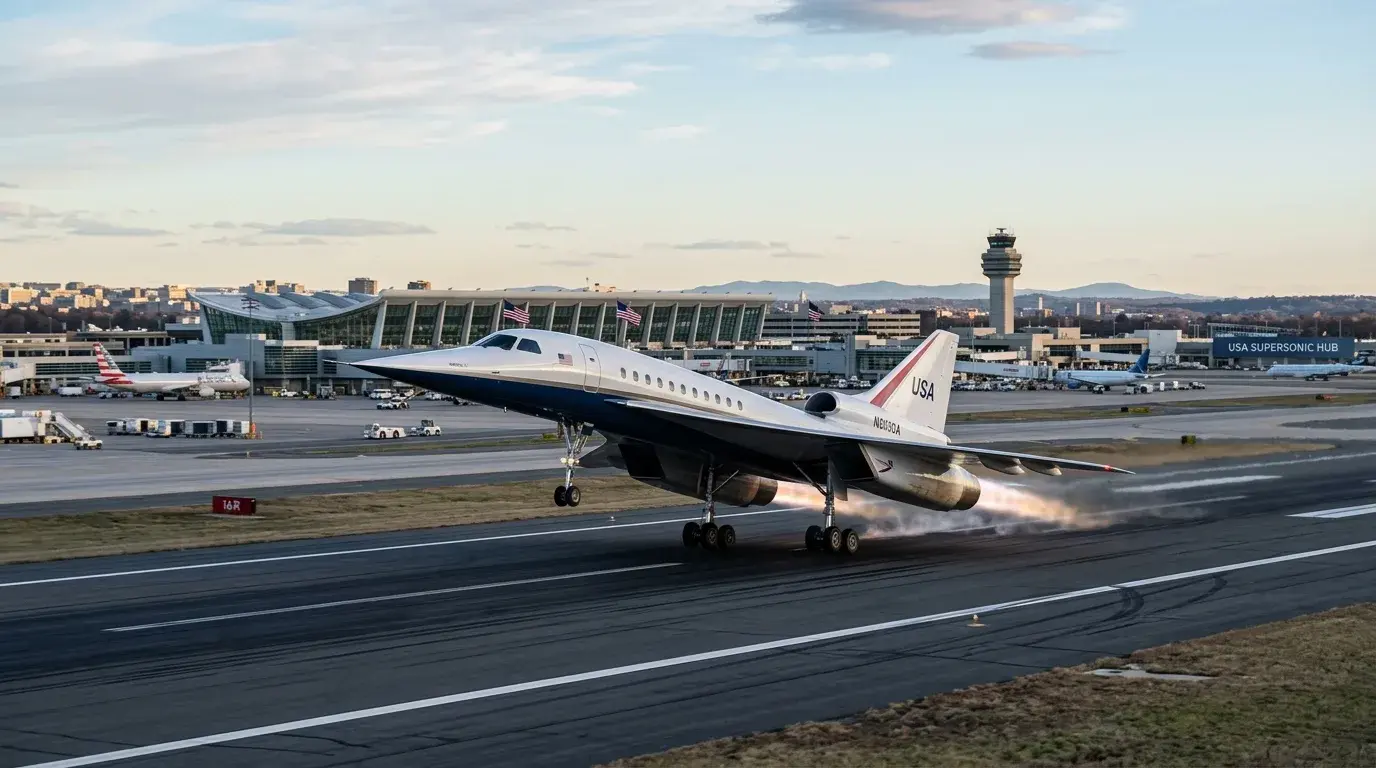
The Federal Aviation Administration (FAA) has opened a historic loophole in commercial aviation. After more than fifty years of banning supersonic flights over U.S. land, the U.S. authority is proposing to allow aircraft to break the sound barrier without imposing a destructive sonic boom on the ground. A revolution that could, by 2030, cut transatlantic routes to just three hours and transform how you plan your trips.
This technical and regulatory breakthrough hinges on a major innovation: the Mach cutoff. Instead of enduring the Concorde’s characteristic double boom, passengers could soon travel at Mach 1.3 while only hearing a muffled rumble, comparable to the distant noise of an aircraft engine. The FAA is banking on a technology capable of bending shockwaves in the atmosphere to render them inaudible from the ground—a world first in commercial transport.
For travelers, the implications are immense. Imagine a Paris-New York flight in 3h30 instead of 7h30, or a London-Tokyo journey in under 8 hours. Airlines like Boom Supersonic are already preparing the Overture, a 64-seat aircraft designed to cover these distances at Mach 1.7. With a planned service entry in 2030, this project aligns with the U.S. strategy to restore American dominance in high-speed transport, as reiterated in the June 2025 presidential decree.
Yet this promise raises questions. While the FAA targets a ground overpressure threshold of 0.11 pounds per square foot—far below the Concorde’s 1.93 psf—some experts warn of a lack of data on the real impact of these noise nuisances. Dan Rutherford of the International Council on Clean Transportation notes that this standard, abandoned by the UN in 2014, fails to measure perceived disturbance among populations. The FAA justifies its choice by the need for a gradual transition, leaving operators responsible for proving compliance.
Behind this announcement lies a colossal operational challenge. The Mach cutoff is only viable at speeds between Mach 1 and Mach 1.15, under precise atmospheric conditions. Manufacturers must integrate real-time flight planning systems capable of adjusting trajectories based on winds and turbulence. Boom Supersonic claims to have validated the concept during tests with its XB-1 demonstrator, reaching Mach 1.18 in February 2025. A technical feat, but one that remains to be confirmed on commercial aircraft.
The FAA has set an ambitious timeline: a final rule on this interim standard is expected by June 2027. Until then, manufacturers and airlines must prove these technologies are not just promises, but viable solutions for millions of passengers. For travelers, this means the return of civil supersonic travel could become a reality before the end of the decade.
The Mach Cutoff: The Technology That Will Make Sonic Booms Inaudible
The Mach cutoff principle relies on a physical phenomenon called atmospheric refraction. At high altitudes and certain speeds, shockwaves generated by an aircraft bend upward, away from the ground, reducing their sound impact to zero. Unlike the Concorde, whose boom reached 1.93 psf in cruise, new aircraft should limit ground overpressure to 0.11 psf—a level comparable to that of a subsonic jet.
This technology was explored as early as the 2000s by NASA, but it is the FAA that is now making it a central argument to reopen U.S. skies to supersonic flights. Studies by the agency show the Mach cutoff is particularly effective at altitudes between 40,000 and 55,000 feet, with favorable winds. However, weather conditions—especially wind direction and strength—will play a key role in the success of these operations.
For Boom Supersonic and other industry players, the challenge is twofold: design aircraft capable of flying at Mach 1.3 without generating a boom heard on the ground, and prove these planes can operate reliably in real-world conditions. The U.S. company is relying on a combination of 3D modeling and wind tunnel tests to validate its calculations. « The Mach cutoff isn’t an option; it’s a necessity for the return of supersonic travel », says Blake Scholl, CEO of Boom.
But this innovation also raises environmental questions. While new aircraft promise optimized fuel consumption compared to the Concorde, their carbon footprint remains a topic of debate. Opponents of supersonic travel point to increased emissions from high-speed flight, while advocates argue these planes could replace energy-intensive long-haul flights, reducing aviation’s overall footprint.
Boom Overture: The Aircraft That Could Revive the Supersonic Dream
With the Overture, Boom Supersonic aims to deliver an aircraft capable of linking continents at Mach 1.7 while meeting new noise standards. Unlike the Concorde, whose First Class was reserved for an elite, the Overture will feature a mixed cabin optimized for comfort and efficiency. Its 64 seats will be split into three classes, with 1-2-1 Business Class seating for direct aisle access and 22-inch 4K screens for every passenger.
The Overture’s cabin will be equipped with advanced noise reduction systems, integrating acoustic materials and active noise control algorithms. These innovations, combined with the Mach cutoff, should allow the aircraft to fly over land without generating major noise disturbances. Boom also promises a 30% reduction in fuel consumption compared to the Concorde, thanks to composite materials and more efficient engines.
Boom’s timeline is tight: the first test flight is scheduled for 2027, with commercial service entry in 2030. The company has already secured orders from United Airlines, Japan Airlines, and American Airlines, totaling 130 aircraft. If these deadlines are met, the Overture could become the first commercial supersonic aircraft certified by the FAA in over fifty years.
Yet the Overture’s success will also depend on Boom’s ability to convince regulators and the public. The FAA has already indicated that final rules on takeoff and landing noise won’t be published until December 2026—after the first test flight. An uncertainty that could delay the project if standards prove stricter than expected.
What This Means for Your Next Trips
If the FAA validates the Mach cutoff, passengers could soon benefit from a new generation of long-haul flights. Here’s how it could change your travel:
Routes cut in half. A Paris-New York flight would shrink from 7h30 to 3h30, while a London-Tokyo journey could take less than 8 hours. Connections will flow more smoothly, and business travel will gain efficiency.
Still-pricey fares, but trending down. Supersonic tickets will likely remain out of reach for most travelers initially, with round-trip transatlantic fares estimated between $5,000 and $10,000. However, competition and economies of scale could make these fares more accessible by 2035.
An impact on the travel industry. Airlines will need to adapt strategies to integrate these new aircraft. Hubs like Paris-Charles de Gaulle, London-Heathrow, or New York-JFK could become supersonic hotspots, offering optimized connections to Asia or South America.
A revolution for cargo. Supersonic aircraft could also transport urgent goods, such as organs for transplants or sensitive electronic components. Projects are already underway to adapt the Overture for cargo, cutting delivery times between continents.
For frequent flyers, this innovation represents an unprecedented opportunity to save time and redefine mobility expectations. Yet the success of supersonic travel will hinge on acceptance by local communities, whose concerns about noise nuisances must be addressed. One thing is certain: after decades of silence, the skies could soon belong again to the world’s fastest aircraft—and your next trips will be transformed forever.
Be the first to comment on this article