Emirates SkyCargo revolutionizes air freight with its first 777-300ERSF: 25% more volume and record 100-ton capacity
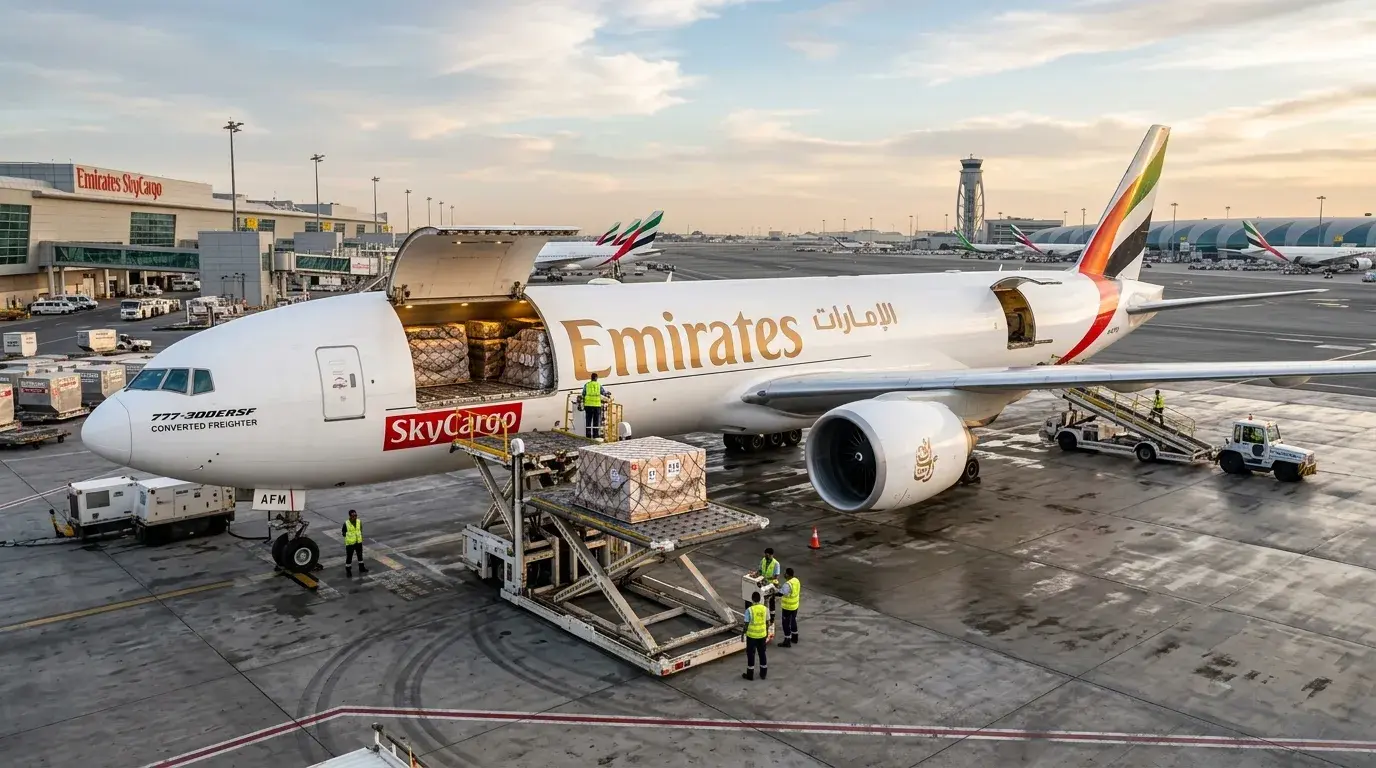
A major air freight player has taken a giant leap in cargo transport evolution. Emirates SkyCargo has deployed its first Boeing 777-300ERSF, a passenger-to-freighter conversion offering a record 100-ton capacity and 25% more cargo volume. The A6-EBK aircraft completed its maiden commercial flight from Hong Kong to Dubai with over 100 tonnes of freight, marking the arrival of a new generation of all-cargo carriers.
This innovation aligns with an ambitious strategy to meet the explosive global e-commerce demand, now accounting for nearly 20% of air cargo tonnage. Bulky shipments—often linked to manufactured goods, electronics, or consumer products—require adapted capacities that the 777-300ERSF now delivers.
For Badr Abbas, Divisional Senior Vice President of Emirates SkyCargo, this conversion represents far more than fleet expansion: « The integration of this first 777-300ERSF marks a turning point in our ability to rapidly transport goods worldwide. Combined with our growing fleet of production Boeing 777F aircraft, this strategy enables us to expand our all-cargo network from 40 destinations in February 2026 to 62 today. » The executive also highlights the enhanced operational flexibility this evolution provides, allowing Emirates SkyCargo to optimize assets while meeting evolving market demands.
The 777-300ERSF, part of the « Big Twin » conversion program developed by Israel Aerospace Industries (IAI) in partnership with lessor AerCap, results from a complex technical process. Converting a passenger aircraft into a full freighter takes about 130 days and involves deep modifications: installation of a large cargo door on the main deck, floor reinforcement, removal of passenger amenities, and integration of a cargo-handling system. The outcome is an aircraft capable of carrying 47 pallet positions—ten more than the production 777F—and a cargo volume of 811 m³.
Emirates SkyCargo isn’t stopping there. The airline plans to integrate five additional Boeing 777F aircraft and a second 777-300ERSF by the end of 2026, followed by three more of this type in 2027. This rapid growth aligns with a strategy to strengthen global connectivity, with Dubai’s hub at its core. « We offer customers scalable cargo capacity and optimal connectivity for transporting goods to and via our hub, » explains Badr Abbas.
This innovation arrives at a time when the air cargo market is booming. Latest projections indicate demand will continue growing in the coming years, driven by the rise of online shopping and globalization of supply chains. The 777-300ERSF, with its record capacity and flexibility, positions itself as an ideal solution for carriers seeking to maximize capacity without investing in new aircraft.
The A6-EBK’s first commercial flights operated on the Hong Kong–Dubai route, a strategic Asian freight corridor. This route allows testing the new aircraft’s real-world performance before expanding to other key destinations in the Emirates SkyCargo network. The airline highlights the reduced transit times and improved logistics enabled by this new capacity.
With this conversion, Emirates SkyCargo reinforces its leadership in the air cargo sector. The group, already operating a diverse fleet of 777F, 747-8F, and A380F aircraft, strengthens its competitive edge by offering tailored solutions to market-specific needs. Emirates’ strategy relies on optimizing existing assets—a approach that balances growth and profitability in a rapidly evolving industry.
Emirates SkyCargo’s customers, from major logistics groups to small businesses, will now benefit from increased capacity and faster response times. The carrier emphasizes its ability to « rapidly transport goods worldwide, » a key selling point for e-commerce and industrial players reliant on speed and delivery reliability.
This technical innovation also reflects on the future of air cargo. Converting passenger aircraft into freighters, like the 777-300ER to 777-300ERSF, extends the lifespan of existing airframes while meeting rising demand—a sustainable solution aligned with circular economy principles and reduced aviation carbon footprint.
Emirates SkyCargo has no shortage of ambition. With this new capacity, the airline aims to strengthen its leadership on major intercontinental routes, particularly between Asia, Europe, and North America. Dubai’s hub, already one of the world’s largest air cargo hubs, is expected to see further traffic growth thanks to these new aircraft.
This technical and operational advancement marks a significant milestone for the air cargo sector. It demonstrates the ability of major players to innovate in response to an ever-evolving market where speed, capacity, and flexibility have become paramount.
A giant leap for air cargo and the global economy
The arrival of the 777-300ERSF at Emirates SkyCargo is more than good news for the airline—it’s a strong signal for the entire air cargo sector and, more broadly, the global economy. In a context where international trade increasingly depends on fast, reliable deliveries, this technological innovation could redefine air cargo transport standards.
The 100-ton capacity offered by the 777-300ERSF represents a significant increase over existing aircraft. This capacity boost not only meets rising e-commerce demand but also enables the transport of heavier, bulkier goods—such as industrial machinery or construction equipment. An evolution that could unlock new opportunities for businesses whose logistics needs exceed traditional cargo aircraft capacities.
Emirates SkyCargo is also banking on the enhanced operational flexibility this aircraft provides. Unlike dedicated freighters, the 777-300ERSF can be deployed on varied routes based on market demand. This adaptability is a major asset for carriers facing fluctuating needs, especially during peak seasons like year-end holidays or sales events.
The air cargo sector is undergoing rapid transformation. Customer expectations are evolving, with heightened demand for fast deliveries, cost control, and real-time tracking. Emirates SkyCargo, with its 777-300ERSF, positions itself as an actor capable of meeting these challenges. The airline’s approach combines technical innovation, asset optimization, and global connectivity.
This advancement is part of a broader modernization trend in air cargo. Converting passenger aircraft into freighters, like the 777-300ER, meets demand without massive investments in new fleets—a smart solution that balances economic performance and environmental sustainability.
For businesses dependent on air cargo transport, this innovation is excellent news. It paves the way for more efficient logistics solutions capable of adapting to an ever-changing market. Whether for e-commerce giants, high-tech manufacturers, or heavy industry players, Emirates SkyCargo’s 777-300ERSF represents a major opportunity.
A fleet in full expansion for an ever-wider network
Emirates SkyCargo isn’t just integrating a new aircraft into its fleet—it’s accelerating growth with a clear strategy: strengthening its presence on major global routes and offering optimal connectivity to customers. By the end of 2026, Emirates SkyCargo plans to integrate five additional Boeing 777F aircraft and a second 777-300ERSF, followed by three more of this type in 2027.
This rapid expansion is accompanied by a diversification of served destinations. Dubai’s hub, already one of the world’s largest air cargo hubs, is expected to see further traffic growth. With a record 100-ton capacity and 25% more cargo volume, the 777-300ERSF enables new routes, particularly where cargo capacity demand is strongest.
The A6-EBK’s first commercial flights between Hong Kong and Dubai serve as a real-world test. They validate the new aircraft’s performance under actual conditions before expanding to other key destinations. Emirates SkyCargo leverages this flexibility to adapt its offering to changing market needs.
This expansion strategy reinforces Emirates SkyCargo’s position as a leader in air cargo. The airline, already operating a diverse fleet of 777F, 747-8F, and A380F aircraft, confirms its commitment to delivering increasingly efficient logistics solutions. With the 777-300ERSF, Emirates SkyCargo now has a major asset to meet rising e-commerce and international trade demand.
Emirates SkyCargo’s customers will benefit not only from increased capacity but also from faster response times and greater flexibility. The airline emphasizes its ability to « rapidly transport goods worldwide, » a key selling point for e-commerce and industrial players reliant on speed and delivery reliability.
This fleet expansion also reflects on the future of air cargo. Converting passenger aircraft into freighters, like the 777-300ER to 777-300ERSF, extends the lifespan of existing airframes while meeting rising demand—a sustainable solution aligned with circular economy principles and reduced aviation carbon footprint.
The future of air cargo: innovation, flexibility, and sustainability
The arrival of the 777-300ERSF at Emirates SkyCargo marks a significant milestone for the air cargo sector. It demonstrates the ability of major players to innovate in response to an ever-evolving market. With a record 100-ton capacity and 25% more cargo volume, this new aircraft redefines air cargo transport standards.
This innovation is part of a broader modernization strategy for air cargo, where flexibility, performance, and sustainability have become imperatives. Converting passenger aircraft into freighters, like the 777-300ER, meets demand without massive investments in new fleets—a smart solution that balances economic performance and environmental sustainability.
For businesses dependent on air cargo transport, this innovation is excellent news. It paves the way for more efficient logistics solutions capable of adapting to an ever-changing market. Whether for e-commerce giants, high-tech manufacturers, or heavy industry players, Emirates SkyCargo’s 777-300ERSF represents a major opportunity.
Emirates SkyCargo confirms its leadership in the air cargo sector with this new capacity. By combining technical innovation, asset optimization, and global connectivity, the airline aims to strengthen its position on major intercontinental routes. A strategy that could redefine air cargo transport standards in the years to come.
Be the first to comment on this article
On the same topic
- Airbus A350F: Historic First Flight of the Cargo Jet Set to Revolutionize Air Freight in 2027
- Vueling and Shark Skin Film to Boost Fuel Savings in 2026
- China Southern Airlines bets on Boeing 777 cargo: a masterstroke to dominate global air freight
- Uganda Airlines Makes Bold Move: Orders 10 Boeing Jets to Become Africa’s Future Hub
- LATAM Launches Direct São Paulo-Brussels Flight: Belgium Now Accessible Nonstop from Brazil