Wizz Air invests $100 million in Brașov: The A321neo set to revolutionize travel in Eastern Europe
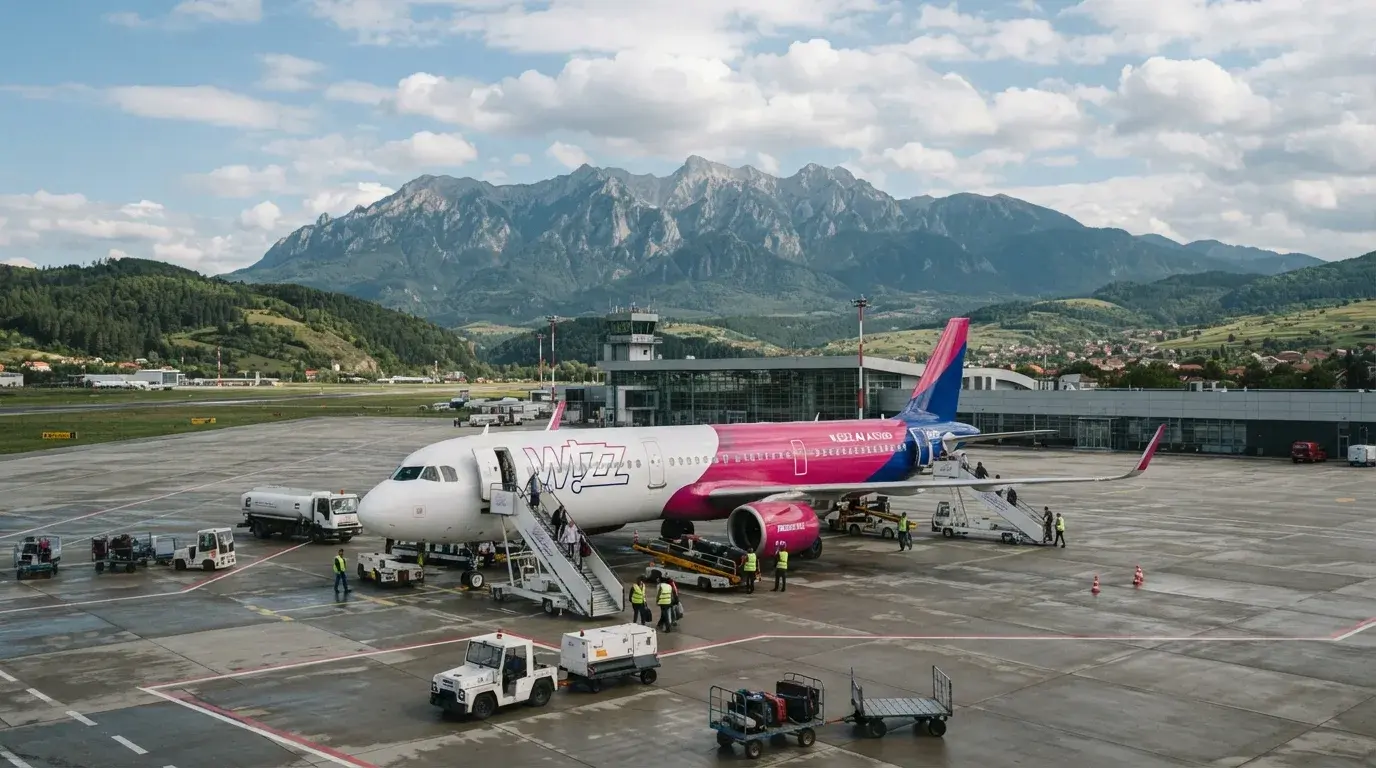
Romania is poised to become Central Europe’s new low-cost aviation hotspot. From December 2026, Wizz Air will base an Airbus A321neo at Brașov-Ghimbav International Airport, marking a major milestone in its regional expansion strategy. This move includes the launch of four new international routes and a boost to service to Nuremberg starting in October, permanently transforming connectivity between Transylvania and the rest of the continent.
For a carrier like Wizz Air, permanently assigning an aircraft to a secondary base is far more than just adding capacity. It enables structured morning rotations and optimized operations throughout the day—a strategic advantage over competitors constrained by saturated hubs like Bucharest or Cluj-Napoca. With this new program, the Hungarian airline will increase the number of destinations served from Brașov to 15, spanning seven European countries. This growth aligns with its policy of local anchoring, initiated when Wizz Air began operations at Brașov-Ghimbav in August 2023.
The choice of a 239-seat A321neo is no coincidence. As the largest narrowbody operated by a low-cost carrier, it spreads fixed costs across a high number of seats while maintaining profitability even on emerging markets. In Brașov, where Wizz Air has already transported over one million passengers since the airport opened in June 2023, this high capacity is a recipe for success on routes like Chișinău, Karlsruhe/Baden-Baden, Barcelona, and Madrid, all launched between December 17 and 20, 2026. A strategy that contrasts sharply with the more cautious approaches of other industry players.
This bold positioning comes at a time when Eastern Europe remains an underserved market for major airlines. With its aggressive low-cost model and deep understanding of local dynamics, Wizz Air is filling a gap left by traditional carriers often focused on major capitals. The arrival of the A321neo in Brașov could inspire other airlines to rethink their strategies in Romania, a country where air traffic has grown by nearly 15% annually since 2023.
Travelers—whether local residents or tourists seeking authentic experiences—will benefit from an offering finally matched to their needs. No more detours via Bucharest or costly layovers: with Wizz Air, Transylvania opens directly to Western Europe, offering competitive fares to destinations previously underserved, such as the German cities of Karlsruhe and Baden-Baden or the Spanish hubs of Barcelona and Madrid.
This initiative follows a series of strategic moves in the region, where low-cost carriers are redefining the rules of the game. After revolutionizing air transport in Central Europe with bases in Budapest, Warsaw, and Sofia, Wizz Air is confirming its ambition to become Europe’s leading pan-regional player, connecting secondary markets without compromising service quality or operational reliability.
Four new routes for a redesigned network starting December 2026
Wizz Air’s winter 2026-2027 schedule at Brașov centers on four key axes, each responding to precise economic or tourism-driven demand. The service to Chișinău, Moldova’s capital, taps into a market where family and cultural ties remain strong—a segment often overlooked by major airlines. The two Spanish destinations, Barcelona and Madrid, target the growing demand from Romanian and Transylvanian travelers seeking leisure or business trips, while Karlsruhe/Baden-Baden expands the offering to one of Germany’s most dynamic economic regions.
These routes complement the strengthened service to Nuremberg, already operating for several years. Starting October 26, Wizz Air will increase this route to two weekly flights, underscoring the robust traffic between Transylvania and Germany, home to a large Romanian community. This choice also reflects the growth in trade and tourism between the two regions, further boosting Brașov’s appeal as a connecting hub.
For passengers, the impact is immediate: fares up to 40% cheaper than those offered by traditional carriers, frequencies tailored to regular travelers, and optimized schedules to facilitate connections to other European destinations. A game-changer in a country where air travel is still perceived as a luxury accessible only to major cities.
Wizz Air is taking a different approach here than Ryanair or easyJet, which often prioritize already saturated bases. In Brașov, the airline is betting on a still-developing airport where it can shape its offering without facing direct competition from industry giants. A risky wager, but one that could pay off in the long run.
Brașov-Ghimbav: The airport on the rise
Inaugurated in June 2023, Brașov-Ghimbav is Romania’s newest commercial airport. In just three years of operation, it has already surpassed one million passengers—a record that speaks volumes about its potential. Wizz Air, present since August 2023, reports over 800,000 passengers carried since its arrival, a figure that places the platform among the country’s most dynamic.
Unlike other Romanian airports such as Otopeni (Bucharest) or Cluj-Napoca, Brașov-Ghimbav focuses on a niche strategy: serving a major tourist and economic region without directly competing with large hubs. This approach allows it to position itself as a credible alternative for travelers seeking flexibility and controlled fares.
The arrival of the A321neo and the launch of new international routes will further accelerate this momentum. Already equipped with modern infrastructure, the airport could attract other low-cost or regional carriers, reinforcing its role as a gateway to Eastern Europe. A prospect that particularly interests investors as Romania emerges as one of Europe’s most promising aviation markets.
For travelers, this evolution means greater accessibility to a region still largely undiscovered by the masses. Between the Carpathian Mountains, the medieval towns of Transylvania, and the ski resorts of the Bucegi Mountains, Brașov-Ghimbav is becoming the ideal gateway to explore an authentic Romania, far from the beaten paths of classic tourism.
Why the A321neo is a game-changer in Eastern Europe
The Airbus A321neo is more than just another aircraft in Wizz Air’s fleet. With its 239 seats, 20% lower fuel consumption than older narrowbodies, and extended range, it represents the next generation of low-cost planes. For Wizz Air, the choice of this model is driven by its ability to serve still-developing markets where traditional carriers hesitate to commit due to uncertain profitability.
By basing an A321neo in Brașov, Wizz Air is sending a clear signal to the rest of the industry: Eastern Europe is a mature market ready to absorb more air capacity. Contrary to popular belief, this region is not just a source of labor for Western Europe but also a hub of demanding travelers and tourists in search of new experiences.
This strategy fits into a broader context where low-cost carriers are reshaping the rules of the game in Europe. With its ultra-competitive model, Wizz Air proves that growth, profitability, and customer satisfaction can coexist even in emerging markets—a lesson traditional carriers would do well to heed.
For passengers, the arrival of the A321neo in Brașov means lower fares, increased frequencies, and better connectivity to previously underserved destinations. An advancement that could inspire other airlines to follow Wizz Air’s lead, permanently transforming Europe’s aviation landscape.
How to take advantage of this revolution now
If you’re planning to travel to Eastern Europe or are a resident in Romania looking to explore new destinations, Wizz Air has simplified booking with its four new routes and expanded service to Nuremberg. Tickets are already available on the airline’s website, with promotional fares for the first flights.
For business travelers, the permanent A321neo base in Brașov offers a credible alternative to major hubs like Bucharest or Budapest, with schedules tailored to professional travel. As for tourists, they’ll benefit from easier access to major sites like Bran and Peleș Castles or the unspoiled landscapes of the Carpathians.
One thing is certain: with this initiative, Wizz Air isn’t just opening new routes. It’s redefining the standards of air travel in Eastern Europe, proving that innovation and low-cost can go hand in hand for the benefit of travelers. A model to watch as Europe’s aviation industry enters a new era of competition and creativity.
A growing network for a booming region
With 15 destinations served from Brașov starting December 2026, Wizz Air isn’t stopping there. The airline has already announced discussions with several other Romanian and Moldovan airports to expand its network, confirming its ambition to become the region’s leading low-cost carrier.
For travelers, this expansion means greater accessibility to cities and regions still poorly served by air transport. For local economies, it’s an opportunity to boost trade and tourism, with a direct impact on job creation and economic growth.
By betting on Brașov-Ghimbav and its A321neo, Wizz Air isn’t just playing the low-cost card. It’s investing in the future of a booming region where air transport could well become the engine of a new economic and cultural dynamic.
Be the first to comment on this article
On the same topic
- Turkish Airlines makes bold move: 150 Boeing 737 MAX ordered, a daring bet to reshape European skies
- Emirates Weighs Swapping Boeing 787s for 777Xs: A Strategic Shift That Could Transform Long-Haul Travel
- Athens emerges as the new US gateway to Greece: Why this hub is winning over travelers
- Royal Air Maroc's 737 MAX-8 boosts Casablanca hub ahead of 2030 World Cup
- TAP Miles&Go and Airbnb Partner: Earn Miles on Your Travel Bookings
- Emirates Relaunches Strategic Offensive in Africa and the Middle East: Baghdad, Algiers and Basra in Sights