Thai Airways Ditches First Class for Futuristic Business Class and Revamped Network
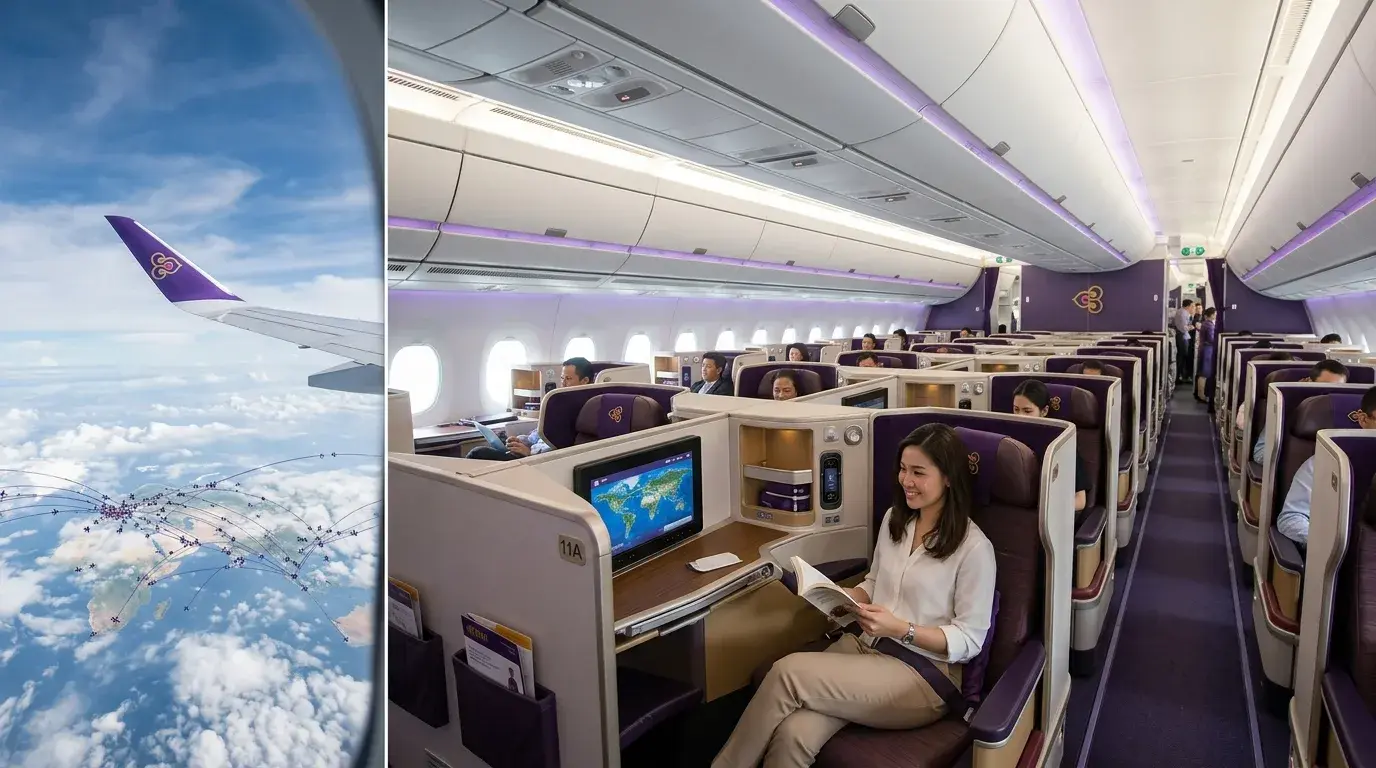
Thai Airways is entering a phase of radical transformation in its long-haul offering. The national carrier has announced the gradual phasing out of its First Class across its entire fleet, shifting to a three-class configuration: Business Class, Premium Economy, and Economy. This decision marks a strategic turning point for the airline as it invests heavily in modernizing its cabins and fleet to meet the evolving expectations of travelers.
This overhaul comes at a time when First Class, once a symbol of prestige for major airlines, struggles to find its audience. Thai Airways has chosen to concentrate its investments on a redesigned Business Class, presented as a more profitable high-end alternative better suited to current demand. A strategy that aligns with a global trend where airlines reassess the utility of their ultra-premium offerings amid high operating costs and a clientele seeking value.
Thai Airways CEO Chai Eamsiri confirmed this direction during a press conference, emphasizing that « Business Class will become the airline’s most premium product. » This decision is accompanied by a major cabin modernization and fleet renewal program, with deliveries of new aircraft configured from the outset for this new distribution.
Thai Airways is retiring First Class because it is no longer profitable or strategic for its current positioning. According to executives, First Class ticket sales did not generate significant profits, with the product relying more on « prestigious image » than a solid economic rationale. An analysis that reflects a reality shared by many airlines, where the gap between the production costs of a First Class product and the revenue generated becomes increasingly difficult to justify.
In parallel, the airline is introducing a next-generation Business Class suite, featuring VantageNOVA seats designed by Thompson Aero. These new seats offer direct aisle access and sliding doors for enhanced privacy, with a « Business Plus » front row installed at the cabin’s head to provide an isolation and space level close to First Class. The goal is clear: deliver a premium experience at a controlled cost while simplifying the overall offering.
This transition goes beyond a simple class elimination. It is part of a broader program to modernize cabins and renew the fleet. Thai Airways has ordered 45 Boeing 787-9 and 787-10 aircraft, scheduled for delivery starting in 2028, configured from the outset with the new three-class layout. Twenty existing Airbus A350-900s will follow with a modernization program beginning in 2028, aligning the entire long-haul network with a uniform standard.
Passengers will need to check seat maps at the time of booking to identify aircraft already equipped with the new suites, particularly on Boeing 777-300ER and Airbus A350 aircraft. For Thai Airways, the objective is to « simplify the premium offering while enhancing the onboard experience, » concentrating investments on a single true premium class. An approach aimed at improving profitability while maintaining appeal for discerning travelers.
Alongside this cabin overhaul, Thai Airways is accelerating the development of its airport infrastructure. The country is investing heavily in seven major projects totaling approximately 470 billion bahts (€11.5–12 billion). Key initiatives include the East Expansion of Bangkok-Suvarnabhumi International Airport for 12 billion bahts, which will increase capacity from 65 to 80 million passengers annually. A South Terminal and a fourth runway are also planned under a revised 200 billion baht master plan.
A Next-Generation Business Class to Compete with Industry Leaders
Thai Airways’ new Business Class, branded « Royal Silk, » aims to be a credible alternative to premium suites offered by airlines like Singapore Airlines or Korean Air. Featuring VantageNOVA seats with 180-degree recline, direct aisle access, and sliding doors, the experience aligns with the standards of the best Business Class products on the market.
Business Class passengers will also benefit from a redesigned onboard service, including high-quality catering and access to exclusive airport lounges at partner airports. The airline is banking on this new offering to attract demanding business travelers while streamlining operating costs. A strategy designed to position Thai Airways as an attractive alternative to direct competitors like Singapore Airlines or Cathay Pacific.
Thai Airways Commercial Director Kittipong Sarasombat emphasized that the new « Royal Silk » Business Class aims to deliver an experience « comparable to First Class but at a far more competitive price. » This approach reflects a desire to make premium experiences accessible while maintaining profitability for the airline.
The introduction of this new Business Class is accompanied by cabin modernizations across existing aircraft. The Boeing 777-300ERs, which form the backbone of Thai Airways’ long-haul network, will undergo a complete retrofit starting in mid-2027. First Class will be removed in favor of a revised Business Class cabin, alongside a new Premium Economy and modernized Economy. A massive undertaking, but one deemed necessary to align the entire fleet with the airline’s new standards.
This shift toward a strengthened Business Class aligns with a broader industry trend. Since the pandemic, airlines have had to rethink their offerings to adapt to an ever-evolving demand. First Class, once the pinnacle of prestige, is now perceived as a luxury difficult to justify, both for airlines and travelers.
A Revamped Long-Haul Network for Improved Profitability
Thai Airways’ repositioning extends beyond cabin redesigns. The airline is also reassessing its long-haul network to focus on more profitable routes better aligned with demand. This strategy comes as airline profitability increasingly depends on optimizing costs and targeting high-value market segments.
Thai Airways, which currently serves 51 international destinations, has already announced capacity reductions on certain routes due to geopolitical and economic constraints. The war in Iran and Pakistan’s airspace restrictions have forced the airline to adjust its long-haul programs, while the domestic market suffers from high jet fuel prices.
These adjustments are accompanied by a refocusing on more stable and profitable markets. The airline is prioritizing routes to Europe, North America, and Australia, where demand remains robust despite economic challenges. This shift aims to reduce reliance on certain Asian routes, often subject to intense competitive pressures.
Simultaneously, Thai Airways is accelerating fleet development to modernize its network. The new Boeing 787-9 and 787-10 aircraft, along with modernized Airbus A350-900s, will improve operational profitability through reduced fuel consumption and capacity tailored to target markets. A strategy designed to position the airline as a key player in Southeast Asian air transport.
This network overhaul is also accompanied by strengthened partnerships and alliances. As a Star Alliance member, Thai Airways continues to develop collaborations with other airlines to expand its offering and improve passenger connectivity. These strategic partnerships help offset capacity reductions on certain routes while providing a smoother experience for travelers.
An Ambitious Modernization Facing Structural Challenges
Thai Airways’ modernization extends beyond cabin and fleet upgrades. The airline must also address structural challenges, particularly in cost management and governance. Since 2022, Air India—encompassing the legacy carrier and its low-cost subsidiary Air India Express—has accumulated over 550 billion rupees in losses, with an estimated annual deficit of nearly $3 billion in its latest fiscal year.
These losses stem from a series of shocks: the fatal crash of a Boeing 787 Dreamliner in June 2025, Pakistan’s airspace closure, the war in Iran leading to costly detours, soaring fuel prices, and a weakened rupee. These factors have forced the airline to revise an expansion plan once based on strong Indian traffic growth and massive aircraft orders.
For Thai Airways, the situation differs, but challenges remain significant. The airline must balance ambitious modernization with rigorous cost management. The group has already announced international capacity reductions in response to the war in Iran and airspace closures, prioritizing operational stability over growth at all costs.
This approach aligns with a desire to preserve short-term profitability while investing in the future. The airline has launched a major transformation plan: a new logo, rebranding, and livery unveiled in mid-2023, alongside a $400 million cabin modernization program. Most Airbus A320neo aircraft have already been reconfigured, and the upgrade continues on Boeing 777 and 787 aircraft.
However, this ambitious modernization faces logistical hurdles. Supply chain delays are pushing back both renovations and some deliveries, further delaying product improvements and fleet expansion ambitions. The decision to defer new deliveries while proceeding with internal upgrades reflects a short-term priority on product quality and financial balance over rapid fleet growth.
For Thai Airways leadership, this strategy is necessary to ensure the airline’s long-term viability in a competitive and economically challenging environment. The elimination of First Class and the shift to a redesigned Business Class align with this focus on profitability and operational efficiency.
A Bold Gamble for Thai Airways’ Future
Thai Airways is betting big on a bold strategy to reclaim its place among Asia’s leading airlines. By sacrificing First Class in favor of a futuristic Business Class and modernizing its network, the airline seeks to differentiate itself in a rapidly evolving sector. An approach that reflects a willingness to adapt to new traveler expectations while preserving profitability.
This transition is accompanied by massive investments in Thailand’s airport infrastructure. The country is focusing on hub development, particularly at Bangkok-Suvarnabhumi, to support traffic growth and strengthen Thai Airways’ competitiveness against rivals like Singapore Airlines or Qatar Airways. These projects are part of a broader strategy to position Thailand as a key aviation hub in Southeast Asia.
For passengers, Thai Airways’ revamped offering presents an opportunity to experience modernized cabins and a redesigned service. Business Class travelers will benefit from innovative seats and enhanced comfort, while Premium Economy and Economy passengers also enjoy updates to improve the overall experience.
This repositioning strategy aligns with a broader industry trend, where airlines must constantly innovate to meet traveler expectations while maintaining profitability. For Thai Airways, the challenge will be to execute this transition without losing sight of its legacy customer base while attracting new passengers drawn to a refreshed and modernized offering.
By ditching First Class for a futuristic Business Class, Thai Airways is making a high-stakes bet on the future. A decision that could redefine its market positioning and help it reclaim its place among the world’s leading airlines.
With this ambitious overhaul, Thai Airways demonstrates its readiness to tackle the sector’s challenges and innovate to meet evolving traveler expectations. A strategy that, if successful, could restore the airline to its former prominence among global carriers.
Be the first to comment on this article
On the same topic
- Emirates Revolutionizes Nairobi-Dubai Route with A350 and Premium Economy
- Etihad Launches Calgary: First Direct Middle East to Western Canada Route, a Travel Revolution
- Aeromexico Launches Milan Route: A Game-Changer for Transatlantic Travel
- Air China Launches Groundbreaking Route to Iceland from Beijing via Copenhagen in 2026
- Starlux Leverages Art and Airbus to Revolutionize A350-1000s and Woo Europe
- Lufthansa Revives All Airbus A380s: Why the German Giant Bets on the Superjumbo for Munich Hub