Eurowings strengthens Berlin operations aiming for top spot at BER
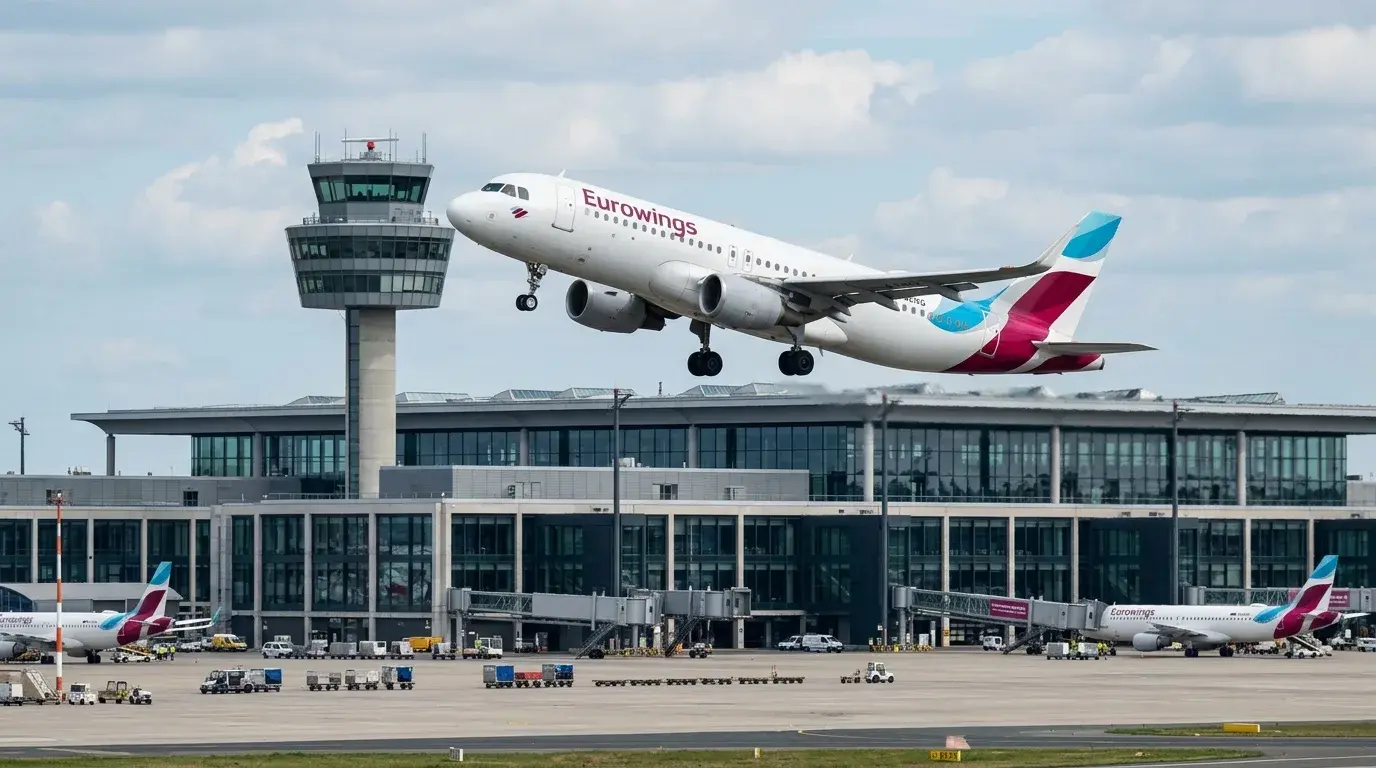
Eurowings is accelerating its Berlin-Brandenburg strategy with a clear goal: to become the leading airline at BER Airport. The Lufthansa Group carrier will base eleven aircraft in the German capital this winter, deploying over 300 crew and ground staff to the hub. The move underscores a market shift already underway in Berlin, where competition is rapidly reshaping.
The choice of Berlin is far from coincidental. On an airport still consolidating its commercial footprint, Eurowings is betting on a classic yet effective formula: more parked aircraft, higher frequencies, and new routes to capture point-to-point traffic. Meanwhile, Ryanair is significantly reducing its presence, freeing up slots and leaving room for airlines capable of establishing a sustainable base. According to Eurowings, this market window should allow it to claim the top spot at BER.
The strategy is also reflected in the network composition. Since the pandemic, the carrier has grown from three based aircraft in Berlin to eleven today. It now serves nearly 50 destinations from the German capital, with an offering targeting both business travel and short getaways, as well as leisure routes. This is a key lever in a country where demand remains highly sensitive to price and schedule availability.
New Berlin–Bologna route launched
Among the most tangible announcements, Eurowings is launching a direct link between Berlin and Bologna. The route will be operated for the first time by the German carrier between the German capital and the Italian city, with fares starting from €49.99 in Basic class. The positioning is clear: attract both leisure travelers drawn to a short Italian getaway and business clients linked to the industrial ecosystem of Emilia-Romagna.
For BER, this opening strengthens the offer toward northern Italy, a market already served by several players. For Eurowings, Bologna fits into a broader strategy focused on Southern Europe, where the airline operates routes from Berlin to Spain, Portugal, Greece, and Italy. This network logic increases seat capacity while spreading risks across multiple markets.
The Berlin–Bologna line also responds to a simple reality: demand exists for destinations offering a mix of tourism, student mobility, and business travel. Eurowings aims to capture this segment, where price matters as much as frequency, with a clear and easy-to-sell direct offer.
Canary Islands remain a winter pillar
Another development axis sees the Canary Islands taking a larger role in Eurowings’ winter program from Berlin. Fuerteventura, Gran Canaria, Lanzarote, and Tenerife will see increased frequencies. The airline has been selling these flights since May 21, signaling that anticipating sales remains central to its strategy.
These reinforcements are more than just a commercial opportunity. The Canary Islands have long been a solid outlet for European carriers during the off-season, particularly in German and Central European markets. Flows are steady, demand is well-defined, and peak periods concentrate around school holidays and the busiest weeks of winter. For passengers, the immediate benefit is clear: more departure days to choose from and greater flexibility in schedules.
Eurowings even claims the title of Germany’s largest leisure airline. This statement encapsulates its model: a robust German base, a network centered on sun destinations, and a competitive pricing strategy against both major carriers and other low-cost operators. In Berlin, this focus becomes a tool for conquest rather than just a commercial axis.
Lufthansa Group consolidates its Berlin foothold
Eurowings is not acting alone. At BER, the Lufthansa Group is also present through Lufthansa, Swiss International Air Lines, Austrian Airlines, Brussels Airlines, and SunExpress. Together, these carriers account for around 30% of flights operated at the capital’s airport. The group already holds a strong position, which Eurowings is now reinforcing in the point-to-point and low-cost segments.
This structure is crucial to understanding the current offensive. Lufthansa manages the network’s major balances, while Eurowings handles traffic more sensitive to price, more seasonal, and more direct. The bet is to cover multiple traveler profiles without dispersing resources. In this setup, Berlin serves as both an expansion base and an operational showcase.
2024 figures already reflected this trend: the Lufthansa Group ended the year as the top operator at BER, with nearly a third of movements, far ahead of its closest competitor at around 17%. The capacity increase announced by Eurowings should now help consolidate this advantage at a time when some low-cost carriers are scaling back.
Ryanair exits, Eurowings fills the gap
The timing of the announcement is not insignificant. Ryanair has decided to significantly reduce or even eliminate its based aircraft presence in Berlin. The Irish carrier cites high costs and fees at BER, opting instead to concentrate resources on other European markets. This withdrawal creates an opportunity that Eurowings is keen to seize.
The German airline describes this as a market opportunity and is adjusting its program accordingly. With two additional aircraft, new routes, and enhanced frequencies, it can reclaim slots and open routes where demand remains viable. The message to the market is straightforward: Berlin remains a priority, but operations must be sustainable within a cost framework deemed manageable.
Eurowings CEO Max Kownatzki describes Berlin as a strategic growth market. He also highlights the negative impact of rising taxes, airport fees, fuel costs, and heavier regulatory constraints across Europe. His remarks extend beyond Berlin, framing a broader debate on the competitiveness of air transport in Germany, where taxation remains a central issue for airlines.
For Eurowings, this cost pressure does not negate the market’s appeal but demands stricter execution. The airline is playing a concrete card: occupying the field, securing available slots, and locking in profitable routes before competitors return. At BER, the battle is now about being present, visible, and consistent.
This move could also reshape the passenger experience at Berlin. More seats, more rotations, and greater options on direct European routes give travelers a wider choice. In an environment where carriers rapidly adapt their offerings, Eurowings’ Berlin base serves as a useful indicator of the German market’s health and competitive tensions.
Be the first to comment on this article
On the same topic
- TAP in search of a new partner: Why France and Germany are vying for the Portuguese flagship
- Air France-KLM vs Lufthansa: The Battle to Rescue TAP Air Portugal
- Lufthansa Challenges Boeing with Shark Skin on A330: A Green Revolution Reshaping Air Travel
- easyJet soon in Apollo’s hands? What the fund battle means for your European flights
- Lufthansa Bets on Airbus A350-1000 Over Boeing 777X: What This Means for Your Long-Haul Flights
- Lufthansa Revives All Airbus A380s: Why the German Giant Bets on the Superjumbo for Munich Hub