Air Congo Launches First Long-Haul Flights to Brussels: DRC Enters the Era of International Aviation
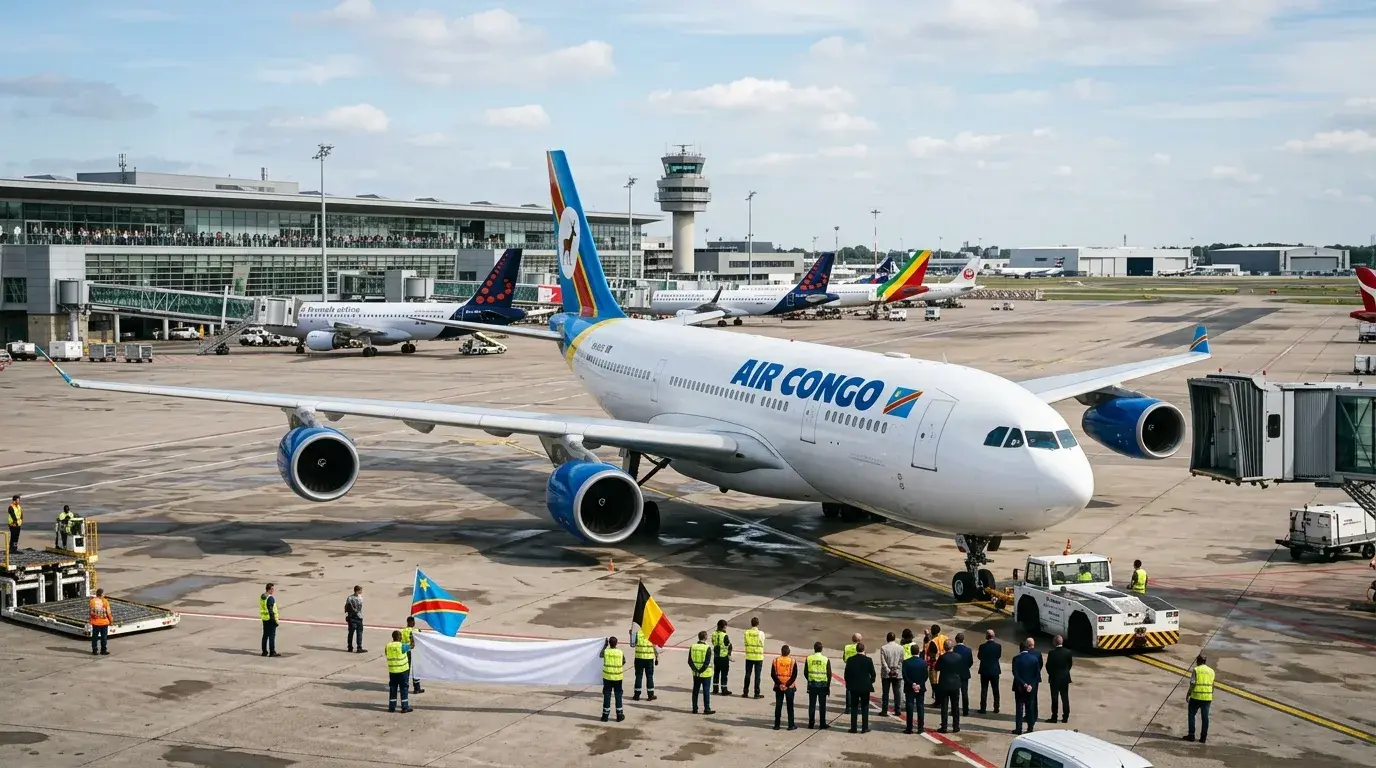
The Democratic Republic of Congo (DRC) makes a spectacular leap into international aviation. Starting July 1, 2026, Air Congo will launch five weekly flights to Brussels, operated using Boeing 787-8 aircraft provided by Ethiopian Airlines. A historic milestone for the young national carrier, marking the DRC’s entry into the global aviation network.
This initiative is part of an ambitious strategy to develop a long-haul network, with plans to expand to Paris and Dubai in the coming months. For Congolese passengers and diaspora communities, this route represents far more than just a flight—it is the culmination of a national project aimed at reducing dependence on foreign airlines and positioning Kinshasa as an essential regional hub. According to Congolese authorities, Brussels was chosen for its historical significance and demographic importance, with a Congolese diaspora estimated in the hundreds of thousands.
The Boeing 787-8, a modern and fuel-efficient aircraft, will cover the 6,000-kilometer distance between Kinshasa and Brussels in approximately 7 hours of nonstop flight. This technology complements Air Congo’s initial fleet, which currently consists of Boeing 737-800 aircraft operated under an ACMI contract with Ethiopian Airlines. In just two years of operation, the airline has already expanded its domestic network to 11 destinations, achieving an average load factor of 70%—a remarkable result for a company still consolidating its operations.
The partnership with Ethiopian Airlines, which holds a 49% stake in Air Congo, is a key driver of this growth. The Ethiopian group not only provides long-haul aircraft but also operational and commercial support, technical expertise, and integration into international reservation networks. This collaboration reflects a strong trend in the African aviation sector, where strategic alliances enable national carriers to quickly bridge the gap in international markets.
For Air Congo, Brussels is just the beginning. Congolese Minister of Transport Jean-Pierre Bemba has confirmed that Paris and Dubai are among the next priority destinations. These two cities—one European, the other Middle Eastern—offer significant potential for tourism, business, and institutional traffic. By strengthening ties with major global economic hubs, the DRC aims to facilitate exchanges for its population while capitalizing on its natural and agricultural resources.
The choice of Dubai is strategic: the Emirati metropolis has become a major transit point for cargo and passengers between Africa, Europe, and Asia. A Kinshasa-Dubai route would allow Air Congo to capture part of the inbound and outbound traffic to and from the DRC while offering Congolese passengers an additional option to reach Asia without transiting through Europe. A key advantage in a context where African airlines seek to diversify their routes to reduce dependence on traditional hubs.
This international expansion comes with logistical and health challenges. Like other African countries, the DRC remains under public health scrutiny, particularly after Ebola outbreaks. Aviation authorities and airlines must adhere to strict protocols to ensure passenger and crew safety. The International Civil Aviation Organization (ICAO) and the World Health Organization (WHO) have reiterated that international flights remain safe, provided health measures are respected.
For Congolese travelers, this new route offers easier access to Europe without costly or lengthy layovers. For Europeans, Brussels becomes a gateway to a country undergoing rapid transformation, with growing business and tourism opportunities. With this first step, Air Congo lays the foundation for an ambitious long-haul network that could eventually connect Kinshasa not only to Brussels, Paris, and Dubai but also to Johannesburg, Luanda, or Dar es Salaam.
This initiative is part of a broader trend in the renaissance of African aviation, following years of fragmentation and reliance on foreign carriers. By leveraging strategic partnerships and modern technology, countries like the DRC, Ethiopia, and Rwanda are demonstrating that Africa can become a major player in global air transport. For Air Congo, the challenge now is to turn this first route into commercial success while preparing for future expansion to other African and international capitals.
A Boeing 787-8 for Modern, Eco-Friendly Long-Haul Flights
The choice of the Boeing 787-8 for the Kinshasa-Brussels route is no coincidence. This long-haul twinjet, produced by the American manufacturer, is renowned for its reduced fuel consumption, lower CO₂ emissions, and enhanced passenger comfort. With a typical seating capacity of 242, it offers an optimal balance between economic performance and travel experience—two critical factors for a company in the development phase.
The 787-8 is equipped with Rolls-Royce Trent 1000 engines, designed to maximize energy efficiency. According to Boeing, this aircraft reduces fuel consumption by 20% compared to previous-generation planes like the Boeing 767 or Airbus A330. This performance is crucial for Air Congo, which must manage high operating costs and fierce competition on African and European routes.
In terms of comfort, the Boeing 787-8 stands out with optimized pressurization, higher cabin humidity, and improved sound insulation. These technological innovations reduce passenger fatigue on long flights—a major advantage for an airline aiming to attract discerning travelers, whether for business or leisure. The aircraft also features individual in-flight entertainment screens, high-speed Wi-Fi connectivity, and ergonomic seats, all contributing to a premium travel experience.
The partnership with Ethiopian Airlines allows Air Congo to benefit from the maintenance and technical management of the 787-8, a significant advantage for a company in the growth phase. Ethiopian Airlines, which already operates a fleet of Boeing 787s, has the expertise to ensure the smooth operation of these aircraft while guaranteeing flight safety. This technical collaboration reduces the risks associated with introducing new aircraft into a fleet—a major challenge for developing airlines.
Finally, the choice of the 787-8 aligns with a sustainability strategy. Boeing designed this aircraft to be compatible with sustainable aviation fuels (SAF), an increasingly adopted solution by airlines committed to reducing their carbon footprint. While SAF production remains limited today, this compatibility positions Air Congo ahead of future regulations while preparing for a transition to cleaner energy sources.
Brussels: A Strategic Destination for Air Congo
Brussels was not chosen at random by Air Congo. The Belgian capital is one of Europe’s most connected cities to Africa, with a strong Congolese diaspora presence and deep historical ties between the two countries. According to available data, over 300,000 Congolese live in Belgium, primarily in Brussels and its surrounding areas. This community represents a captive market for Air Congo, both for business and leisure travel, as well as family visits.
In terms of air traffic, Brussels is a major hub for connections between Europe and Africa. Brussels-National Airport (BRU) is served by several African and European airlines, making it an ideal gateway for a new carrier like Air Congo. The five weekly flights provide sufficient capacity to meet demand while maintaining operational reliability.
For European travelers, this route offers an alternative to flights operated by traditional major airlines, which are often more expensive and less tailored to the specific needs of passengers traveling to or from the DRC. Air Congo is banking on competitive fares and personalized service to differentiate itself, leveraging its local roots and deep understanding of African and European markets.
The national Congolese airline has also planned measures to facilitate connections to other European destinations. Through partnerships with partner airlines, Air Congo will enable passengers to reach Paris, Amsterdam, Frankfurt, or London in a single journey without changing planes—a practical solution for travelers looking to avoid multiple layovers and extended wait times.
Finally, Brussels is a hub for European institutions and international organizations, making it an attractive destination for business travelers. Air Congo could capture part of the professional traffic between the DRC and Europe by offering schedules tailored to meetings and urgent travel. This strategy aligns with the DRC’s goal of strengthening economic ties with Europe while attracting foreign investment.
Paris and Dubai: The Next Steps in Air Congo’s Expansion
While Brussels marks Air Congo’s entry into international aviation, Paris and Dubai could well be the next milestones in its growth. These two destinations—one European, the other Middle Eastern—offer major growth prospects for the Congolese airline, both in passenger and cargo traffic.
Paris, with its Charles de Gaulle Airport (CDG), is the primary gateway to France and Europe for many African countries. A Kinshasa-Paris route would allow Air Congo to capture part of the tourism and business traffic between the DRC and France while offering Congolese passengers an additional option to travel to Europe. According to Congolese authorities, this route is already under discussion with French authorities and airport managers, with a target launch within 12 to 18 months.
For Air France and other European carriers, this new competition could spur innovation and diversification in offerings. Traditional airlines, often perceived as expensive and rigid, may see the emergence of a local and more flexible alternative capable of meeting the specific needs of Congolese and European passengers. This dynamic could also encourage other African airlines to develop their own routes to Paris, further strengthening connectivity between Africa and Europe.
In Dubai, the Emirati metropolis has become a major transit hub for air traffic between Africa, Europe, and Asia. A Kinshasa-Dubai route would allow Air Congo to capture part of the inbound and outbound traffic to and from the DRC while offering Congolese passengers an option to reach Asia without transiting through Europe. This route aligns with a strategy to diversify destinations, reduce dependence on traditional hubs, and explore new markets.
Dubai is also a strategic destination for air cargo, with Dubai International Airport (DXB) ranking among the world’s busiest. A cargo route between Kinshasa and Dubai would allow Air Congo to develop a complementary activity, transporting Congolese products to Asian and Middle Eastern markets. This diversification could enhance the airline’s profitability while contributing to the local economy.
To realize these projects, Air Congo will need to overcome several challenges, including regulatory, security, and logistical hurdles. Negotiations with Paris and Dubai airport authorities, as well as discussions with partner airlines, will be critical to ensuring the success of these new routes. The DRC, with the support of its partner Ethiopian Airlines, has significant assets: a clear strategy, a modern fleet, and a strong political will to develop national aviation.
The Future of Congolese Aviation Takes Flight
With the launch of its first long-haul route to Brussels, Air Congo is writing a new chapter in the history of Congolese aviation. This initiative symbolizes the renaissance of an aviation sector long plagued by structural challenges, as well as the DRC’s ambition to assert itself on the global stage. By leveraging strategic partnerships, modern technology, and a tailored commercial approach, Air Congo could well become a key player in Central African air transport.
In the long term, the national Congolese airline aims to develop a comprehensive network connecting Kinshasa to major African and international capitals. Paris, Dubai, Johannesburg, Luanda, or Dar es Salaam could join Brussels in the coming years, positioning the DRC as an essential regional hub. This expansion will inevitably require investments in airport infrastructure, staff training, and in-flight services—all factors that will determine Air Congo’s success.
For Congolese travelers, this new era in aviation opens up previously inaccessible opportunities: direct flights to Europe, competitive fares, and services tailored to their needs. For international passengers, it’s an opportunity to discover the DRC and its riches while benefiting from an alternative to traditional airlines. With this first step, Air Congo is laying the groundwork for a promising aviation future, where the DRC could play a central role in connectivity between Africa, Europe, and Asia.
Be the first to comment on this article
On the same topic
- Emirates Revolutionizes Nairobi-Dubai Route with A350 and Premium Economy
- China Finally Validates Its Order for 200 Boeing Aircraft: What This Means for Your Next International Flights
- Etihad Launches Calgary Route: A Game-Changer for Middle East-Canada Travel
- Israir Launches Flights to New York: How to Book Tickets for the Big Apple from October 2026
- Air Congo Launches Paris Service with Dreamliner: How to Book Tickets to Kinshasa Now
- Singapore Airlines Expands European Network with Madrid, Manchester and Munich