Ryanair and Google Cloud Partner to Revolutionize Flights with AI by 2026
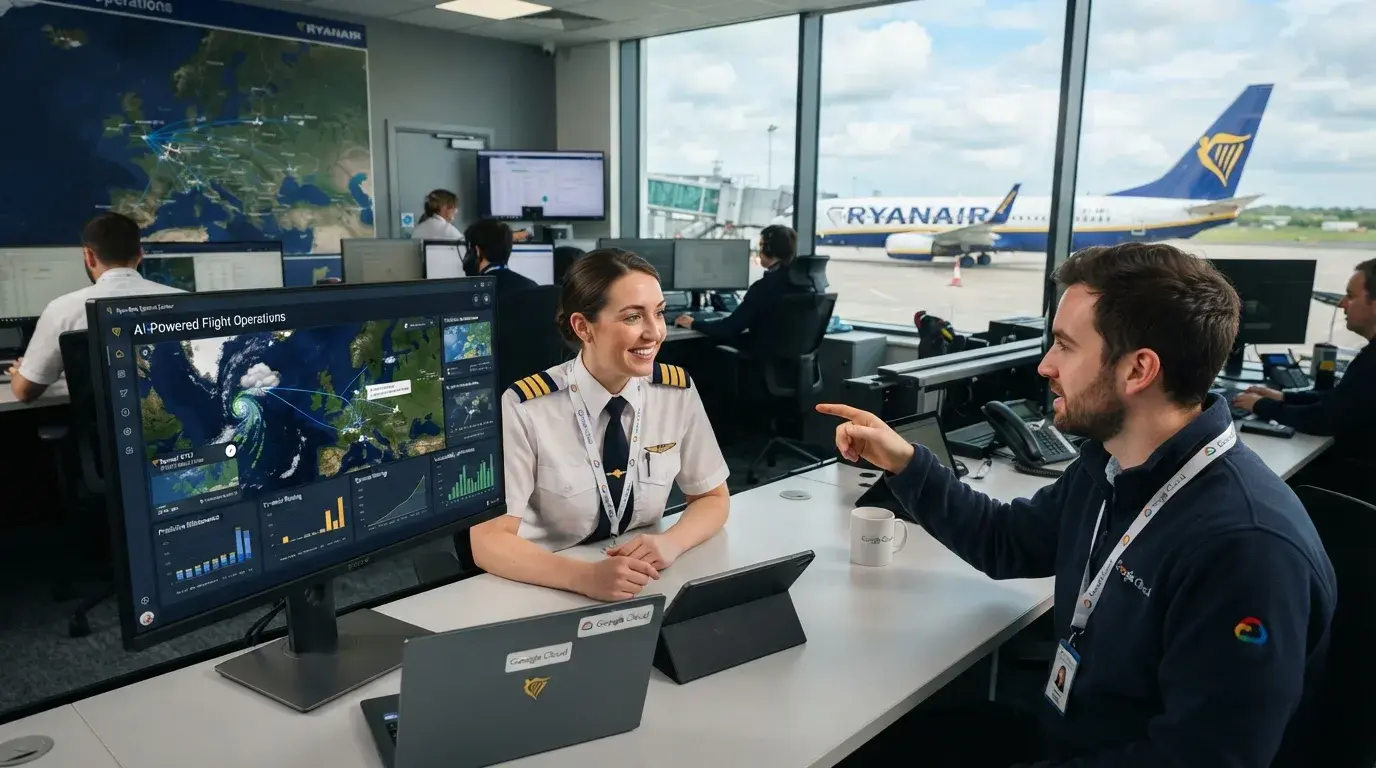
The Irish low-cost carrier Ryanair has taken a major leap in its digital transformation by signing a five-year strategic partnership with Google Cloud. This alliance goes beyond a simple cloud migration: it paves the way for a revolution in airline operations through artificial intelligence. With an ambitious target of 300 million annual passengers by 2034, Ryanair is leveraging AI tools to optimize crew management, improve fleet maintenance, and enhance the efficiency of its logistics. While the first benefits will primarily be felt internally, the changes could redefine the travel experience for millions of passengers.
From the outset, Ryanair has adopted a bold approach: equipping its 35,000 employees with Google Workspace and Gemini Enterprise, Google’s agentic AI platform. The goal? To create AI agents capable of automating complex tasks such as crew assignment, maintenance planning, and internal data management. “We are on an exceptional growth trajectory toward 300 million passengers by 2034,” said Eddie Wilson, Ryanair’s CEO. “To support this growth, we need to have excellent resilience in our infrastructure.” This technological collaboration aims precisely to secure and accelerate operations in an industry where every minute counts.
Among the flagship tools integrated are AlphaEvolve, an algorithmic optimization model developed by Google DeepMind, and WeatherNext, an advanced weather forecasting system. These technologies will enable Ryanair to anticipate operational constraints linked to weather conditions, better plan aircraft rotations, and reduce delays. AI models will also be used to analyze internal data, identify bottlenecks, and propose real-time solutions. An advancement that could ultimately reduce disruptions for travelers, though Ryanair emphasizes that AI will never replace critical decisions related to safety.
To avoid over-reliance on a single provider, Ryanair has adopted a “dual cloud” strategy, combining Google Cloud and Amazon Web Services (AWS). This redundancy aims to minimize the risk of IT outages—a scenario dreaded in an industry where operational continuity is vital. “This architecture allows us to better protect our critical systems against technical unavailability or large-scale failures,” explains a company spokesperson. A cautious approach that reflects the growing importance of digital resilience in aviation.
AI Tools for Smoother Operations and Reduced Delays
One of Ryanair’s major challenges lies in managing the logistics flows tied to its operations. With an ultra-dense European network, the airline faces constant challenges in crew assignment, aircraft rotation, and preventive maintenance. The integrated AI tools should help streamline these processes by automating parts of decision-making. For example, algorithms could analyze real-time data on weather conditions, previous flight delays, and crew availability to propose optimized solutions. The result: better-planned rotations, fewer disruptions, and improved punctuality.
Ryanair has also announced the deployment of Gemini Enterprise to enhance internal collaboration. Employees will benefit from optimized data-sharing and process management tools, while models like AlphaEvolve can help resolve complex issues, such as optimizing maintenance costs or managing spare parts inventories. These innovations align with a “operational performance” logic, where every detail matters in keeping a fleet of over 500 aircraft airworthy.
The first applications of these tools will primarily focus on internal organization and operations, but passengers could quickly feel the indirect effects. Better crew and rotation management means fewer canceled or delayed flights, better-coordinated connections, and a smoother overall experience. Ryanair has emphasized that AI will only be used to support decisions, not replace them—especially in critical areas like aviation safety.
A Secure and Scalable Cloud Infrastructure to Support Growth
The partnership with Google Cloud is part of a broader technological modernization strategy at Ryanair. The airline, a leader in European low-cost air transport, is banking on the cloud to support its massive expansion. With 300 million annual passengers expected by 2034, Ryanair must rely on an infrastructure capable of handling exponential growth without sacrificing reliability. “We need to have excellent resilience in our infrastructure,” Wilson recalled. “This collaboration with Google Cloud allows us to strengthen our ability to innovate while ensuring the stability of our operations.”
The “dual cloud” strategy is a major asset for Ryanair. By combining Google Cloud and AWS, the airline reduces its dependence on a single provider and limits risks associated with technical failures. This approach is particularly relevant in an industry where service interruptions can have costly consequences. Ryanair’s technical teams can switch between the two platforms in case of issues, ensuring optimal service continuity.
Collaborative tools like Google Workspace will also enable better coordination among teams across Europe. Employees can access their data in real time, securely share files, and work more efficiently—even remotely. An evolution that could inspire other airlines to adopt similar solutions to boost productivity.
A Bet on the Future with Passenger-Centric Technologies
While the first applications of AI and cloud computing focus on internal operations, passengers could indirectly benefit from these innovations. Better crew and rotation management means fewer canceled or delayed flights, better-coordinated connections, and a smoother overall experience. Ryanair has stressed that the goal is not to replace human decisions but to support teams in their daily work.
AI models like WeatherNext could also help anticipate disruptions caused by weather conditions—a recurring challenge in air transport. By adjusting schedules in real time, Ryanair could reduce delays and improve flight punctuality. An advancement that would be particularly appreciated by travelers, often frustrated by cancellations and delays.
In the longer term, Ryanair could expand the use of these tools to enhance the customer experience. For example, AI-powered chatbots could help answer passenger questions in real time, while personalized recommendation systems could suggest travel options tailored to their needs. While these applications have not yet been officially announced, they align with the innovation-driven logic of the partnership with Google Cloud.
In conclusion, the alliance between Ryanair and Google Cloud marks a key milestone in the digital transformation of air transport. With advanced AI tools and a secure cloud infrastructure, the Irish low-cost carrier is preparing to support its growth while improving the efficiency of its operations. For passengers, this could translate into fewer disruptions, better-managed connections, and a smoother travel experience. A silent revolution, but one whose effects could extend far beyond the backstage of aviation.
Be the first to comment on this article
On the same topic
- Boeing 737 MAX 10: Why the Software Bug Is Blocking Certification and How It Affects Your Bookings
- Ryanair doubles Baltic traffic with massive investment plan
- Charleroi-Brussels South closed for 11 weeks in 2028: how to organize your trips stress-free
- How Ryanair Prepares for Its Biggest 2026/27 Winter with 80 Million Seats and 1,700 Routes
- easyJet soon in Apollo’s hands? What the fund battle means for your European flights
- Dublin Airport: Ireland to Lift Passenger Cap Threatening Growth