American Airlines revolutionizes flights with Starlink: ultra-fast Wi-Fi arrives on 1,000 aircraft by 2027
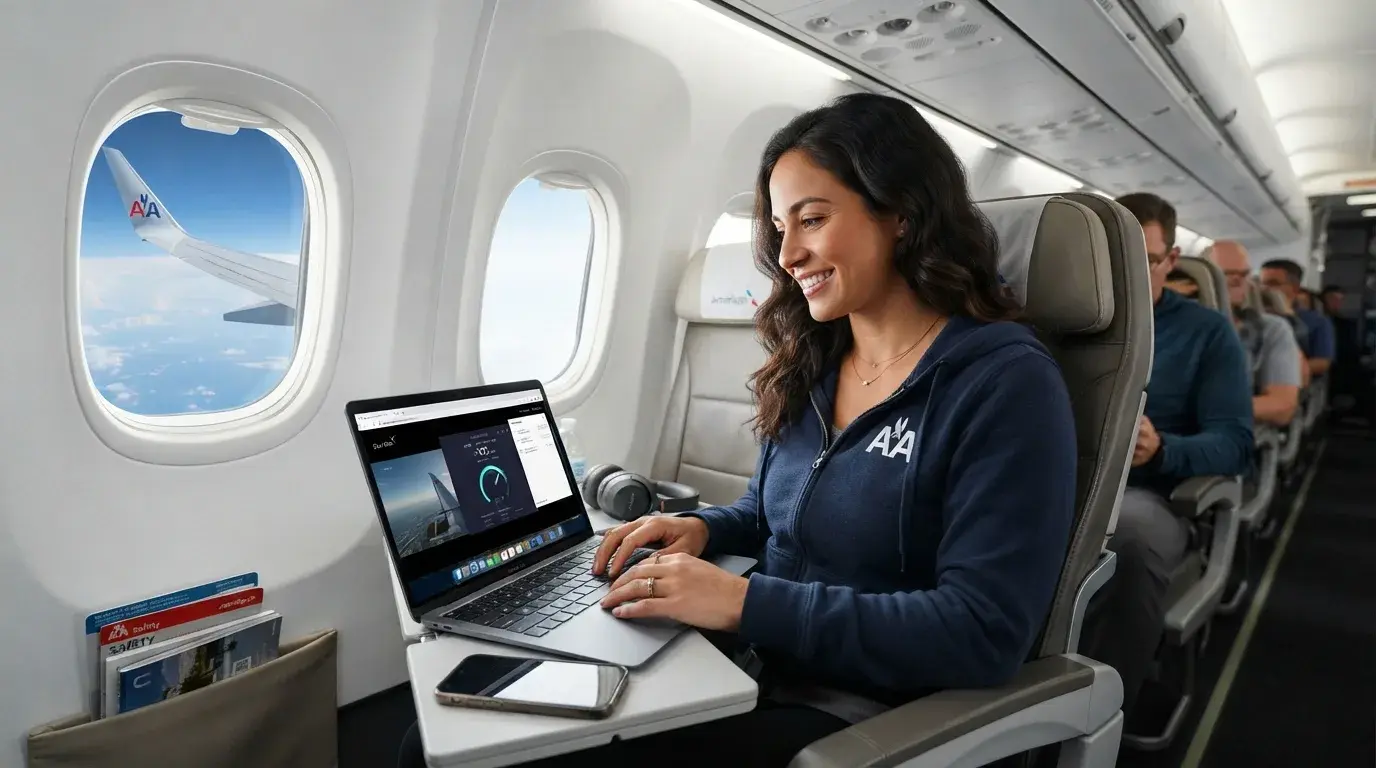
Starting in early 2027, American Airlines will transform the onboard experience with the deployment of Starlink, SpaceX’s high-speed satellite network. Over 1,000 aircraft in its main fleet will be equipped with this technology, promising ultra-fast internet connectivity from gate to gate. This revolution is part of a broader strategy to modernize onboard Wi-Fi, meeting the growing expectations of travelers for reliable and high-performance connectivity.
This announcement marks a major turning point for the U.S. carrier, which is no longer limiting its upgrades to single-aisle aircraft. The initial program, unveiled in May 2026, covered only a few hundred Airbus A321neo and A321XLRs. Now, Boeing 737, 777, and 787 Dreamliner aircraft will also benefit from this innovation. American Airlines aims to operate one of the largest connected fleets in the world, with speeds reaching up to 1 Gbit/s per terminal, though this performance will be shared among passengers onboard.
For frequent flyers, this evolution is more than just a technical improvement—it addresses a real need: the ability to work, stream videos, or stay in touch with loved ones without interruption, even mid-flight. Heather Garboden, American Airlines’ Customer Experience Director, notes that “our customers have told us that reliable connectivity can make a real difference in how they spend their time in the air.” This reflects a broader trend in the aviation sector, where digital comfort is becoming a key passenger choice criterion.
The transition to Starlink also aligns with American Airlines’ network consistency strategy. By standardizing connectivity across its entire fleet, the airline simplifies travel for passengers, whether in transit, connecting, or simply seeking a pleasant flight. This uniformity is especially important as the airline transports over 165 million passengers annually on its main fleet, with ambitions to add 300 new aircraft in the coming years.
Installation work will begin in early 2027, though the exact deployment timeline remains unspecified. American Airlines has not yet detailed the pace of modifications or the commercial terms of the new service. One thing is certain: this transition is poised to be one of the most ambitious in recent aviation history, both in scale and potential impact on the travel experience.
For passengers, this means a radical shift in how they experience air travel. Gone are the frustrations of slow connections or unexpected dropouts. With Starlink, American Airlines aims to deliver a travel experience where technology serves comfort and productivity from takeoff to landing.
Starlink: A SpaceX-made technology to revolutionize air travel
The choice of Starlink is no coincidence. This low-orbit satellite network, developed by SpaceX, has become a benchmark for high-speed connectivity. Unlike traditional geostationary satellite solutions, which often suffer from high latency and limited bandwidth, Starlink offers latency comparable to terrestrial connections while guaranteeing superior bandwidth.
For American Airlines, adopting this technology represents an opportunity to stand out in an increasingly competitive market. Laurent Dreyer, SpaceX’s Vice President of Commercial Operations for Starlink, emphasizes this breakthrough: “Passengers will have access to fast and reliable internet, from door to door.” A promise that goes beyond onboard Wi-Fi, extending to the entire journey—from airport arrival to the return home.
This innovation aligns with a broader trend of modernization in the aviation sector. As airlines compete to offer ever-more-comfortable cabins, connectivity is becoming a key commercial argument. American Airlines isn’t just following this trend—it’s leading it by opting for cutting-edge technology capable of supporting the most demanding uses, from streaming to professional videoconferencing.
The Starlink Performance Aero terminal, which will equip American Airlines’ aircraft, is designed to withstand the extreme conditions of flight. Its ability to reach 1 Gbit/s makes it one of the most advanced systems available in aviation. A performance that could well become the standard for airlines looking to retain their most demanding passengers.
From single-aisle to long-haul: A fully reimagined fleet
The expansion of the Starlink program to over 1,000 aircraft marks a crucial step in American Airlines’ modernization strategy. While initial commitments focused on Airbus A321neo single-aisle aircraft, the airline has now broadened the scope to include Boeing 737, 777, and 787 Dreamliner aircraft. A decision driven by consistency, performance, and economic necessity.
The inclusion of long-haul aircraft like the 777 and 787 is particularly strategic. These planes, which represent a significant portion of international flights, are often used for trips lasting several hours—or even over twelve hours for transpacific routes. For travelers, this means a radically transformed travel experience: no more hours without internet, no more unexpected dropouts, just reliable connectivity to work, entertain, or stay in touch.
Standardizing connectivity across the entire fleet also offers operational advantages. Connecting passengers, for example, will benefit from a uniform experience regardless of the aircraft. This consistency eases connection management and reduces frustration from disparate services between flights.
For American Airlines, this transition also presents a significant logistical challenge. Installing Starlink on over 1,000 aircraft requires close coordination with SpaceX and the airline’s technical teams. Work will begin in early 2027, though the exact deployment timeline remains unspecified. One thing is certain: this modernization is part of a long-term vision where connectivity becomes a cornerstone of the travel experience.
Free Wi-Fi for AAdvantage members: The first step toward a revolution
This announcement follows a broader strategy to modernize onboard Wi-Fi. As early as January 2026, American Airlines launched a free Wi-Fi program for members of its AAdvantage loyalty program—but only on aircraft equipped with Viasat and Intelsat satellite systems. An initiative that marked a first step toward democratizing onboard connectivity.
With Starlink, the airline is going far beyond this initial step. The SpaceX network offers superior performance, with reduced latency and much higher speeds. An evolution that could well challenge existing solutions, both for American Airlines and its competitors. It remains to be seen whether this innovation will be extended to all passengers or reserved for loyalty program members. For now, the airline has not disclosed the commercial terms of the new service.
This transition also raises questions about the future of existing equipment. Will the Viasat and Intelsat systems, which still equip part of the fleet, be gradually replaced or retained in parallel? No information has been provided, but one thing is clear: American Airlines is betting on Starlink to become a key player in airborne connectivity.
For travelers, this evolution is excellent news. With faster, more reliable connections, flights become less burdensome, and time in the air can be used for work, entertainment, or relaxation. A revolution that could redefine passenger expectations for years to come.
By choosing Starlink, American Airlines isn’t just improving the onboard experience—it’s laying the groundwork for a new era of air travel, where technology serves comfort and productivity. An initiative that could inspire other airlines to follow suit, making connectivity an essential flight choice criterion.
With over 1,000 aircraft equipped by 2027, American Airlines is on the cusp of a major transformation. A revolution that, if successfully executed, could change the game for the entire aviation sector.
Why is this innovation a turning point for aviation?
The adoption of Starlink by American Airlines marks a turning point in the history of air travel. For the first time, an airline is offering high-speed connectivity from gate to gate. A performance that meets the expectations of an increasingly demanding clientele, where the need to stay connected has never been stronger.
This innovation also reflects a trend of intensifying competition among carriers. With faster, more reliable connections, airlines can differentiate themselves in a saturated market where price alone is no longer enough to attract passengers. Connectivity is becoming a key commercial argument, on par with seat comfort or onboard service quality.
Finally, this transition represents a major technological challenge. Starlink, with its constellation of low-orbit satellites, offers a far more advanced solution than traditional technologies. An advancement that could inspire other industry players to adopt similar solutions, making connectivity a standard across the entire aviation sector.
For American Airlines, this revolution is also an opportunity to strengthen its market position. By offering an uninterrupted travel experience, the airline can retain its most demanding passengers and attract new customers seeking a pleasant and productive flight. An initiative that, if successful, could redefine expectations across the entire industry.
Be the first to comment on this article
On the same topic
- Royal Air Maroc and Starlink: High-Speed Wi-Fi Coming to 41 Aircraft by 2027, a First in Africa
- Royal Air Maroc First in Africa with Starlink: How to Enjoy Unlimited Wi-Fi from 2027
- Wizz Air to equip all Airbus aircraft with Starlink Wi-Fi from 2027: what it means for European flights
- United Airlines Bets on the Airbus A321XLR to Redefine Long-Haul Travel in 2026
- Copa Airlines unveils its 2026 ambitions: 420 daily flights and 88 destinations