FLY91 signs historic deal for 40 ATR 72-600s: Is the turboprop the future of European short-haul?
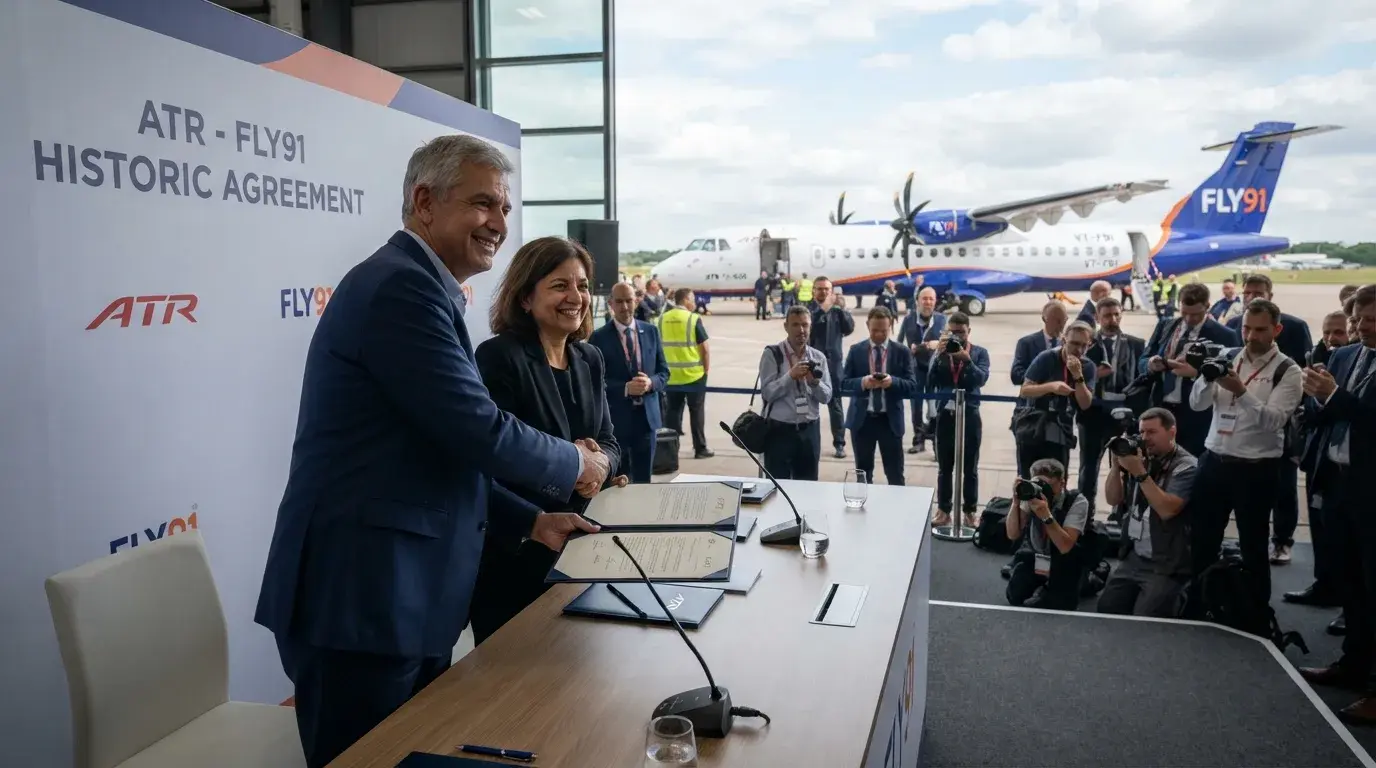
Indian carrier FLY91 has made a major move in the regional aviation sector by signing a firm order for 40 ATR 72-600s, valued at nearly $1 billion at list prices. The announcement redefines the game for turboprops and could inspire more than just Asian airlines.
This is the largest firm order ATR has received in nearly a decade, and the largest ever placed with the Franco-Italian manufacturer by a regional airline. Based in Goa, FLY91 currently operates six ATR 72-600s and aims to grow its fleet to over 60 aircraft by 2032, as part of an ambitious strategy to connect India’s secondary cities.
This massive order could signal a turning point for turboprops, long seen as a declining segment. With operating costs up to 45% lower than comparable regional jets, the ATR 72-600 is emerging as the ideal solution for routes between secondary and tertiary cities—where traditional carriers hesitate to deploy larger single-aisle jets.
FLY91 bets on the ATR 72-600 to unlock India’s secondary cities
Launched commercially in March 2024 under the name Just Udo Aviation Private Limited, FLY91 has carved out a precise niche: direct flights between India’s secondary and tertiary cities, often overlooked by major carriers. The airline currently operates nearly 280 weekly flights to twelve destinations, with a thirteenth on the way.
Its network connects Goa and Hyderabad to Pune, Sindhudurg, Solapur and Jalgaon in Maharashtra, Hubballi in Karnataka, Tirupati, Vijayawada and Rajahmundry in Andhra Pradesh, as well as Agatti in the Lakshadweep archipelago. This strategy aligns perfectly with India’s Modified UDAN program, which aims to develop 100 additional airports by 2035-2036.
For Manoj Chacko, FLY91’s founder, CEO and managing director, “this order for 40 aircraft is the catalyst for our next phase of expansion.” He adds that “the ATR 72-600 offers the ideal operating economics for our network,” highlighting the turboprop’s advantages in terms of cost efficiency and ability to serve airports with limited infrastructure.
For ATR, a much-needed industrial boost
For ATR, the joint venture equally owned by Airbus and Leonardo, the announcement is more than just a contract. It breathes new life into the company’s industrial outlook for 2026, with 54 aircraft ordered since the start of the fiscal year—already surpassing the 50 net orders recorded for all of 2025.
The Franco-Italian manufacturer has long championed turboprops as a solution tailored to regional markets. The ATR 72-600, with a capacity of 68 to 78 seats depending on configuration, offers cost-effective operations on short-haul routes and the ability to serve airports with limited infrastructure.
Nathalie Tarnaud Laude, ATR’s CEO, stated in a press release: “The ATR 72-600 combines unmatched economy, efficiency and reliability, enabling airlines to offer affordable fares while connecting millions of passengers to new opportunities.”
Can the ATR 72-600 win over Europe?
While FLY91 operates in India—where the potential for short-haul development is vast—the question now arises for Europe. Could turboprops become a credible solution for connecting secondary cities across the continent, often poorly served by major hubs?
Several factors favor a renewed interest in turboprops in Europe. First, cost pressures amid rising fuel prices. Second, the growing saturation of Europe’s major airports, making slot availability increasingly scarce. And third, the push to reduce aviation’s carbon footprint, as turboprops emit up to 45% less CO₂ than comparable regional jets.
Several European airlines have already begun exploring this path. In France, Flywest is closely monitoring turboprop market developments, particularly for flights to less frequented destinations. The airline has tested hybrid solutions and remains attentive to technological innovations in the sector.
A model for European airlines to follow?
The success of FLY91 could inspire other airlines worldwide, including in Europe. A well-sized turboprop fleet could allow regional carriers to capture significant market share on secondary-city routes while offering competitive fares.
For travelers, this could mean more direct connections, fewer layovers, and potentially lower fares. For airports, it could represent an opportunity for growth and territorial connectivity.
Whether European airlines will take the leap remains to be seen. Several hurdles remain, including the perception of turboprops as “outdated” by some travelers, as well as challenges related to certification and integration into existing fleets.
A deal that could change everything for ATR
Regardless of Europe’s future, FLY91’s order is a major victory for ATR. It confirms the central role of the turboprop in the manufacturer’s growth strategy and could reignite interest in this technology in the years ahead.
With a backlog already filling up and production expected to ramp up by 2027, ATR is positioning itself as a key player in the renewal of regional fleets worldwide. And if FLY91 sets the example, others may well follow.
What’s next for turboprops in Europe?
Europe, with its thousands of secondary cities and dense but saturated rail network, could become an ideal playground for turboprops. Several scenarios are possible:
Public-private partnerships to develop regional routes, drawing inspiration from programs like India’s UDAN. Public funding could ease aircraft acquisition and support the launch of new routes.
New market entrants, specializing in regional short-haul. Startups or low-cost carriers could enter this niche, leveraging modern turboprops and innovative business models.
Hybrid solutions, including electric or hybrid turboprops. Several projects are underway in this area, and Europe—leader in energy transition—could play a key role in their deployment.
Whatever the path, FLY91’s historic order marks a turning point. It could well herald a new era for turboprops, in Asia as in Europe, and redefine the future of regional aviation for years to come.
Be the first to comment on this article