Amazon Air Boeing 767 Crash in Miami: NTSB Report Reveals Fatal Errors
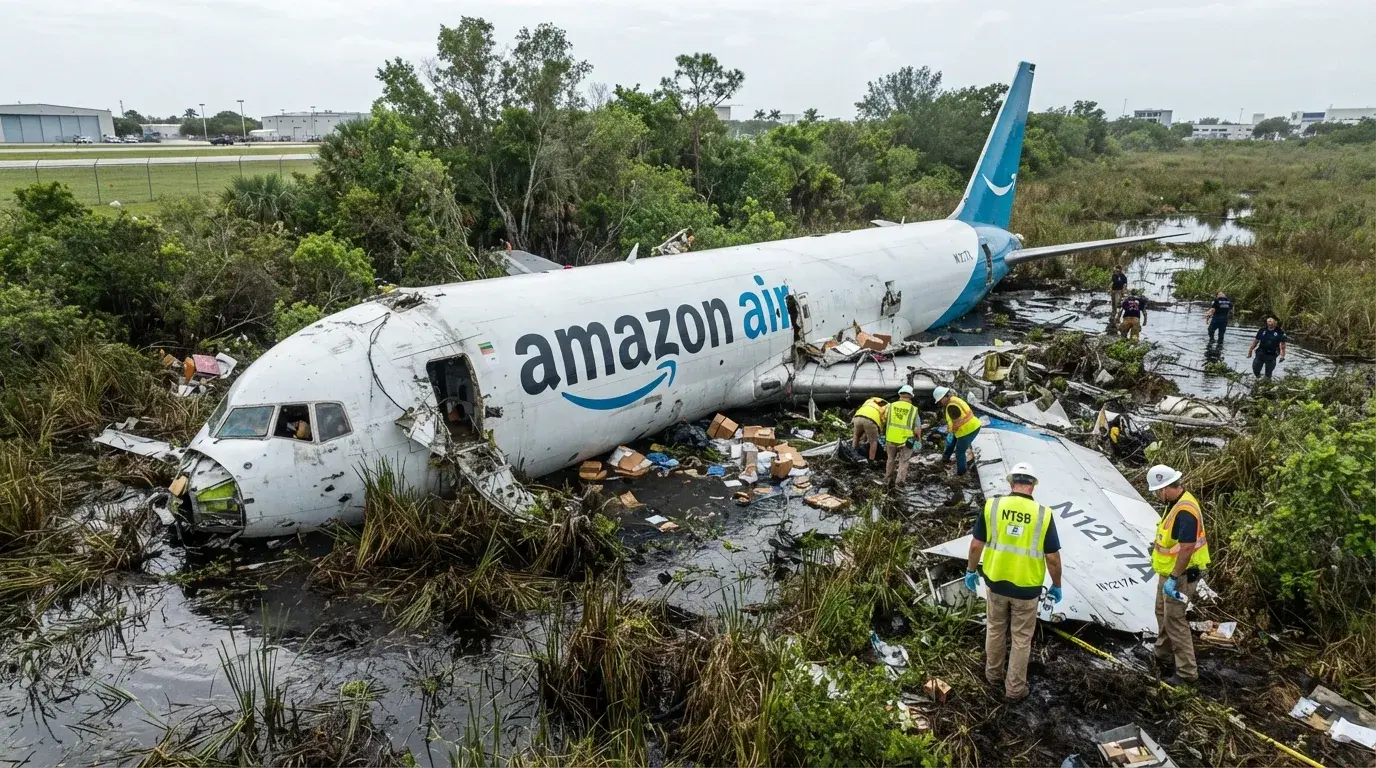
The National Transportation Safety Board (NTSB) released its preliminary report in early October 2026 on the crash of an Amazon Air Boeing 767 cargo aircraft at Miami International Airport. Five people on the ground were killed, three others were seriously injured, while the two pilots survived with minor injuries. Investigators detail a series of human and technical errors that led to the tragedy. The Boeing 767, operated by 21 Air on behalf of Amazon, was en route from Puerto Rico and attempted to land on Runway 30 at Miami International Airport on September 6, 2026. The findings are damning: excessive speed, a delayed go-around attempt, and a failure to respond appropriately to repeated cockpit alerts.
From the descent phase, the pilots faced multiple warning signals. Approximately one minute and 42 seconds before the end of the recording, the co-pilot repeatedly reported that the aircraft was approaching too fast. Yet, no systematic response was provided to these observations. The autopilot was disengaged only 19 seconds after the first warning, by which time the aircraft’s ground speed had already exceeded 328 km/h (177 knots). Alerts escalated: two "sink rate" warnings indicating an excessive descent rate, followed by four "too low terrain" announcements signaling insufficient altitude above the terrain. Despite these signals, the crew failed to correct the trajectory in time.
The report highlights another critical factor: the aircraft touched down more than one kilometer past the runway threshold at a speed of nearly 296 km/h (160 knots). By that point, the plane had already traveled a significant portion of the runway before making contact with the ground. Speed brakes and thrust reversers were not deployed during landing or the subsequent rollout. Wheel brakes were manually activated only at 146 knots (~270 km/h), and the go-around attempt was initiated when only 283 meters of runway remained. Four seconds after increasing thrust, the throttles were returned to idle, and braking resumed with just 126 meters of runway left. The aircraft ultimately overran the runway at 113 knots, colliding with vehicles outside the airport perimeter.
Investigators also point to a failure in wind information transmission. According to Federal Aviation Administration (FAA) procedures, the control tower must communicate wind direction and speed when a tailwind component exists on the landing runway. However, the controller did not relay this information to Flight 7598, despite providing the same data to another aircraft minutes earlier. This omission likely exacerbated the approach’s difficulty, though its exact impact remains under investigation.
Amazon suspended operations with 21 Air in response, while the latter announced full cooperation with authorities. The NTSB is continuing its work with the FAA, Boeing, GE Aerospace, and airport representatives. No probable cause has been determined yet, but this preliminary report exposes severe dysfunctions in crew coordination, aircraft system use, and air traffic control information management. Final findings could have major implications for air cargo safety procedures and cargo operations.
Ignored Alerts and a Delayed Go-Around
The NTSB investigation focuses heavily on cockpit alert management. Recorded data shows the pilots did not respond appropriately to speed and descent warnings. The first speed warning occurred as the aircraft neared the runway threshold, but the pilot at the controls failed to reduce speed in time. Multiple "too low terrain" announcements signaled insufficient altitude to avoid terrain, yet no immediate corrective action was taken.
Aviation safety experts emphasize that the go-around was initiated far too late to prevent the runway overrun. At that stage, the aircraft was still traveling over 200 km/h (110 knots) with less than 300 meters of runway remaining. Standard procedures require a go-around to be initiated as soon as conditions no longer allow for a safe landing. In this case, the decision came too late, leaving little chance for success. Investigators will determine whether this error stemmed from inadequate training, poor crew communication, or an underestimation of the situation’s severity.
The aircraft’s systems are also under scrutiny. Speed brakes and thrust reversers were not used during the landing attempt, prolonging the braking distance. Additionally, wheel brakes were manually activated only at a high speed, reducing their effectiveness. These issues raise questions about the aircraft’s maintenance, which had been converted from passenger to cargo service. While the aircraft’s age is not directly implicated, investigators will examine whether critical systems functioned correctly during the landing.
Unreported Wind and Unclear Responsibilities
The NTSB’s preliminary report highlights another anomaly: the control tower’s failure to transmit wind information. According to FAA guidelines, wind direction and speed must be communicated to crews when landing with a tailwind component. In this case, the controller had provided this data to another aircraft minutes before the Amazon Air Boeing 767’s arrival. Yet, this information was not relayed to Flight 7598, depriving the pilots of critical data to adjust their approach.
This omission raises questions about controller workload and procedural clarity. While the exact role of wind in the accident remains undetermined, its absence likely complicated the pilots’ task. Investigators will assess whether this failure is isolated or reflects a broader issue in air traffic communication management. Meanwhile, Amazon has suspended operations with 21 Air, which stated it would take all appropriate measures to enhance flight safety in cooperation with authorities.
The next steps in the investigation will involve precise synchronization of cockpit voice and flight data recorder timelines, followed by an in-depth analysis of the collected data. Final findings could lead to procedural changes for cargo flights and high-speed landing operations. This report also underscores the importance of crew training and optimal use of aircraft systems to prevent similar accidents in the future.
Implications for the Future of Air Cargo
The Miami accident is a stark reminder of the risks associated with air cargo transport, especially when cargo aircraft operate under demanding conditions. The NTSB and FAA investigations may result in recommendations to strengthen safety procedures for cargo flights, particularly regarding excessive speed management and crew coordination. Airlines operating cargo flights will likely need to revise landing and go-around protocols to avoid similar scenarios.
For travelers, this accident does not compromise the safety of commercial passenger flights but highlights the need for constant vigilance across the aviation industry. Lessons from this investigation could also influence future regulations, particularly regarding pilot training and cargo aircraft maintenance. Amazon Air will need to demonstrate its ability to ensure operational safety as the air cargo sector continues to grow to meet surging e-commerce demand.
This preliminary report is a call to action for the entire industry. Airlines, regulators, and crews must work together to ensure every flight—whether carrying passengers or cargo—proceeds under the safest possible conditions. The NTSB’s final findings will be closely watched, as they could redefine safety standards for years to come.
Be the first to comment on this article