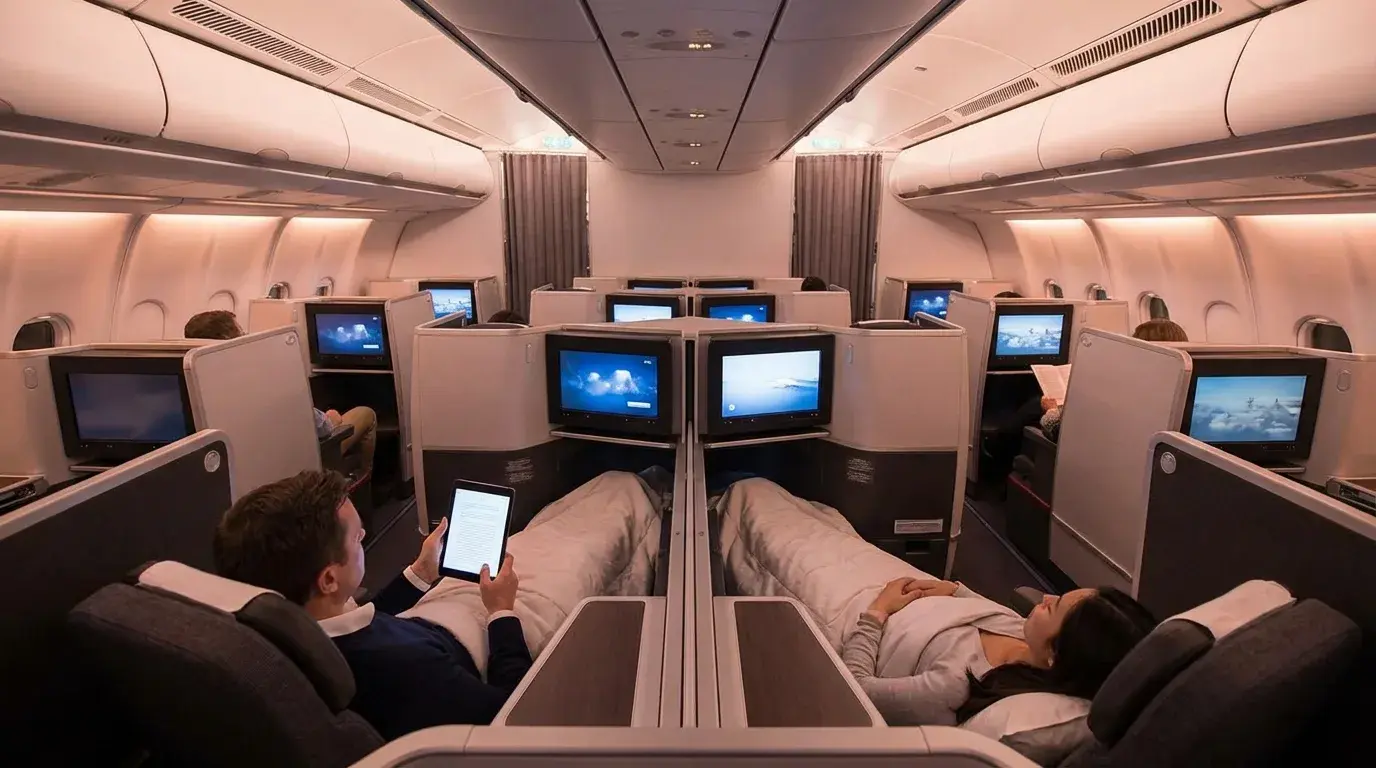
The air travel industry is constantly evolving, seeking to improve the passenger experience while optimizing cabin space. With this in mind’Airbus has filed a bold patent aimed at radically transforming the design of business-class seats. This ambitious project could redefine the standards of premium travel, whether on long-haul or even medium-haul aircraft.
The patent, details of which were revealed by the specialist website Simple Flying available on WIPO's PATENTSCOPE database, proposes an innovative modular approach. The main objective is to enable the installation of true flat beds, while increasing the density of premium cabins. This dual ambition meets a growing demand from airlines wishing to increase their profitability without compromising the comfort offered to their most demanding passengers.
Ingenious design for optimum comfort
At the heart of this innovation is a seat with a parallelogram-shaped footprint. This particular geometry creates a fixed space between the seat and the side console, offering a greater sense of space even in denser configurations. The trick lies in the way the seats can be positioned against the cabin walls, avoiding any impression of narrowness. This design would be adaptable to both large aircraft like the A350 and more compact single-aisle aircraft like the A321XLR.
The mechanism for transforming the seat into a bed is particularly remarkable. Described in the patent as being operated by a single engine, This motor allows the seat and backrest to move together from a sitting to a lying position. The use of a single motor for all movements (backrest, seat, footrest) offers significant advantages: weight reduction, simplified wiring and reduced risk of failure. Airbus points out that the system can be adapted to integrate additional motors if required, offering even greater flexibility.
Mini-suites for enhanced privacy
In addition to the seat mechanism, Airbus' innovation also concerns the passenger's immediate environment. An enveloping structure, comprising a rear partition, a side panel and sliding doors, is provided around each seat. These elements create a real cocoon, approaching the intimacy of a mini-suite. To form the bed, the armrest lowers, the footrest integrates into the structure, and a console extension completes the flat surface. The result is a comfortable sleeping space that feels spacious, without appearing overcrowded.
This design also allows passengers to benefit from a more comfortable direct driveway access, an important comfort criterion. The orientation of the seats, often in solo configuration or in diagonal pairs (
Be the first to comment on this article
On the same topicbusiness class
- Alaska Airlines revolutionizes its business class for long-haul flights
- Emirates launches its Premium Economy class on Montreal with the Airbus A350
- Emirates reinvents luxury travel: chauffeur-driven car service expands to Japan
- qatar airways or singapore airlines: who's the business class champion?
- SWISS: Economy Class passengers' cleanliness habits compared to those in Business and First Class
- Beyond the Blocked Middle Seat: Which European Airlines Offer True Business Class on Short-haul Flights?