China Southern Airlines Orders 137 A320neo: Airbus Strengthens Lead in China
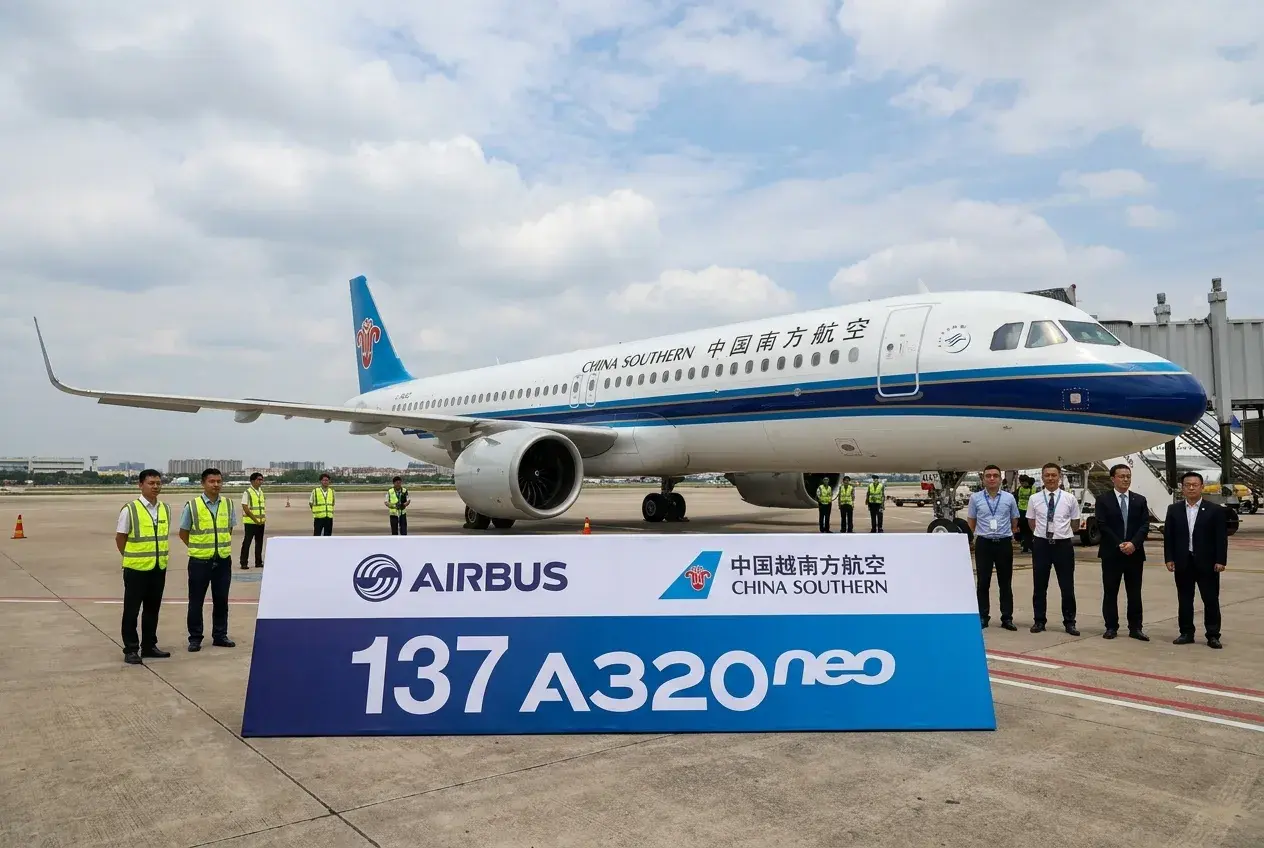
Airbus has finalized a landmark deal with China Southern Airlines and its subsidiary Xiamen Airlines for 137 A320neo aircraft, underscoring two key trends in China’s aviation sector: accelerated renewal of single-aisle fleets and Airbus’s ability to secure substantial orders in the most strategic market segment. While the deal’s catalog value stands at approximately $21.4 billion, its true significance lies in its industrial and commercial implications. Deliveries are scheduled between 2028 and 2032—a period already heavily booked for the European manufacturer.
This order carries particular weight as it targets the core of Airbus’s market. China Southern Airlines is taking 102 aircraft, while Xiamen Airlines commits to 35. Rather than a one-off purchase, this deal signals a strategic shift: Chinese carriers continue to favor the A320neo family to replace older aircraft and support more selective growth, with staggered deliveries and negotiated price reductions.
Airbus’s competitive edge in this deal stems from its industrial footprint in China, including the final assembly line in Tianjin. This long-established presence fosters stronger relationships with authorities and reinforces Airbus’s role as a long-term partner. For Boeing, the comparison remains unfavorable, as the U.S. manufacturer continues to await an equivalent agreement in the Chinese market.
An order aligned with fleet strategy
China Southern Airlines is not starting from scratch. The airline had already placed an order for 96 A320neo aircraft in 2022 as part of a broader deal covering 292 single-aisle jets for major Chinese carriers. The new order extends this strategy: homogenizing the fleet, reducing operating costs, and progressively phasing out older aircraft.
The airline’s statement, as reported by Flywest, highlights the replacement of A320ceo and certain Boeing 737 models. This is a critical aspect of the deal. In China’s still robust domestic market, single-aisle aircraft remain the most suitable for domestic and regional routes. The A320neo’s selection addresses fuel efficiency, operational flexibility, and standardized training and maintenance—key priorities for airlines under margin pressure.
Xiamen Airlines, historically Boeing-centric, is gradually diversifying its orders toward Airbus. The carrier had already ordered 40 A320neo in 2022, signaling a durable shift rather than a tactical adjustment. For a medium-haul operator, the logic is clear: a more fuel-efficient and flexible aircraft improves route profitability, especially in markets where margin pressure is intense.
Deliveries spread between 2028 and 2032
The announced timeline is as significant as the volume. China Southern will receive most of its 102 aircraft between 2028 and 2032, while Xiamen Airlines will take delivery of its 35 jets between 2029 and 2032. Such a schedule allows airlines to absorb new capacity without immediate financial strain while securing delivery slots in an already crowded Airbus production calendar.
This delivery window also reflects the industrial constraints weighing on the sector. Airbus must navigate a still-tight supply chain, particularly for engines and certain components. Ramping up A320neo production in the coming years requires a delicate balance between output, logistics, and service quality. When a major Chinese client secures so many slots, it inevitably impacts the manufacturer’s overall capacity allocation.
The 2028–2032 timeline also coincides with a period of transition for global commercial aviation. Airlines are renewing fleets to cut fuel consumption and meet stricter environmental standards, yet they must avoid overburdening their balance sheets. Mega-orders are thus becoming tools for long-term planning as much as purchase agreements. China Southern and Xiamen Airlines’ deal exemplifies this approach.
Airbus solidifies its position in China
Strategically, this deal comes at an opportune moment for Airbus. The European manufacturer has secured numerous large contracts in China since 2019, capitalizing on Boeing’s challenges. The A320 family remains the global bestseller in the single-aisle segment, accounting for most of Airbus’s commercial deliveries. In 2025 alone, Airbus delivered over 600 A320-family aircraft out of 793 total commercial jets handed over, underscoring its dominance in the company’s industrial model.
The Chinese market is one of the most competitive in the world, yet it is also where Airbus enjoys a clearer commercial and industrial relationship. The Tianjin final assembly line allows Airbus to position itself as an already integrated local player. In negotiations with state-owned and semi-state-owned carriers, this presence is a decisive advantage—it reassures on delivery timelines, logistics, and ongoing support.
This 137-aircraft A320neo order further cements Airbus’s lead. Boeing continues to seek a comparable breakthrough in China but remains constrained by the aftermath of the 737 MAX crisis and a diplomatic climate that complicates major announcements. Meanwhile, Airbus advances in a market where purchasing decisions are made at scale, with long-term timelines and highly political considerations.
China Southern maintains focus on single-aisle
For China Southern, the benefits are clear: modernizing the fleet without disrupting the network. Based in Guangzhou, the airline is China’s largest carrier and must maintain sufficient capacity on domestic and regional routes. The arrival of new A320neo aircraft provides flexibility to adjust capacity on high-demand routes while reducing unit costs on medium-haul flights.
The airline has framed its strategy simply: enhancing competitiveness by increasing transport capacity. Behind this statement lies a concrete reality. Major Chinese carriers face vast networks, profitability pressures, and the need to keep fleets modern. The A320neo fits this logic, offering fuel efficiency and versatility tailored to market demands.
Xiamen Airlines, meanwhile, continues diversifying in pursuit of the same economic logic. The carrier aims to secure future capacity without becoming overly dependent on a single manufacturer. Its shift toward Airbus reflects a pragmatic market assessment: on certain routes, the European single-aisle offers a better balance of cost, range, and availability.
This 137-aircraft A320neo order adds to a series of announcements confirming China’s pivotal role in Airbus’s order book. It also illustrates how airlines now structure their purchases: high volumes, staggered deliveries, tight price negotiations, and phased renewal strategies. In this context, the A320neo remains the aircraft that drives the most decisions, as it aligns with the broadest global market demand.
Ultimately, the deal serves as a snapshot of the current power dynamics between the two Western aircraft giants. Airbus benefits from an industrial network in China, a well-established product, and strong commercial visibility. Boeing, by contrast, still struggles to regain meaningful traction in the country. While the China Southern/Xiamen order alone does not reshape the global balance, it confirms that in China, the European single-aisle maintains a clear lead over its American rival.
Be the first to comment on this article
On the same topic
- Airbus Calls for Streamlined Environmental Procedures to Stay Competitive Against Boeing and Comac
- FLY91 signs historic deal for 40 ATR 72-600s: Is the turboprop the future of European short-haul?
- Flynas and Saudi Arabia Bet $10 Billion on 25 Airbus Jets to Dominate Skies: How This Gamble Reshapes Travel
- Airbus Unveils Revolutionary Wings for Jets: The Future of Long-Haul Flights Will Be Faster and Cheaper
- Frontier Airlines Revolutionizes Airbus Fleet with Starlink Wi-Fi by 2027: What It Means for Budget Travel
- AirAsia Group Transforms into a Global Low-Cost Giant: How the Malaysian Airline Challenges Aviation Titans