VietJet Enters Europe with Prague: What This New Airline Route Really Means for Travel
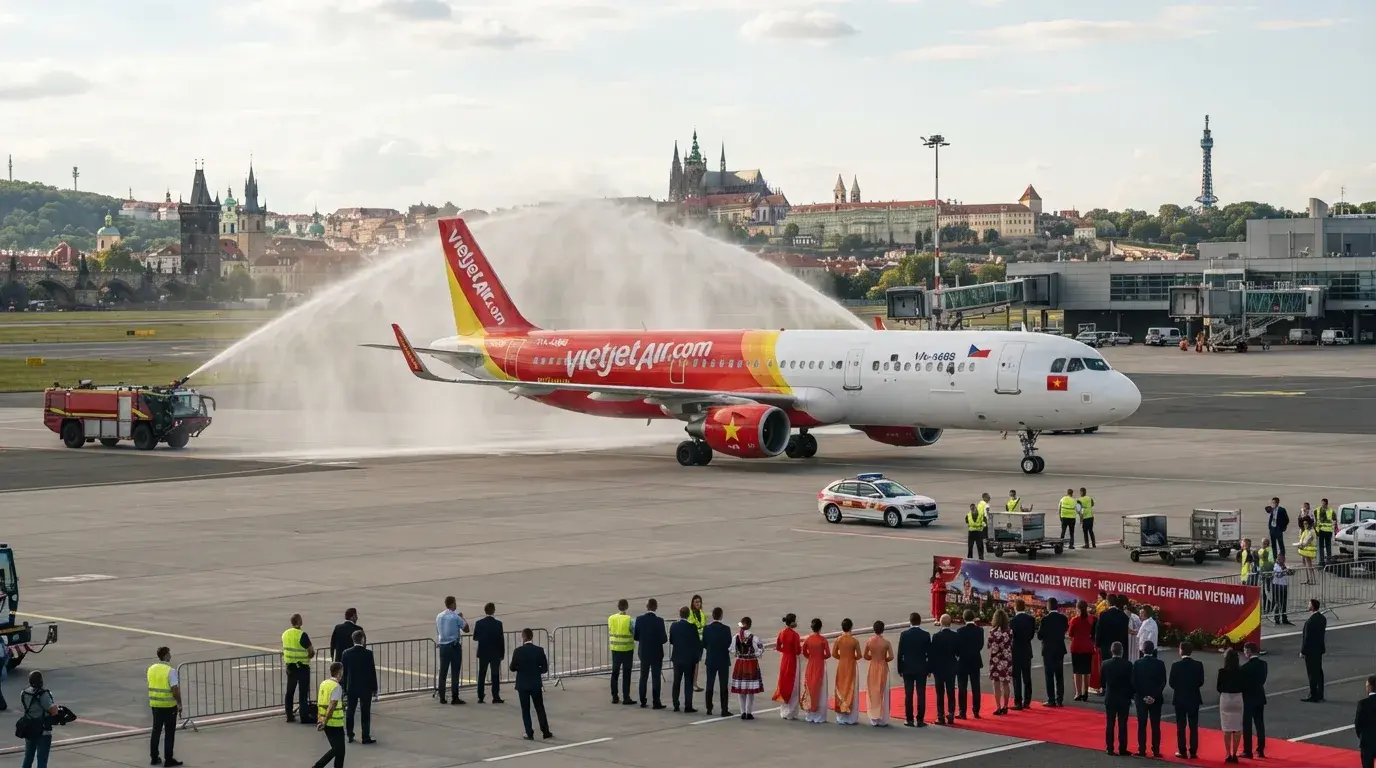
Vietnamese low-cost airline VietJet has launched a new route connecting Hanoi and Prague, with a stopover in Almaty, Kazakhstan. This marks the first time an Asian budget carrier has operated in Europe, representing a significant milestone in the airline’s international expansion. The service operates twice weekly using Airbus A330-300 aircraft, with schedules designed to facilitate connections. The launch also includes the commercialization of intermediate segments, such as Almaty–Prague, allowing passengers to travel solely between these two cities under fifth-freedom rights. The choice of Prague is strategic: the Czech capital sees over 75,000 travelers annually from Hanoi and hosts a large Vietnamese community in Central Europe. For tourists, this new route opens up opportunities to explore a city renowned for its historic heritage, iconic bridges, and vibrant cultural scene. Travelers transiting to other European or Asian destinations also benefit from a more affordable alternative to traditional flights. With this launch, VietJet reaffirms its commitment to strengthening its presence on intercontinental markets while offering competitive fares on a route previously dominated by Gulf carriers.
Beyond the commercial announcement, this move reflects a broader strategy. VietJet is positioning Central Asia as a key connecting hub between Europe and Southeast Asia. The Almaty stopover is not merely a technical layover but enables the airline to serve three distinct markets with a single rotation: Hanoi–Almaty, Hanoi–Prague, and Almaty–Prague. This flexibility is unprecedented for travelers looking to explore less accessible regions. The partnership with Kazakhstan aligns with a wider global dynamic, including another agreement with local carrier Qazaq Air. This cooperation underscores Central Asia’s growing importance in VietJet’s expansion plans, which views the region as a natural hub for future European projects. For passengers, this translates into attractive fares for routes that previously required multiple layovers or costly connections. Launched on October 10, 2026, the service is expected to gradually expand, with the potential removal of the Almaty stopover if demand justifies it.
A tailored offering for travelers and families
The weekly double round-trips between Hanoi and Prague are operated using Airbus A330-300 aircraft, featuring 377 seats across three classes: Eco, Business, and SkyBoss. The Deluxe fare option includes an extended baggage allowance and a hot meal, allowing VietJet to adapt its low-cost model to an intercontinental route. While the schedules may be restrictive for some, they are optimized for arrival in Prague in the late afternoon, enabling travelers to start their stay immediately upon landing. On the return leg, evening departures from Prague allow passengers to reach Hanoi the following morning, avoiding overnight layovers. For those connecting to other European cities, the Almaty stopover offers a brief opportunity to explore Kazakhstan’s capital, though connection times remain tight.
This new route also addresses growing demand from the Vietnamese community in Europe. According to Jiří Pos, CEO of Prague Airport, over 75,000 people traveled between Prague and Hanoi in 2025, a figure that continues to rise due to economic and cultural exchanges between the two countries. The route is also seen as a boost for tourism in the Czech Republic, which is targeting Southeast Asia as a major source of visitors. For travelers looking to visit Prague without transiting through traditional hubs like Istanbul or Dubai, this option provides a direct and cost-effective alternative. VietJet’s fares, while variable depending on the season, remain competitive compared to legacy carriers and traditional tour operators. A boon for budget-conscious travelers, as well as families or groups planning group trips without breaking the bank.
Prague: Gateway to Central Europe and Asia
The selection of Prague as VietJet’s first European destination is far from random. The city, ranked among Europe’s most beautiful, attracts millions of tourists annually thanks to its UNESCO-listed historic center, iconic castles, and lively nightlife. For travelers coming from Asia, Prague offers a secure and well-connected gateway to the rest of the continent. Václav Havel Airport Prague, modern and efficient, facilitates connections to other European destinations, whether by train or plane. With this new route, VietJet is embracing a strategy of enhanced connectivity, allowing passengers to travel directly between Southeast Asia and Central Europe without transiting through Gulf or Western European hubs. An opportunity likely to appeal to tourists seeking unique itineraries, as well as business travelers looking to avoid lengthy layovers.
For adventurous travelers looking to explore off-the-beaten-path destinations, this route opens up unprecedented possibilities. The Czech Republic, often overshadowed by neighboring Germany or Austria, is home to hidden gems: the thermal baths of Karlovy Vary, the vineyards of Moravia, and the landscapes of Bohemia. With VietJet, it’s now possible to combine a stay in Prague with exploration of lesser-known regions, all at an affordable price. Recognizing the appeal of these destinations, the airline may expand partnerships with local tour operators to offer packages including transport and accommodation. A strategy in line with its low-cost model, where simplicity and accessibility take precedence. For travelers seeking to explore Europe differently, this new route represents a unique chance to discover an authentic and unspoiled region, far from the crowds.
Expansion prospects and challenges ahead
This entry into Europe is a symbolic step for VietJet, but also a test of its international expansion strategy. Having already captured significant market share in Asia, the airline is now eyeing Europe as a new growth frontier. While future destinations remain undisclosed, Berlin, Budapest, and Warsaw are among the cities rumored to be next. The success of the Hanoi–Prague route will depend on several factors, including flight regularity, connection management in Almaty, and the ability to offer competitive fares amid an already established competitive landscape. VietJet will also need to navigate regulatory and operational challenges inherent to entering the European market, where safety and service standards are particularly stringent.
Another challenge lies in brand perception in Europe. While VietJet is already a low-cost leader in Asia, it will need to carve out a niche in Europe against established players like Ryanair, easyJet, and Wizz Air. Its strengths? Competitive fares and a simplified service offering, as well as a cabin experience tailored for long-haul flights. The choice of the Airbus A330-300, a spacious and comfortable aircraft, should work in its favor, particularly for passengers accustomed to the single-aisle jets of European budget carriers. For travelers, VietJet’s arrival in Central Europe could herald the start of a new era where intercontinental travel becomes more accessible and flexible. An opportunity to seize before other airlines follow suit.
Be the first to comment on this article