Emirates SkyCargo: Why the Airline is Betting $1 Billion on South America This Year
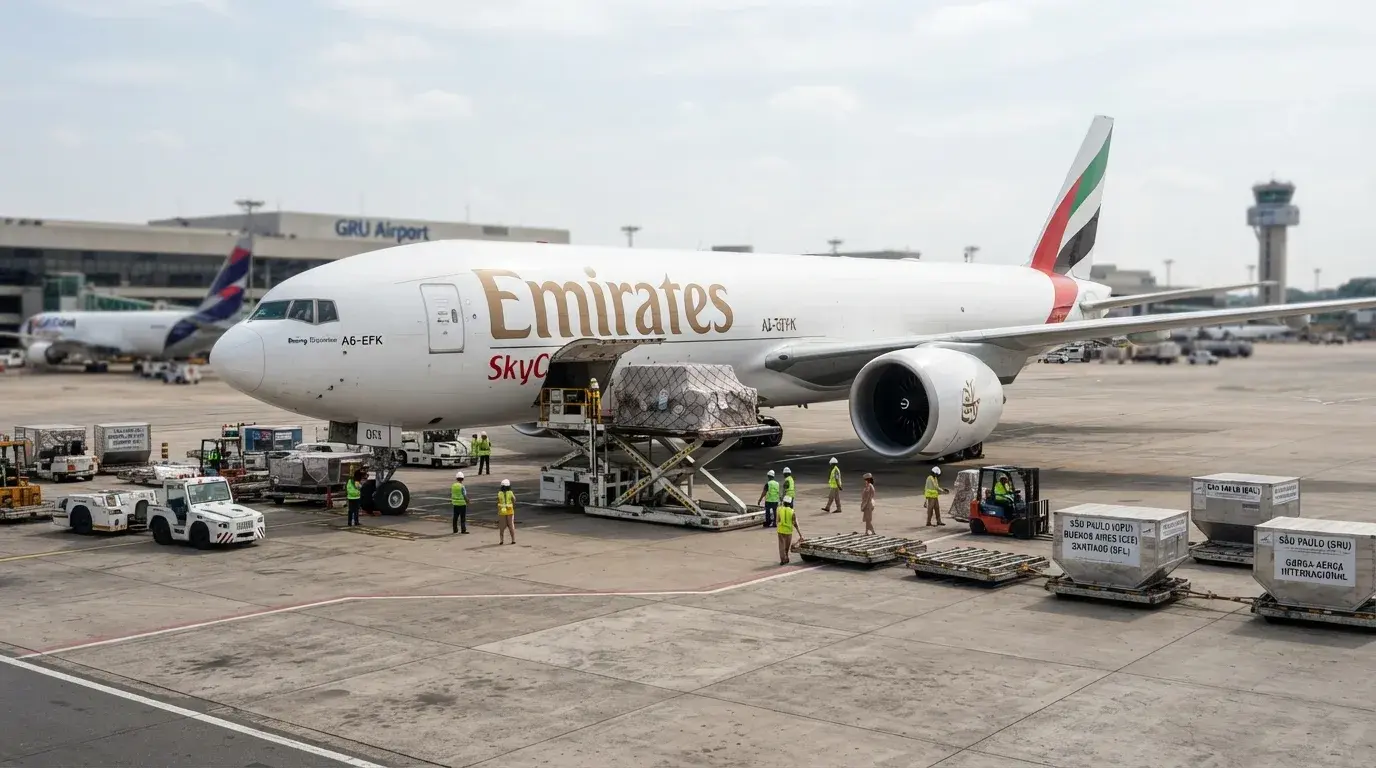
The global air logistics sector is at a pivotal moment. Facing surging demand for intercontinental cargo, Emirates SkyCargo, the cargo division of the UAE-based airline, is making a bold play for South America—a region experiencing explosive commercial growth. Starting in October 2026, the airline will add seven new weekly cargo flights, significantly strengthening its footprint in a market where trade volumes are skyrocketing. But this strategy goes beyond mere capacity expansion: Emirates aims to transform South America into a vital hub for transporting goods between Europe, North America, and Asia.
This aggressive push is part of a nearly $1 billion investment plan for 2026, a staggering sum that underscores the region’s strategic importance. Emirates SkyCargo isn’t just adding flights—it’s restructuring its network to better serve local industries, particularly agri-food, floriculture, and pharmaceuticals. A move that could reshape global logistics flows in the coming years.
South America: The New Frontier of Air Freight
South America is no longer just a vacation destination or an emerging tourism market. It has become a key player in international trade, with exports surging 18% in the first half of 2026 compared to 2025. Emirates SkyCargo recognized this early. By April 2026, the airline was already transporting over 22,000 tonnes of cargo from its primary South American markets—a figure that has only continued to climb.
Among the most dynamic countries, Ecuador stands out as the airline’s top partner on the continent. Quito, the capital, has become the beating heart of this strategy. With a sixth weekly cargo flight added in May 2026, the city is now the central hub for Ecuadorian freight bound for Europe. Over 90% of cargo exported by Emirates SkyCargo from Quito consists of floriculture: thousands of tonnes of roses, gypsophila, and other cut flowers are shipped weekly to Amsterdam, Europe’s primary redistribution hub. In the first half of 2026-2027, nearly 24,000 tonnes of flowers transited this route, marking a 14% year-on-year increase.
This specialization is no coincidence. Ecuadorian flowers are renowned for their freshness and quality, but transporting them requires an impeccable cold chain. Emirates SkyCargo has invested heavily in specialized equipment to ensure every shipment arrives in optimal condition. A logistical challenge that, if met, could give the airline a decisive competitive edge over rivals.
Buenos Aires, Bogotá, and São Paulo: Hubs in Transition
Argentina, Colombia, and Brazil are following Ecuador’s lead. In Buenos Aires, Emirates SkyCargo has tripled its frequencies in just months, increasing from one weekly cargo flight in March 2026 to three today. Export volumes have surged 57% in the first half of 2026-2027, driven by fresh produce and meat products. This growth is partly fueled by rising demand in Europe, where consumers increasingly seek these goods.
In Colombia, Bogotá has seen a surge in cargo traffic since May 2026. With one weekly frequency, the city has become an essential transit point for perishable goods, particularly flowers and fresh produce. Transported volumes have risen 18% over the semester, confirming the route’s appeal. In Brazil, São Paulo has also benefited from increased capacity. With four weekly cargo flights—two added in 2026—the city solidifies its position as South America’s leader in trade with Europe and North America. Export tonnage has climbed 22%, placing Brazil among the continent’s most dynamic markets.
This expansion is accompanied by a fleet renewal and growth. Since March 2026, Emirates SkyCargo has taken delivery of seven new Boeing 777F aircraft and its first 777-300ERSF, a passenger-to-cargo converted jet. With 23 all-cargo aircraft planned by the end of March 2027, the airline’s dedicated network has expanded from 40 to over 60 destinations in just months—a growth rate that underscores Emirates’ ambition to become a major player in global air freight.
A Bold Economic Model Against Competition
Emirates SkyCargo’s South America strategy hinges on a daring bet: targeting high-growth markets while offering premium services. The 777-300ERSF, for example, boasts a payload capacity of 100 tonnes and a volume of 811 m³—25% more than a standard 777F. This capacity is ideal for bulky cargo like industrial equipment or consumer goods, which represent an increasing share of trade between South America and the rest of the world.
What truly sets Emirates apart is the complementarity between dedicated cargo flights and passenger aircraft holds. The airline leverages this synergy to maximize capacity. Passenger flights from Dubai to destinations like São Paulo or Buenos Aires already carry some cargo in their holds. With the addition of all-cargo flights, Emirates can now offer a more flexible and tailored solution to meet customer needs.
Badr Abbas, Senior Vice President of Emirates SkyCargo, summarizes this vision: « Since April of this year, we’ve transported over 22,000 tonnes of export cargo from our South American markets—a 18% increase compared to last year. These results show our strategy is paying off. We continue to invest to strengthen our presence and meet our customers’ growing demand. »
What Challenges Lie Ahead?
Despite these advances, Emirates SkyCargo faces several hurdles to sustain its position in South America. The first is geopolitical. Trade tensions between the U.S. and key South American nations like Ecuador or Colombia could disrupt logistics flows. Additionally, competition from other players like LATAM Cargo or Avianca Cargo is fierce. These airlines, already well-established in the region, will likely respond aggressively to Emirates’ offensive.
Another critical challenge is sustainability. With mounting environmental concerns, airlines face pressure to reduce their carbon footprint. Emirates SkyCargo has begun investing in sustainable aviation fuels (SAF), but the road ahead is long. The company must prove it can balance growth with environmental responsibility to win over customers and regulators.
Finally, there’s the issue of infrastructure. While South American airports are improving, some remain ill-equipped to handle large-scale cargo operations. Emirates will need to collaborate closely with local authorities to modernize facilities and ensure efficient cargo handling.
A Long-Term Vision
Emirates SkyCargo isn’t betting on South America for just one year. The airline is playing the long game. With an expanding network and a fleet in renewal, it is positioning itself as a key partner for South American industries. Whether exporting Ecuadorian flowers, Argentine produce, or Brazilian pharmaceuticals, Emirates offers a comprehensive, fast, and reliable logistics solution.
If the airline can overcome the challenges ahead, it could become the air bridge between South America and the rest of the world—a revolution that would forever change the landscape of air freight. For South American businesses, it’s an opportunity not to be missed. For travelers, it promises faster delivery of packages to and from the region. And for the aviation industry, it’s proof that innovation and boldness can transform traditional markets into new goldmines.
Emirates SkyCargo has gone all-in on South America. Is the gamble a winning one? Only time will tell. But one thing is certain: South America has never been more strategically vital to air freight.
Be the first to comment on this article