Singapore Airlines bets $160 million on AI: How algorithms will revolutionize your flights by 2026
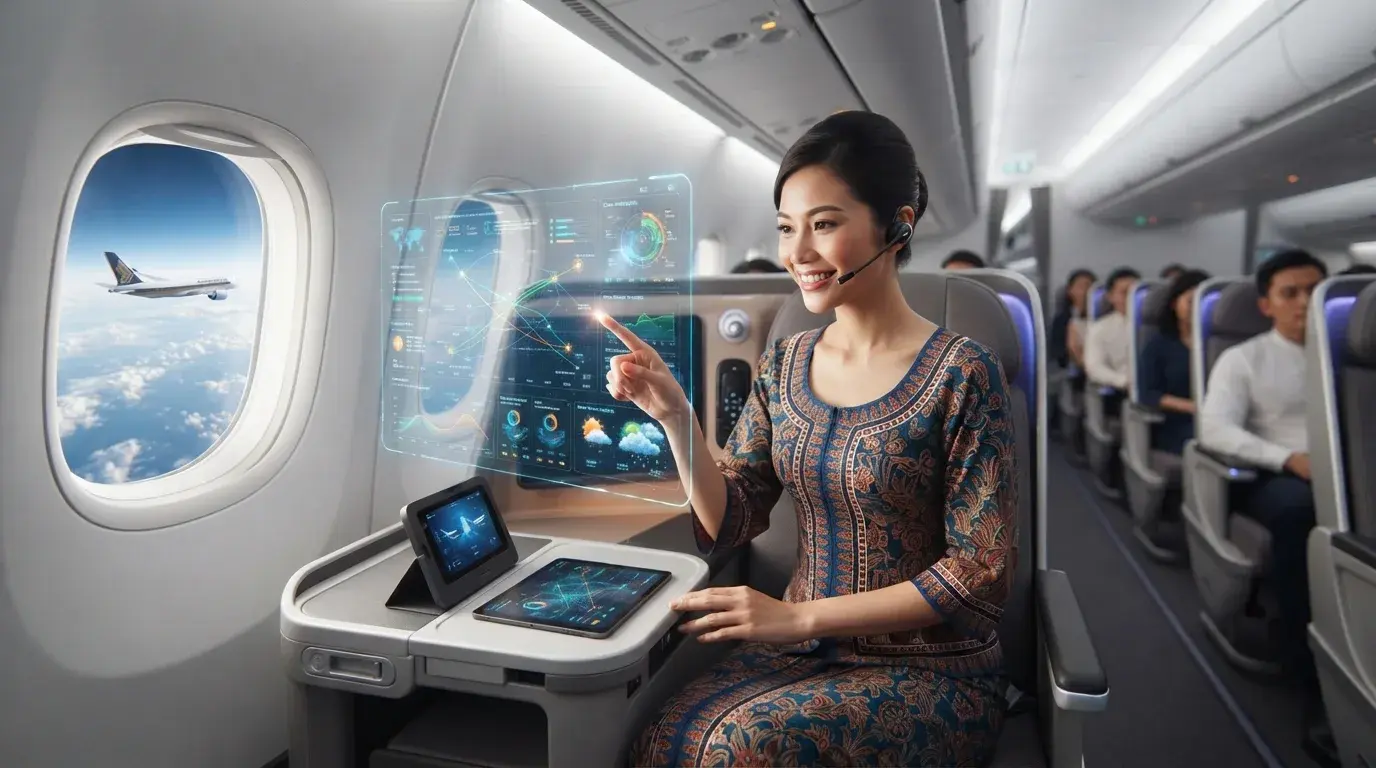
Artificial intelligence is no longer a futuristic promise in air transport—it is now deeply embedded in daily operations. Singapore Airlines is making a bold move in 2026 with the deployment of over 160 AI applications across its operations, from bookings to crew management. A quiet but concrete revolution transforming both the passenger experience and airline productivity.
With more than 550 identified use cases—140 already operational—the Singaporean group is not merely experimenting; it is industrializing AI to make it a central lever in its operational model. Behind these impressive figures lie tools that redefine how passengers interact with the airline, as well as how teams optimize their behind-the-scenes tasks. A transformation that could well become the industry standard within a few years.
The goal is clear: turning technology into a commercial advantage and a service quality differentiator. Singapore Airlines is banking on AI to enhance precision, responsiveness, and personalization—three pillars that make all the difference in an industry where every detail counts. But how do these innovations translate into tangible benefits for travelers? And what lessons can other airlines learn from this approach?
Kris: The assistant simplifying your journeys
The visible face of this revolution is named Kris, Singapore Airlines’ conversational assistant. Revamped in July 2025 with a major upgrade integrating a large language model, Kris is now available 24/7 to handle routine queries and facilitate certain transactions. Its customer satisfaction score has nearly doubled since the update—a clear indicator of its utility.
For travelers, the benefits are immediate: no more navigating websites or contacting customer service for simple requests like baggage tracking, flight schedules, or boarding conditions. Kris handles these queries in just a few exchanges via an intuitive interface. The airline emphasizes that the tool does not replace human advisors but helps them focus on complex requests, thereby improving overall service quality.
This is not all: Singapore Airlines has also developed a tool called Flight Recommender, capable of suggesting itineraries based on natural language queries. Imagine asking for a flight to Tokyo with a short layover, and receiving a selection of tickets tailored to your criteria—including business class options or KrisFlyer fares. According to the airline, this assistant now processes nearly 10,000 daily requests, a volume that underscores its widespread adoption by passengers.
The goal is not just to simplify the search process but to make booking more transparent and less stressful. In an industry where flight comparison tools often present incomplete or poorly contextualized options, a tool like Flight Recommender offers a more intuitive and personalized alternative.
AI serving teams, not just customers
Innovation extends beyond customer relations. Singapore Airlines is also leveraging AI to optimize internal operations—a domain where productivity gains can directly enhance flight quality. Among the most promising applications are crew management and rotation planning. By automating administrative tasks and complex calculations, the airline reduces human errors and frees up time for teams.
According to George Wang, Senior Vice President of Information Technology at SIA, this approach improves flight punctuality and better anticipates operational disruptions. For example, AI can analyze real-time data on weather conditions, previous flight delays, or maintenance constraints to adjust crew schedules and avoid scheduling conflicts. A time-saving measure that translates into improved on-time performance and fewer last-minute cancellations.
These tools are not reserved for industry giants; they could inspire mid-sized airlines or airports looking to optimize costs without compromising service quality. The stakes are high, especially in a context where margin pressures remain intense and passenger expectations for reliability continue to rise.
Strategic tech partnerships to accelerate transformation
To bring this vision to life, Singapore Airlines is forging strategic alliances with tech leaders. In March 2025, the airline partnered with Salesforce to integrate solutions like Agentforce and Einstein into its customer management system. The aim? To help advisors access interaction histories more quickly and personalize responses based on each passenger’s profile.
A month later, Singapore Airlines and OpenAI announced a collaboration to develop tools capable of interpreting text, audio, diagrams, and even videos. These solutions are designed not only to enhance the Kris assistant but also to streamline complex internal processes, such as analyzing technical documents or transcribing operational meetings.
These partnerships highlight a broader trend in the industry: airlines are no longer developing their own technological solutions in-house but are instead collaborating with specialized players to accelerate their transformation. An approach that allows them to share R&D costs and benefit from the latest advances in generative AI and automation.
For travelers, these innovations translate into a smoother experience, faster responses, and better adaptation to unforeseen circumstances. For airlines, it’s an opportunity to stand out in an ultra-competitive market where technology is becoming as critical a differentiator as price or flight frequency.
A model for the airline industry to follow
The example set by Singapore Airlines exemplifies a broader trend in air transport: the mass adoption of AI to enhance operational efficiency and customer satisfaction. With over 160 deployed applications and more than 550 identified use cases, the Singaporean group demonstrates that technological innovation is no longer an option but a necessity for staying competitive.
Other airlines, whether low-cost or premium, are closely monitoring this transformation. Several are already testing similar tools, particularly for baggage handling, dynamic pricing optimization, or personalized offers. The challenge for them will be to adapt these innovations to their scale, tailoring solutions to their specific operational constraints.
For passengers, these developments promise a more intuitive, less stressful, and better-tailored travel experience. Whether booking a flight, tracking luggage, or receiving real-time assistance, AI is positioning itself as a discreet yet powerful ally. And with airlines like Singapore Airlines leading the charge, the future of air travel looks smarter and more responsive than ever.
As the airline industry continues to recover from recent crises and adapt to evolving passenger expectations, AI could well become the key differentiator enabling airlines to stand out. The question remains: Will other industry players keep pace with this technological revolution?
Be the first to comment on this article
On the same topic
- TAP Miles&Go and Airbnb Partner: Earn Miles on Your Travel Bookings
- Frontier Airlines Revolutionizes Airbus Fleet with Starlink Wi-Fi by 2027: What It Means for Budget Travel
- Wizz Air links Paris-Beauvais to Varna, new gateway to the Black Sea
- Porter Airlines: Canada's West Coast flies to Phoenix
- Air France-KLM : How Flying Blue transforms your miles into exclusive VIP experiences
- Carry-on baggage: Air Algérie steps up checks, sparking passenger discontent