LATAM Airlines accelerates its growth with a fleet of 410 aircraft by 2026
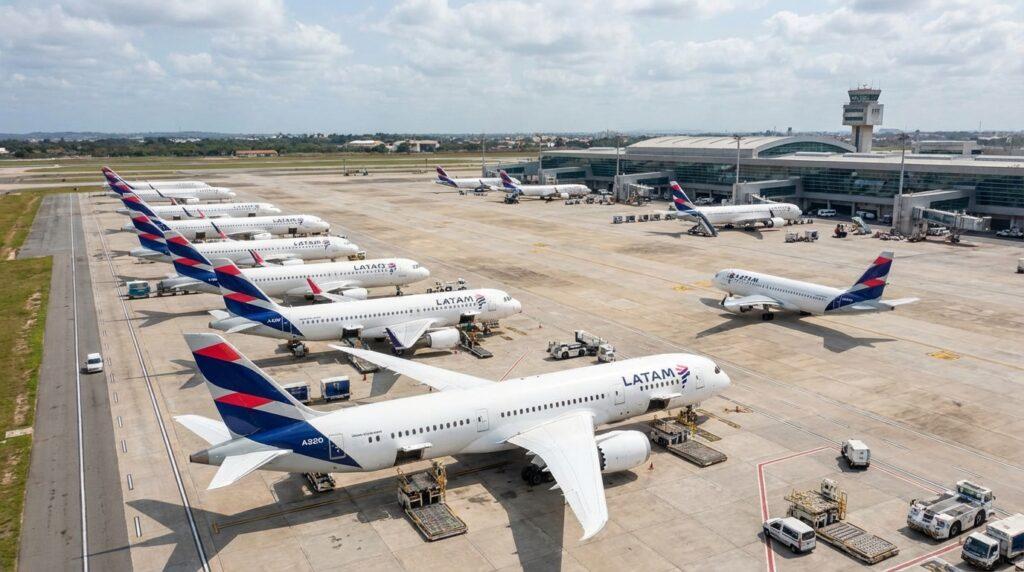
LATAM Airlines is stepping up fleet modernization. The Latin American group, already ranked among the world's 12 largest airlines by fleet size, plans to increase its fleet from 371 to around 410 aircraft by the end of 2026. This expansion includes the arrival of more than 40 latest-generation aircraft, including the first Embraers for the Brazilian domestic market.
By the end of 2025, LATAM Airlines Group was operating 371 aircraft, having integrated 26 recent models, including new Boeing 787-9s powered by GEnx engines. This fleet size positions the Group among the world's largest, alongside the major North American, Chinese and European players. This growth in capacity has been accompanied by a significant increase in traffic and revenues, with LATAM capitalizing on the recovery in demand in South America and the opening of new long-haul routes, notably to Amsterdam, Brussels and Cape Town.
Rapid expansion and the arrival of Embraer
Expansion continues apace. LATAM anticipates taking delivery of a further 41 aircraft in 2026, bringing its fleet to around 410 by the end of the year. These deliveries will include a mix of Boeing 787 Dreamliners, Airbus A320/A321neo and, for the first time in the group's history, Embraer E195-E2s. The latter are intended to strengthen the domestic network in Brazil.
The agreement with Embraer provides for up to 74 E195-E2s, including 24 firm orders. First deliveries to LATAM Airlines Brazil are scheduled for the second half of 2026. These aircraft, renowned for their fuel efficiency (up to 25% less fuel consumption per seat than the previous generation), will enable the airline to increase frequencies on less dense domestic routes, while avoiding overcapacity.
«This growth responds not only to an increased need for connectivity, both within the region and with other international markets, but also to our belief that the future of aviation must be more efficient and sustainable,» emphasizes Sebastiá**n Acuto**, Director of Fleet and Projects at LATAM Airlines Group. «Every new aircraft we integrate will be equipped with the latest generation technologies, enabling us to reduce our emissions and make concrete progress towards our roadmap of carbon neutrality by 2050.».
First Airbus A321XLR in 2027
By 2027, LATAM plans to integrate a further 27 aircraft, including its first Airbus A321XLR. This ultra-long-range version of the Airbus single-aisle jet has been ordered for at least 13 aircraft. The A321XLR will enable the airline to deploy a long-haul single-aisle business model, with a claimed range of around 4,700 nautical miles (almost 8,700 kilometers).
These aircraft will pave the way for new point-to-point connections between South America and secondary cities in North America and Europe, from bases such as Lima, Brasilia and the Brazilian Nordeste. They will complement the long-haul fleet of Boeing 767s and 787s. For LATAM, the A321XLR offers a combination of economic efficiency and operational flexibility, particularly suited to markets where a wide-body aircraft would be oversized, but where the range of a conventional single-aisle aircraft remains insufficient.
An assertive shift to new-generation aircraft
By 2030, LATAM plans to integrate more than 130 new aircraft from various manufacturers. This should bring the proportion of «latest generation» aircraft to over 50% of its fleet, or at least 200 aircraft. These new single-aisle and long-haul aircraft reduce CO2 emissions by between 20% and 25% compared with previous generations, thanks to more efficient engines, lighter airframes and optimized cabins.
In parallel with this fleet strategy, LATAM focuses on improving the travel experience at every stage of the customer journey. This commitment has been recognized by Skytrax, which has upgraded the company's classification in its latest rankings. The rating agency took into account the progress made in digital interactions, check-in procedures, passenger assistance and the lounge experience, as well as the increased consistency of service standards, whatever the route.
Recent fleet developments, including the arrival of new Boeing 787s and the future integration of Embraer E195-E2s and Airbus A321XLRs, testify to LATAM Airlines Group's determination to strengthen its position in the global market while focusing on operational efficiency and sustainability.
Be the first to comment on this article