Global Airlines Bankruptcy: Why Its Transatlantic A380 Never Took Off
Global Airlines, which promised to revive the Airbus A380 on transatlantic routes, ended in spectacular failure. The UK High Court ordered the airline’s liquidation on November 4, 2026, bringing an abrupt end to an ambitious but ill-prepared commercial venture. With just four commercial flights in May 2025—between Glasgow, Manchester, and New York—the company never gained traction, despite its rhetoric about returning to the golden age of air travel.
The balance sheet is damning: a single aircraft operated, an A380 grounded in Tarbes since July 2025, and a court ruling sealing the fate of a project that never progressed beyond sporadic operations. The UK High Court ordered liquidation following a creditor petition, leaving behind an unspecified debt and aggrieved investors. The reasons for the failure? A toxic mix of mismanagement, over-reliance on a third-party operator, and a glaring lack of operational preparation.
Global Airlines had touted a premium experience and meticulous onboard service, but these promises could not offset structural flaws. Founder James Asquith was still touting revival plans as late as June 2026, including adding a second aircraft or launching flights to the Maldives. None of these projects materialized. Worse, the company’s sole A380, registered 9H-GLOBL, never received the necessary maintenance to resume service due to a lack of funds. Its future—and that of creditors seeking to recover investments—remains uncertain.
A Flawed Business Model from the Start
From the outset, Global Airlines operated on shaky ground. The UK-based carrier lacked its own air operator’s certificate and relied entirely on Hi Fly Malta under a wet-lease agreement to operate transatlantic flights. This dependency exposed a critical weakness: without operational autonomy, Global Airlines had no control over its production tool. The four commercial flights in May 2025 were operated under its brand, but without any real infrastructure behind them. Once the Hi Fly agreement ended, the airline was left with no means to continue operations.
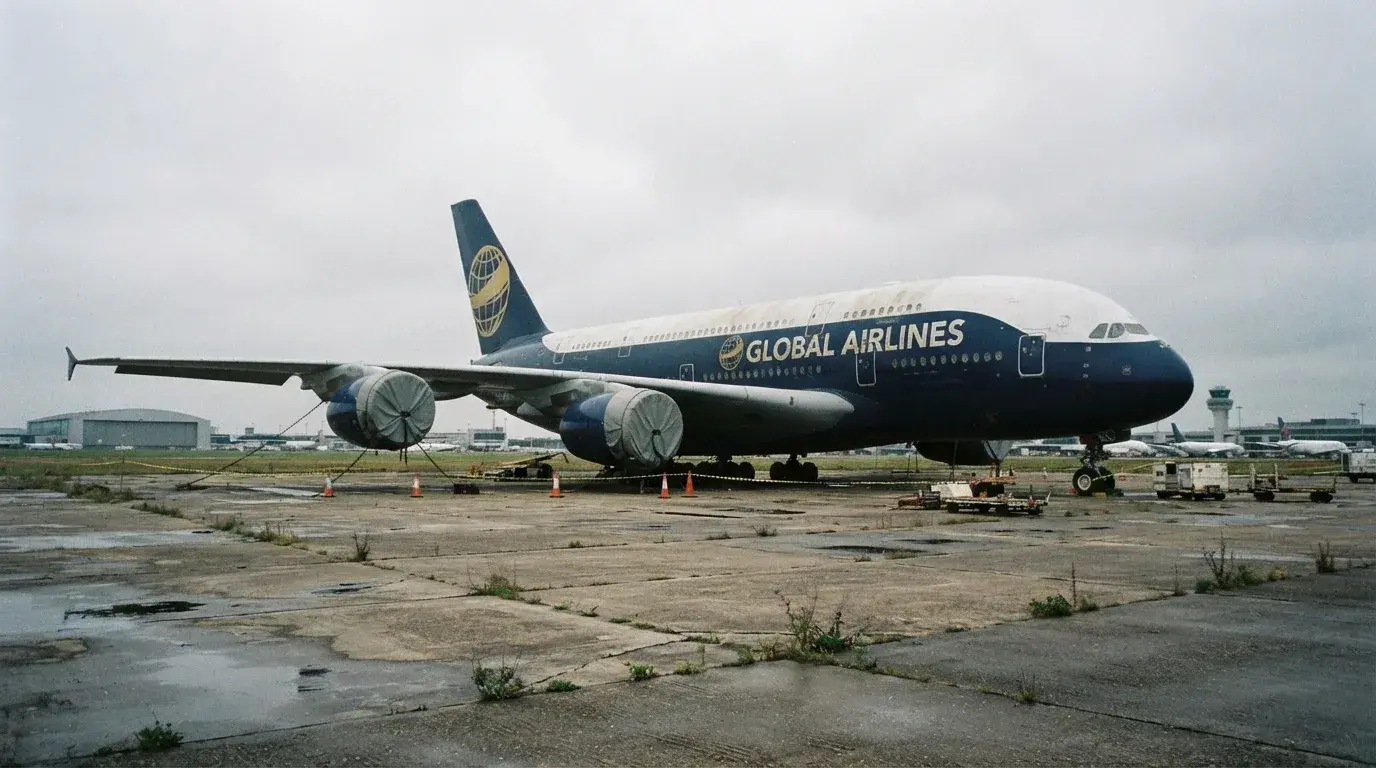
Global Airlines’ ambitions rested on a single aircraft, a second-hand Airbus A380 previously operated by China Southern Airlines. After brief transatlantic rotations, the plane was ferried to Tarbes, where it has been parked for over a year. Maintenance work estimated at several million dollars was never funded. Asquith blamed logistical constraints, but the reality was simpler: the company lacked the financial resources to cover these costs. Without an operational aircraft or management autonomy, Global Airlines stood no chance of survival.
Commercial Promises Far Removed from Reality
Global Airlines positioned itself as a premium alternative to traditional long-haul carriers, touting a return to the golden age of air travel with promises of unparalleled comfort and service. Yet the reality fell short. The airline never established a regular flight program, operating just four round-trips between the UK and New York. These sporadic flights, though widely publicized, represented a negligible share of the transatlantic market with no real competitive impact.
The onboard service, often cited as a selling point, was never scaled up. With an average of just one commercial flight per week, Global Airlines had no opportunity to refine its offering or build a loyal customer base. Passengers who flew on these routes reported a decent experience but nothing that justified a departure from industry standards. Worse, the lack of a regular network made coherent commercial strategy impossible. Without recurring customers, the airline could never hope to turn a profit.
The liquidation marks a logical conclusion for a project that never got off the ground. Between reckless management, technical shortfalls, and cutthroat competition, Global Airlines failed to equip itself with the tools needed to succeed in an already saturated market. Its collapse underscores an unyielding truth in aviation: ambition alone is not enough without solid financial and operational foundations.
The A380 Stranded in Tarbes: A Symbol of Broken Dreams
The Airbus A380 operated by Global Airlines has been parked at Tarbes-Lourdes-Pyrénées for over a year, a stark symbol of a failed venture. Grounded due to lack of funds, the aircraft never received the maintenance required to resume service. Its future—and that of the liquidator tasked with liquidating the company’s assets—remains uncertain. While no decision has been made regarding a potential sale, the chances of the jet flying again are slim.
For the 50 passengers who boarded Global Airlines, the experience was fleeting. For investors and creditors, it was painful. The airline’s liquidation closes a brief but disastrous chapter, reminding industry players that aviation—even on paper—demands rigorous preparation and adequate financing. Without these, failure is inevitable.
Global Airlines’ story is one of a project that tried to play in the big leagues without the necessary assets. Its stranded A380 in Tarbes is the last remnant of an adventure that lasted barely a handful of commercial flights. A lesson for future aviation entrepreneurs: in this industry, dreams must be backed by realistic budgets and flawless execution.
The UK High Court ordered Global Airlines’ liquidation on November 4, 2026, ending a transatlantic A380 project that never managed to take off. With just four commercial flights in May 2025 and a single aircraft grounded in Tarbes, the airline could not survive its own shortcomings. Global Airlines’ website remains accessible, but no flights are scheduled.
A Transatlantic Market Already Overcrowded
The transatlantic market is one of the most competitive in the world, dominated by established players like United Airlines, American Airlines, and Air Canada. These carriers boast dense networks, modern fleets, and proven commercial strategies. Global Airlines, with its minimalist and sporadic offering, never stood a chance. Its sole selling point—the A380—was not enough to attract sufficient passengers to make the operation viable.
Passengers seeking a premium experience on the London-New York route already had reliable, well-serviced alternatives. Global Airlines failed to differentiate itself beyond its operational unreliability. Its collapse yet again proves that in aviation, consistency and reliability outweigh marketing promises.
For travelers, this liquidation highlights the importance of choosing an airline wisely. Ambitious projects often grab headlines, but stability and credibility are what guarantee a smooth journey. Global Airlines was ultimately just a flash in the pan in an already crowded sky.
Be the first to comment on this article
On the same topic
- British Airways Unveils Major Winter Expansion: 11 New Long-Haul Routes, A380 Return and Melbourne Rebound
- British Airways Elevates Its Lounges at Heathrow: 17-Meter Bar and Concorde Suites for Royal Travel
- British Airways Revives East Africa Routes: Kilimanjaro and Zanzibar from London
- Qatar Airways Expands Network: Zanzibar and Canberra Return, London and Phuket Soar
- British Airways and Porter Airlines: The Winning Duo for Exploring Canada Nonstop
- The Grand Return of First Class in the Skies