CDG Express enters final stretch before opening, but price pressure remains
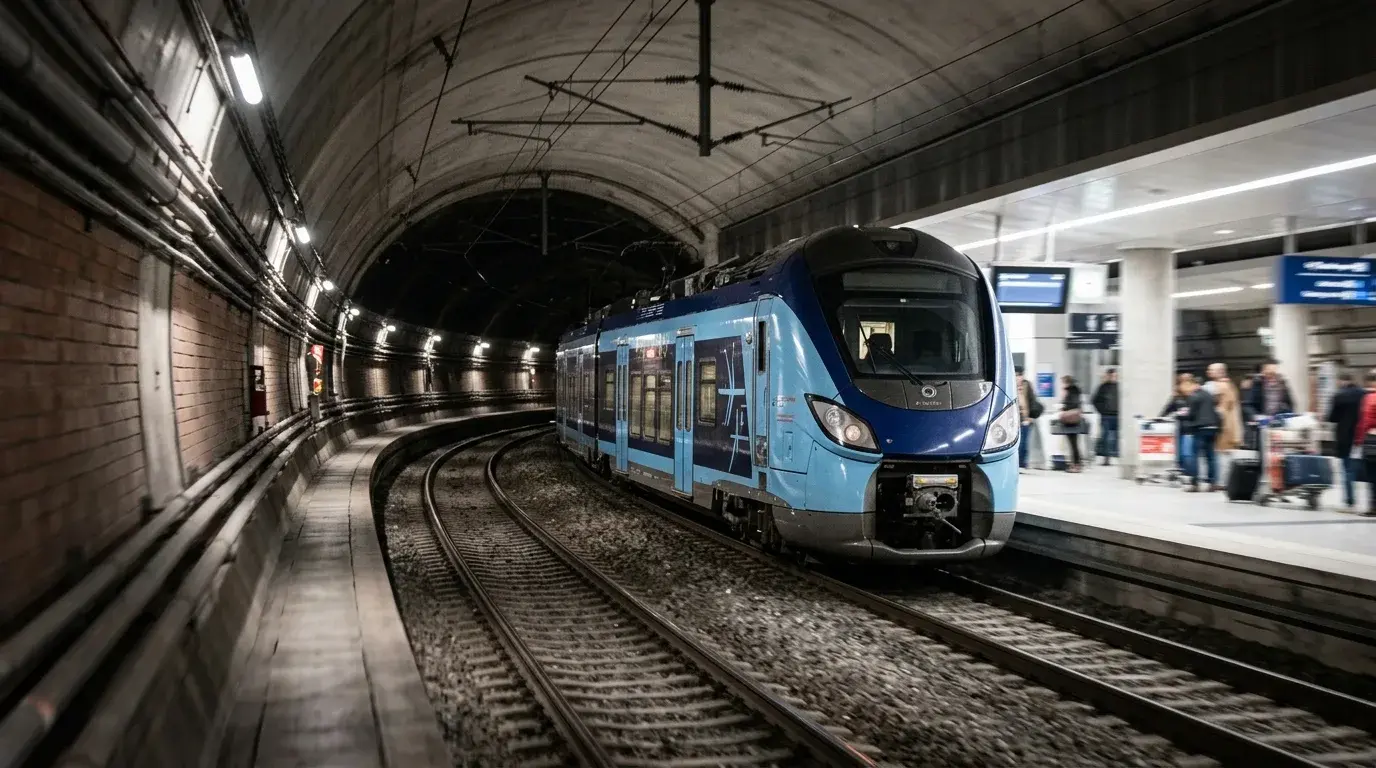
The CDG Express project is nearing completion between Paris-Gare de l’Est and Paris-Charles de Gaulle Airport. After seven years of construction, the direct rail link between the capital and Roissy enters its final phase, with commercial service scheduled for March 28, 2027. On paper, the project fulfills a long-awaited need for business travelers and connecting passengers. In practice, the fare remains the most contentious issue.
The timeline is now tight. The final major connection was completed this Pentecost weekend, spanning 4.5 kilometers of new tracks between Gare de l’Est and La Plaine–Stade de France. SNCF Réseau describes this as a milestone for the infrastructure, ahead of several months of technical testing and operational adjustments. The project now enters a less visible but critical phase for the future service’s reliability.
The CDG Express is set to offer a train every 15 minutes, from 5 AM to midnight, with an advertised travel time of 20 minutes between central Paris and the airport. It is this promise of regularity—more than pure speed—that forms the project’s central argument. In a sector where transfers to Roissy are often disrupted by RER B delays, road traffic, and tight connections, the direct link targets passengers willing to pay for reduced uncertainty.
The project is complete, but the service isn’t ready to roll
According to SNCF Réseau, the installation of the final track segment marks the completion of the heaviest part of the construction. Nearly 300 operators participated in this final phase, supported by teams from Eiffage and Alstom. For project promoters, this milestone confirms that the physical line now exists and can enter the operational validation phase.
The next steps will focus on testing, signalization system coordination, train circulation, and integration into the existing network. As is often the case with such infrastructure, the commercial timeline will depend less on earthworks than on the operators’ ability to secure regular service. The CDG Express will need to coexist with other rail traffic already using the Paris-Nord corridor, requiring thorough technical preparation.
The project is backed by Aéroports de Paris, SNCF Réseau, and the Banque des Territoires. The total investment reaches €2.6 billion, partly financed by a €2.2 billion state-guaranteed loan. This figure explains the tension surrounding the economic model: the line must balance speed, frequency, comfort, and sufficient revenue to amortize the investment.
A €25 ticket fuels criticism
The most sensitive issue remains the price. The single ticket was initially announced at €24, but L’Informé reported that operator Hello Paris now plans to charge €25 at launch. While the difference may seem minor, it reinforces the perception of a service designed primarily for passengers willing to pay more than existing transport options.
The CDG Express will not be integrated into the Navigo pass. This choice excludes combined pricing with Île-de-France subscriptions and further distances the link from everyday transport. For project supporters, this positioning is consistent: the line targets passengers seeking a direct, predictable, and straightforward journey within a short timeframe. For critics, the price confirms it is a premium offering, partly financed by an exceptional rather than widespread usage logic.
Comparisons with RER B, whose fare to Charles de Gaulle remains significantly lower despite its disruptions, will be inevitable. The CDG Express targets a different customer segment—those for whom journey simplicity outweighs price differences. Still, in a context of strained purchasing power, a €25 ticket for a 20-minute ride will naturally fuel public debate.
A response to global capital standards
For its promoters, the CDG Express aims to place Paris among the world’s capitals with a fast, direct rail link to their main airport. The argument is standard but grounded in reality: major international cities often feature dedicated airport rail connections. London, Madrid, Amsterdam, and Frankfurt have already established such services in their transport landscapes.
In Paris, the challenge is more complex due to network density, operational constraints, and the role of RER B. The CDG Express will not replace this line but will complement it. This is precisely what fuels controversy: some elected officials and user associations argue that part of the funding could have been allocated to improving the existing network instead of creating a service primarily aimed at air passengers.
SNCF Réseau counters that approximately €500 million of the investment has also benefited RER B and other suburban lines. The argument aims to show that the funding was not solely for an air passenger shuttle. Yet, the project’s image remains tied to a separate, more expensive, and less inclusive service in its pricing logic.
An operation designed for air traffic flows
The announced operation of the CDG Express addresses a concrete need: absorbing regular flows between Paris and Roissy without relying on shared traffic with regional transport. With departures every 15 minutes and a wide operating window, the line targets early morning departures, international arrivals, and tight connections. This frequency should also reduce dependence on taxis and ride-hailing services, often costlier and prone to congestion on the A1 highway.
For business travelers, the time saved is primarily about predictability. For tourists, the promise is direct access to Paris without transfers or confusion over which train to take. This is where the project seeks profitability: capturing a clientele that prioritizes reliability, even at a higher cost than standard public transport.
The comparison with taxis or ride-hailing remains central to the promoters’ argument. A private ride between Paris and Roissy can easily cost €55 to €70 depending on the time and traffic conditions. From this perspective, the CDG Express positions itself as an intermediate solution—more expensive than a suburban train but more predictable than a car ride. This narrative will be decisive at launch, as it must convince passengers that the service meets a real need.
The countdown has begun. After construction, testing, and fare decisions, the CDG Express must prove it is more than just a completed infrastructure project. Its success will hinge on smooth operations, price acceptance, and its ability to become a habit for travelers heading to Charles de Gaulle.
Be the first to comment on this article