Why Japan Is Betting on Recycled Cooking Oil for Its Aircraft—and How It’s Reshaping Global Aviation
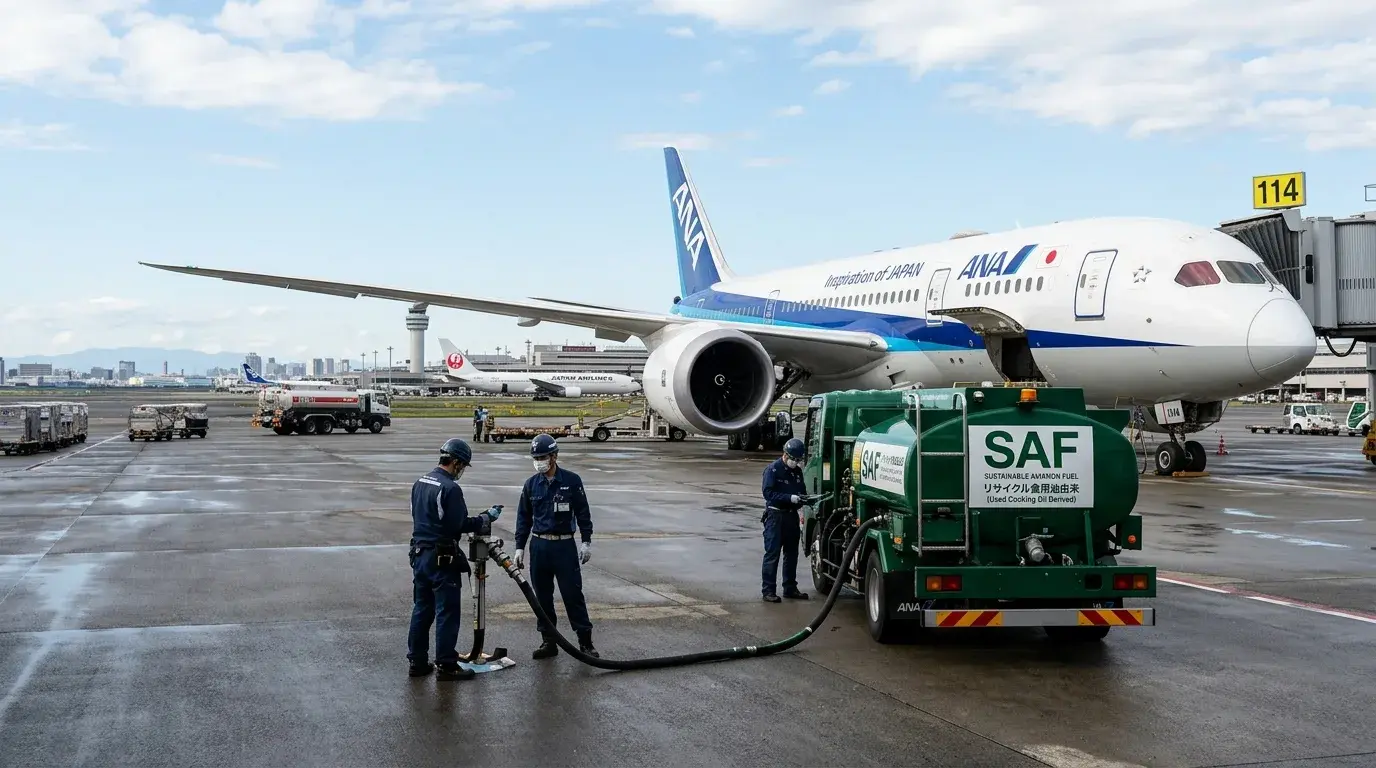
Japan is pioneering a bold initiative to green its aviation sector by collecting used cooking oil nationwide and converting it into Sustainable Aviation Fuel (SAF). The move, which could set a global precedent, arrives as the aeronautics industry scrambles for carbon-neutral solutions without crippling cost increases. Yet behind the promise lie monumental hurdles: logistics, yield efficiency, and reliance on imports.
In central Tokyo, major retailers like Aeon, Ito‑Yokado, and 7‑Eleven have become official collection points where households deposit used cooking oil for eventual conversion into sustainable fuel. The program, dubbed “Fry to Fly,” sets an ambitious target: sourcing 10% of Japan’s SAF needs by 2030. This is no small feat in a resource-scarce nation where energy dependence remains a geopolitical flashpoint. Still, despite media buzz, the reality is sobering: in 2024, only 160 kiloliters were collected—enough to power a Boeing 787 Dreamliner for just 17 hours of flight.
Tokyo is doubling down. The government projects demand at 1.7 million kiloliters of SAF annually by 2030, a volume that could be partially met by domestic used cooking oil. Experts caution, however, that even if Japan recovered 100% of its used cooking oil, it would still cover only 25% of its SAF needs. The remaining 75% would require imports or alternative technologies like bioethanol. To accelerate collection, authorities have distributed 13,000 plastic funnels with QR codes to streamline sorting and tracking. Local firms such as Fujifilm are also pitching in by recycling oil from employee cafeterias. This nationwide mobilization underscores the urgency of finding alternatives to traditional kerosene—or risk soaring ticket prices.
Japan’s flagship carriers, ANA and JAL, have sounded the alarm. “We face a reality far tougher than anticipated,” the airlines warned in a joint May 2026 presentation. Both carriers acknowledge aviation as one of the highest greenhouse-gas emitters and warn that missing the 2030 SAF targets would trigger massive cost overruns for refiners and airlines alike. Already, Middle East tensions and the war in Iran have destabilized kerosene supply chains, pushing carriers to seek urgent solutions. SAF, derived from used oils or biomass, is touted as the silver bullet—but domestic output currently stands at just 30,000 kiloliters per year, less than 0.3% of the country’s total kerosene consumption.
Japan is not alone in this race. At the IATA Annual General Meeting in Rio de Janeiro in early June 2026, the organization reiterated that SAF is the linchpin of aviation’s climate strategy. “We must act now, or costs will explode,” warned Willie Walsh, IATA’s Director General. The risk? A “cost wall” that would ripple into ticket prices already under pressure from rising energy costs and environmental levies. In Europe, several carriers have already announced capacity cuts or route suspensions for summer 2026 due to unprofitability.
Tokyo is pressing ahead. The government has commissioned its first commercial SAF production unit using used cooking oil, with an annual capacity of 30,000 kiloliters. The project, led by JGC, Cosmo Energy, and REVO International, could serve as a template for other nations. Yet the road is long: Eneos, Japan’s refining leader, notes that the final investment decision to reach 400,000 kiloliters of SAF by 2028 hinges on collection volumes. “2026 will be a pivotal year,” says Motoomi Suzuki, Senior Economist at the Norinchukin Research Institute. “If we don’t start now, we simply won’t make it by 2030.”
This strategy aligns with broader trends. The European Union adopted a 2023 directive mandating 2% SAF in 2025, 5% in 2030, and 63% in 2050. In the United States, the Inflation Reduction Act offers massive subsidies for sustainable fuel production. But Japan’s “Fry to Fly” program leverages a locally abundant, low-cost resource—a pragmatic approach that could inspire peers across Asia, where geopolitical tensions and energy costs make SAF adoption even more urgent.
The SAF Imperative: A Promising but Fragile Solution
Sustainable Aviation Fuel (SAF) is hailed as the aviation industry’s best shot at decarbonization. Produced from used oils, biomass, or agricultural waste, it slashes CO₂ emissions by an average of 80% versus conventional kerosene. Yet production remains marginal: in 2025, SAF accounted for just 0.5% of global aviation fuel consumption. IATA forecasts that output must increase 100-fold by 2050 to meet climate targets.
The catch? SAF costs three to five times more than traditional jet fuel. This price gap directly inflates ticket prices. In Europe, carriers have already announced surcharges, while U.S. federal subsidies aim to soften the blow. For now, SAF remains a luxury few airlines can afford without public support. Japan’s “Fry to Fly” initiative seeks to mitigate this by tapping into a local, low-cost feedstock—but even then, logistical and industrial challenges loom large. Years of infrastructure build-out and workforce training will be required to scale the sector.
Airlines are torn. They recognize SAF as the only viable medium-term path to decarbonization, yet fear the transition could erode profitability already strained by soaring fuel costs and environmental levies. IATA has cautioned that without sufficient SAF supply, carriers may be forced to cut capacity or raise fares, risking a post-pandemic demand slowdown.
Beyond Used Cooking Oil: Alternative SAF Pathways
While used cooking oil grabs headlines, it’s not the only feedstock. Japan is also exploring bioethanol and synthetic fuels (e-fuels), though these technologies remain in testing phases with industrialization years away. For now, recycled cooking oil is the only near-term option. Other nations like France and Germany are partnering with refiners to import SAF from agricultural or forestry waste, but such imports raise sovereignty and price volatility concerns.
Brazil, for instance, already produces SAF from sugarcane—a resource abundant in the country. Europe, however, will rely heavily on imports, likely from North America or Asia where production costs are lower. This could spark trade and geopolitical friction, especially as SAF-producing nations (U.S., Brazil, Indonesia) seek to protect domestic industries.
Could Japan’s Model Become Aviation’s Global Blueprint?
Japan’s strategy hinges on a pragmatic, localized approach: transforming a waste stream into a strategic resource while reducing energy dependence. The model could inspire other nations, particularly in Asia, where limited natural resources and geopolitical risks make energy security paramount.
Success hinges on three pillars: household participation—without massive collection, the project remains marginal; infrastructure development—refineries capable of large-scale conversion; and public-private coordination. Tokyo has already invested millions in industrial partnerships, but speed is critical to meet the 2030 goals.
If Japan delivers, it could become a global case study proving that ecological transition and local innovation can go hand in hand. If it stumbles, the industry will need a Plan B—and fast. Aviation has no choice: slash emissions dramatically or face unsustainable costs and plummeting demand.
In the meantime, ANA and JAL are investing in more efficient fleets and carbon-offset programs. Yet without a massive SAF rollout, these efforts will remain marginal. Japan has issued a challenge to the world: what if the answer to saving aviation… came from our trash cans?
Be the first to comment on this article