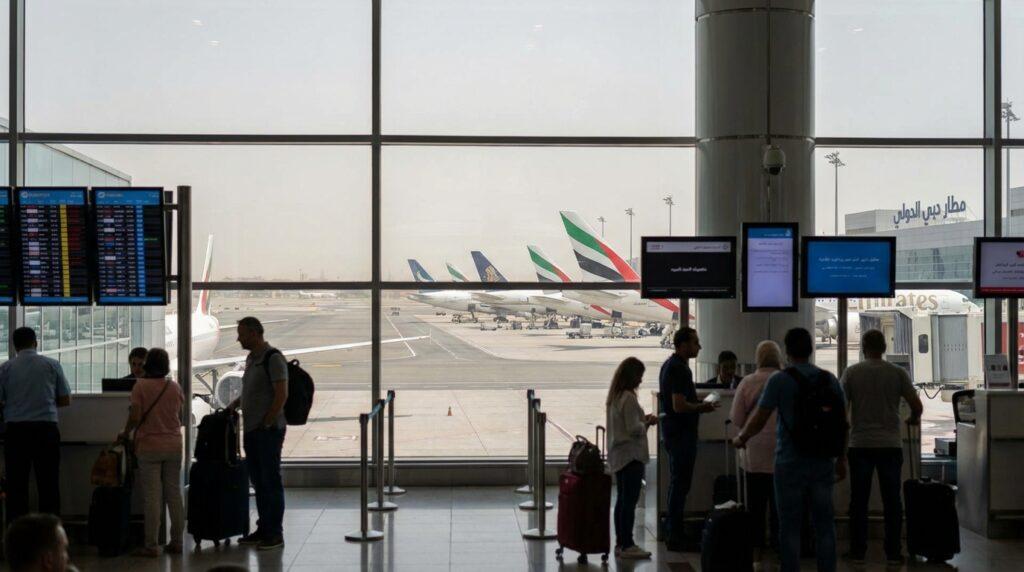
The war in the Middle East continues to weigh heavily on the airline industry, with many airlines suspending and canceling flights. As the geopolitical situation remains tense, airlines are adjusting their networks and operations to cope with uncertainties and security risks.
Air France: extended suspension and compensatory strategies
Air France, dependent on French government decisions concerning the resumption of flights in the region, has reiterated the suspension of its air links. Flights to Dubai and Riyadh have been extended until March 20, 2026 inclusive. For more sensitive destinations such as Tel Aviv and Beirut, the suspension is scheduled to run until March 21, 2026. Faced with this situation, Air France cabin crew unions have expressed fears about the safety of repatriation flights, fearing exposure to conflict zones. The company is attempting to partially compensate for the loss of these flights by increasing its frequencies to Thailand. Additional flights were introduced on March 16 and 17, with a limited seat quota and a fixed fare of 1,390 euros, notably for repatriation operations.
British Airways: massive cancellations and strategic reorientation
Against a backdrop of marked security instability, British Airways has taken the radical decision to cancel all its flights to and from Abu Dhabi until the end of 2026. Routes to Amman, Bahrain, Dubai and Tel Aviv are suspended until May 31 inclusive. This drastic measure reflects the perceived high risk in the region. Meanwhile, British Airways is strengthening its long-haul network for winter 2026, marking a return to Melbourne via Kuala Lumpur, and adding Colombo to its schedule. This strategy seems to be aimed at a reorientation towards destinations less exposed to current tensions, notably in Asia and the Caribbean.
Lufthansa: cautious measures and capacity justification
Lufthansa is taking a more measured approach. The airline has suspended its flights to Dubai, Abu Dhabi, Amman and Erbil until March 28, 2026. Lufthansa justified this extension, initially scheduled to run until March 15, on the grounds of capacity constraints at Dubai airport, which considerably reduce the number of aircraft movements. For Beirut and Tel Aviv, the suspension is longer, extending to March 28 and April 2 respectively. These adjustments reflect prudent risk management while taking into account local operational constraints.
Impact on passenger flows and recovery strategies
The multiplication of these suspensions and cancellations has a direct impact on international passenger flows, forcing travelers to seek alternatives and airlines to rethink their networks. The situation in the Middle East is acting as a catalyst for a redefinition of air routes, potentially encouraging alternative destinations and diversification strategies. Airlines such as Air France, which are increasing their capacity to destinations like Thailand, or those such as British Airways, which are strengthening their routes to Asia and the Caribbean, are anticipating a shift in demand.
All these measures underline the complexity of managing flight operations in an unstable geopolitical context. Airlines must constantly juggle the need to maintain transport services and safety imperatives, while adapting to government decisions and rapid changes in the regional situation. The full resumption of flights in this sensitive area will depend on the evolution of tensions and the restoration of a climate of security conducive to international air transport.
Be the first to comment on this article
On the same topicair france
- Air France threatens to cut Asian network due to sustainable fuel costs
- Air France strengthens its Paris-New York airlift with 11 daily flights
- Air France steps up prevention of sexist and sexual violence in the wake of the MeToo revelations
- The challenges of air punctuality: analysis of delays and cancellations in 2025
- Air France relaunch Paris-Saint-Domingue: what French and international travellers need to know
- Air France revolutionizes the skies with the introduction of ultra-fast WiFi on board its aircraft thanks to Starlink