Why the French government wants to tax kerosene to fund sustainable aviation fuels
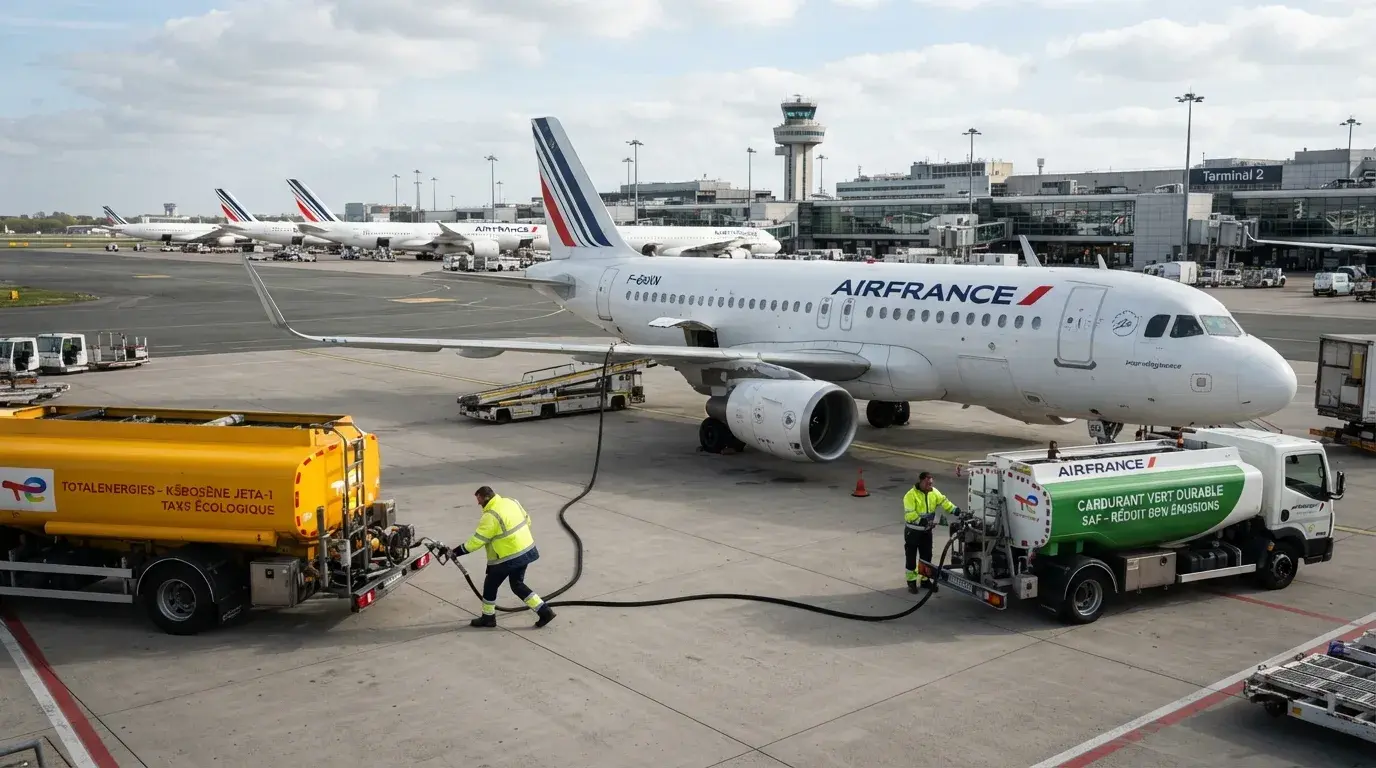
The 2027 French budget bill marks a turning point in the country’s strategy to decarbonize air transport. While airlines and passengers fear another cost increase, the government is proposing an unprecedented contribution: a tax on fossil kerosene suppliers to fund the development of sustainable aviation fuels, better known by the acronym e-SAF.
This measure, included in Article 24 of the budget bill, aims to accelerate the ecological transition of the aviation sector by supporting the industrial production of synthetic fuels. Unlike a direct tax on tickets or airlines, it targets the volumes of fossil fuel delivered to the French market. The goal? To gradually reduce dependence on traditional kerosene while meeting European obligations to cut CO₂ emissions in aviation.
A targeted contribution on suppliers, not passengers
The draft law specifies that this contribution for the development of synthetic aviation fuels will be paid by aviation fuel suppliers in metropolitan France. It will be calculated based on the volumes of fossil kerosene consumed, following an industrial solidarity principle. The more kerosene a supplier delivers, the higher its contribution will be, encouraging investment in sustainable alternatives.
This approach echoes the double auction mechanism, a system already tested by Germany and Luxembourg. In practice, a public intermediary will purchase e-SAF volumes from producers through long-term contracts, then resell them to aviation fuel suppliers via short-term auctions. The state hopes to reduce financial risk for industrial players while ensuring price visibility for airlines.
e-SAF still scarce, but growing EU obligations
e-SAF is produced from green hydrogen and captured atmospheric CO₂. Unlike biofuels, it is neither derived from biomass nor oil. However, production remains in its infancy at an industrial scale, with only a few pilot projects underway in the European Union.
The government is banking on this scheme to bridge the gap between supply and demand. According to estimates from the French Civil Aviation Authority (DGAC), funding needs could reach €500 million over eleven years. The General Inspectorate of Finance, more pessimistic, cites a range from €100 million to €7 billion over ten years, depending on the evolution of electricity, green hydrogen, and carbon prices.
A response to the EU’s ReFuelEU Aviation obligation
This initiative aligns with the European regulation ReFuelEU Aviation, which came into force in 2025. This text requires aviation fuel suppliers to ensure a minimum share of 2% sustainable fuels in EU airports by 2025, with progressive targets to reach 70% by 2050. By 2030, synthetic fuels must account for 1.2% of the mix.
France, which is part of the European coalition of e-SAF pioneer countries, is now the fourth member state to consider a double auction mechanism, alongside Germany, Luxembourg, and Austria. This harmonization aims to avoid market distortions between member states and accelerate the scaling up of the industrial sector.
Long-term impact on ticket prices?
Unlike a direct tax on kerosene, this contribution should not lead to an immediate and visible increase in ticket prices. However, its cost could be indirectly passed on through the supply chain. Fuel suppliers might, for example, adjust their tariffs based on their exposure to the new contribution.
The government has pledged to design the scheme with airlines, energy companies, and industrial players, ensuring it « preserves the competitiveness of air transport in France ». A promise that will need to be kept in a context of heightened competition with neighboring European hubs, where e-SAF production costs could be lower.
An industrial and ecological gamble
The stakes are high: successfully developing a French e-SAF sector capable of competing with foreign producers. Several industrial projects are already underway, particularly in Occitanie and Nouvelle-Aquitaine, where pilot plants are planned for 2028–2030. The state is banking on this sector to create local jobs and reduce dependence on fossil fuel imports.
For travelers, this transition could translate into a wider range of « green » flights in the medium term. Several airlines, including Air France and KLM, have already begun testing e-SAF blends in their tanks, though volumes remain marginal for now.
In the meantime, the government will need to strike a balance between supporting industrial players, protecting passengers, and maintaining the competitiveness of French airports. A daunting task in a sector already strained by rising costs and geopolitical uncertainties.
A divisive mechanism
While the NGO Transport & Environment France welcomes this measure, the issue of cost repercussions on passengers remains sensitive. Diane Strauss, the NGO’s director, believes the scheme « will reassure private investors and guarantee the launch of the first two production plants ». She also highlights the principle of financing demanded from kerosene suppliers like TotalEnergies, « holding them accountable ».
However, some industry players are already worried about a knock-on effect on prices. With rising kerosene costs and the introduction of this new contribution, airlines may be forced to reduce their margins or pass on some of these costs to ticket prices.
The parliamentary debate, expected to be contentious, will have to weigh the urgency of rapidly decarbonizing the aviation sector against protecting travelers’ purchasing power. One thing is certain: this reform could reshape France’s air transport landscape in the years to come.
Be the first to comment on this article