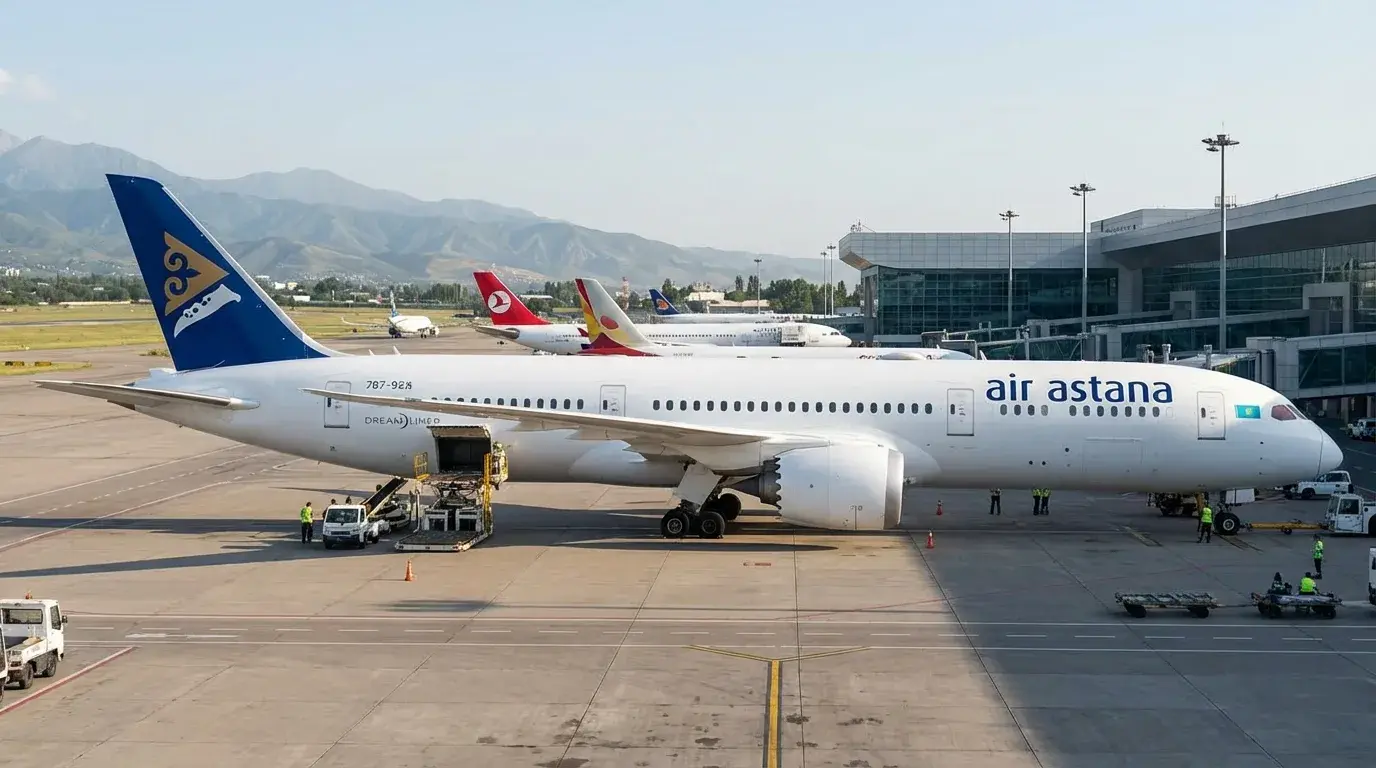
Kazakhstan's airline, Air Astana, has taken a major step forward in its fleet modernization strategy by finalizing an order for up to 15 Boeing 787-9 Dreamliners. This agreement, described as the largest aircraft purchase in the company's history, marks a firm commitment to the expansion and renewal of its long-haul capabilities.
Strategic development for long-haul
The announcement, made from Seattle on February 17, 2026, formalizes a commitment made public in November 2025. The firm order for 15 Boeing 787-9s, with options for additional aircraft, is part of an ambitious growth strategy. By 2026-2027, Air Astana plans to have a potential fleet of 18 Dreamliners, including three aircraft acquired via leasing agreements. This will enable the company to gradually replace the Boeing 767-300ERs still in service, and open up new routes to Asia, Europe and, eventually, North America.
«Air Astana is strategically committed to strengthening its service capabilities from Central Asia and the Caucasus to Asia, Europe and the rest of the world over the next decade, with the arrival of the first Boeing 787-9 Dreamliner next year marking the start of this development phase,» said Air Astana CEO Peter Foster in November 2025. «With its passenger-friendly cabin, fuel efficiency and range flexibility, the fleet of up to 18 Boeing 787-9s is destined to be a success for the airline and its customers.»
A twin-engine fleet built around Boeing and Airbus engines
This strategy of moving upmarket in the long-haul segment is accompanied by a parallel modernization of the medium-haul fleet. Air Astana is now building its growth around a duo of Boeing for long-haul and Airbus for medium-haul. In November 2025, the Group signed a memorandum of understanding with Airbus for up to 50 A320neo Family single-aisle aircraft (25 firm orders and 25 options), mainly A321neo and A321LR. Scheduled for delivery from 2031, these aircraft will increase frequencies to major European and Asian hubs, while reducing the carbon footprint per seat.
Air Astana already operates the A321LR on routes linking Kazakhstan with Asia and Europe, and claims to have helped define the operating standards for this version. The new order for A320neo and A321 aircraft, in addition to a previous order, underlines the airline's ambition to densify its medium-haul network while improving operational efficiency.
Central Asia asserts itself on the world aviation stage
For the global airline industry, Air Astana's fleet plan illustrates the growing ambition of Central Asian carriers to capture a significant share of flows between Europe, Asia and the Middle East. With a potential fleet of 18 Boeing 787-9s and some 50 Airbus A320neo and A321neo aircraft in the pipeline, Air Astana is positioning itself as a key regional player. The Kazakh airline intends to densely network the regional skies with its single-aisle aircraft, while substantially boosting its long-haul capacity, thus affirming Central Asia's place on the global air transport map.
This strategic move by Air Astana confirms the region's growing role in global air traffic, and strengthens the presence of aircraft manufacturers Boeing and Airbus in this fast-growing market.
Be the first to comment on this article
On the same topicair transport
- AirAsia X holds firm on Bahrain hub despite Middle East turmoil
- Alaska Airlines revolutionizes its business class for long-haul flights
- Royal Jordanian strengthens its presence in Germany with the reopening of the Amman-Munich route
- Wizz Air links Paris-Beauvais to Varna, new gateway to the Black Sea
- Israel closes its skies: El Al reduced to 5% of its capacity
- Middle East flights resume: airlines navigate uncertainty