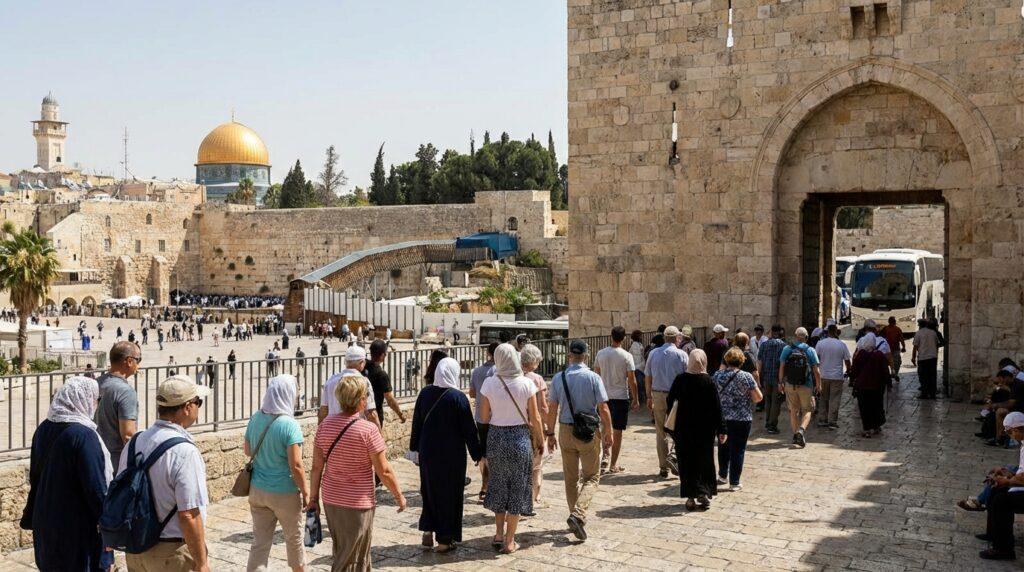
Israel relies more than ever on Christian pilgrimages and religious travel to revitalize its tourism industry, severely affected by nearly two years of conflict in the Gaza Strip. The aim is to re-establish a steady flow of visitors to Jerusalem and the major holy sites.
This strategic direction was announced in early February at the International Mediterranean Tourism Market (IMTM) trade fair in Tel Aviv, presented as the starting point for an overhaul of the sector. The Israeli Ministry of Tourism is specifically targeting Christian pilgrims, evangelical travellers and diaspora Jews to gradually rebuild international arrivals, as traditional leisure tourism remains hampered by security uncertainties.
«Uncertainty and travel warnings have affected tourism activity, but with the improved availability of air links in 2026, there is reason to be optimistic that the seeds of recovery are already here,» said Israel's Minister of Tourism, Haim Katz. «Our aim is not just to return to previous levels, but to improve and break records,» he insisted.
Targeted campaigns and innovative digital tools
To make this strategy a reality, the Ministry of Tourism has allocated over 20 million shekels (approx. $6.5 million) to a vast global digital campaign. The slogan «I Am Israel» was designed to directly reach «religious» audiences, evangelicals and North American Jewish communities. At the same time, the Israel National Tourist Board (ONIT) is carrying out promotional actions in other markets, notably South America and countries with large Catholic populations.
The destination also relies on immersive technologies to facilitate the travel decision. At IMTM 2026, the ministry launched HolyLandTravel.ai, a free trip-planning app designed for religious visitors. It offers personalized itineraries and content guided by artificial intelligence, overlaid on interactive maps. U.S. Ambassador to Israel Mike Huckabee, himself an evangelical pastor, hailed the tool as «one of the most practical» for planning a trip to the Holy Land, pointing to «considerable latent demand» among America's 80 million evangelicals.
Investments in Jerusalem and holy sites
Beyond digital marketing, Israel is strengthening its infrastructure to enhance the pilgrimage experience, particularly in Jerusalem and the north of the country. By the end of 2025, the Ministry of Tourism had approved over 180 million shekels in subsidies for the construction of 2,050 new hotel rooms. A further 174 million shekels are earmarked for local tourism infrastructure projects in 2026. Efforts are focused on places that are emblematic for Christians, such as the Christian quarter of Jerusalem's Old City, the area around the Holy Sepulchre, sites in Galilee (Capernaum, Nazareth) and the Jordan River baptismal site, Yardenit, where improvements are planned to welcome groups.
To enhance Jerusalem's spiritual appeal, the tourism authorities are also banking on the opening of the Pilgrim's Way, a new visitor route through the heart of the City of David. Inaugurated on September 15, 2025, this archaeological trail will allow visitors, for the first time in 2,000 years, to walk up the ancient artery linking the Pool of Siloam to the Temple Mount, following the paving stones of the Second Temple period. The route features relics of markets, coins and trade objects, as well as a network of underground pipes that served as a refuge during the Great Revolt. Designed as an immersive experience, the Pilgrim's Way is destined to become a must-see on both Christian and Jewish tours.
The Israeli government is also preparing a tourism development plan worth some 86 million shekels for the Judea-Samaria region, which is rich in heritage and religious sites but still lacks hotel infrastructure. According to the Ministry of Tourism, these investments are aimed at «bridging the infrastructure gap» in an area that accounts for less than 2% of national hotel capacity.
The growing importance of religious tourism
Before the events of October 2023, Israel was aiming for a record 5.5 million visitors by 2023. The reality was more mixed, with around 3 million visitors in 2023, less than a million in 2024, then 1.3 million in 2025.
Recent data indicate a recomposition of the traveler profile. In 2025, pilgrims accounted for 9% of the 1.3 million visitors, compared with 5% the previous year. The proportion of Jewish tourists fell from 66% to 51%. The Ministry of Tourism speaks of a «turning point» for 2025, the Catholic jubilee year, when pilgrimages to the holy sites served as the driving force behind an initial upturn in international arrivals.
Historically, 50 to 60% of tourists to Israel identify themselves as Christian. In 2018, out of 4 million visitors, 61% were Christians, generating around $5.8 billion in revenue. Nearly 40% of these visitors returned at least once.
Finally, the authorities are banking on the testimonial effect of returning pilgrims. American ambassador Mike Huckabee says he feels «completely safe in Israel», convinced that ’once you've walked this land, you read the Bible differently for the rest of your life«. The question remains whether this confidence will be enough to reassure enough travelers to bring Jerusalem and the Holy Land back to pre-war levels.
Be the first to comment on this article