
External batteries on flights to Japan: what passengers need to know before departure
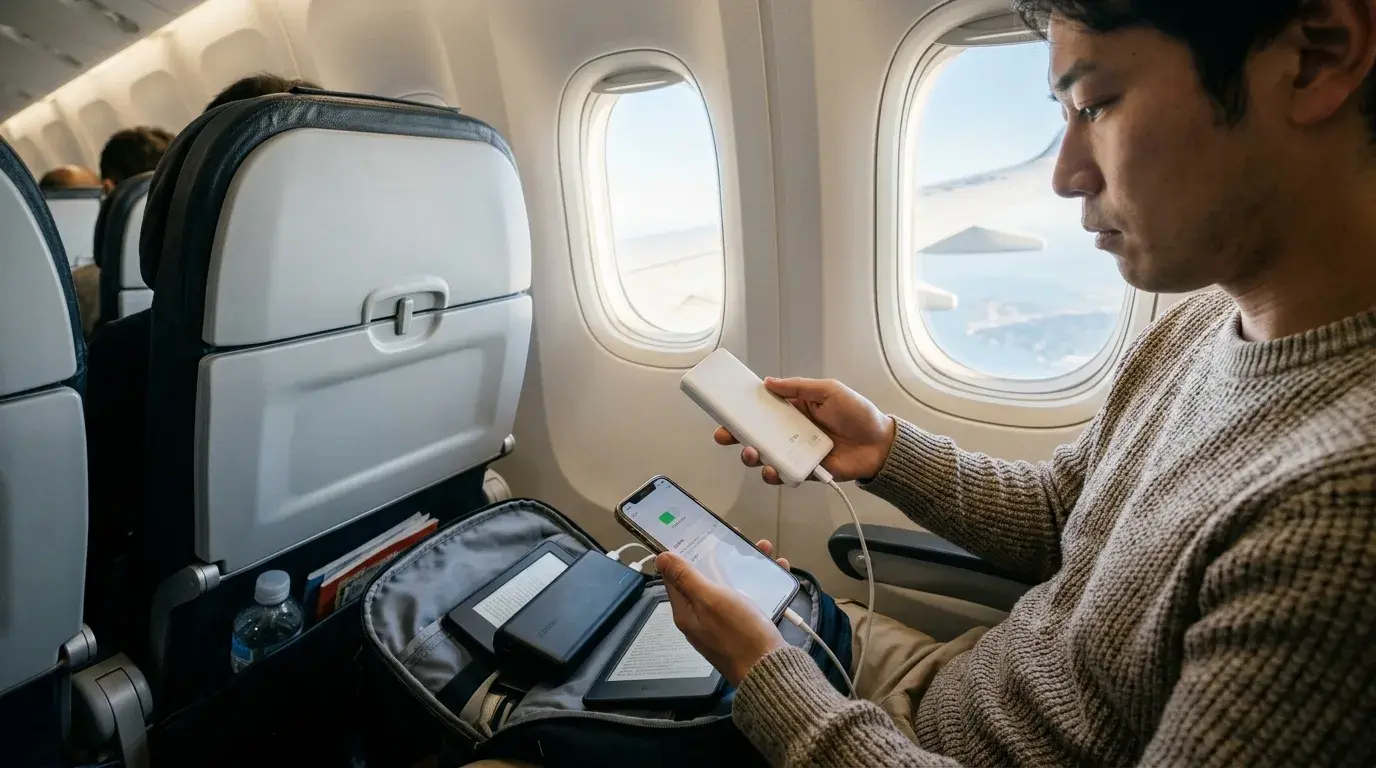
As of April 24, 2026, travelers heading to Japan face a new regulation to consider when packing their carry-on luggage. The country has tightened restrictions on external batteries, commonly known as power banks, with the stated goal of preventing in-flight fire risks. For passengers, the change is tangible: the number of permitted devices is limited, their capacity is capped, and their use during the flight is now banned.
This tightening is not merely an administrative adjustment. It reflects a broader context of heightened vigilance around lithium-ion batteries following several reported in-flight incidents worldwide. In practice, Japan is adopting one of the strictest stances among major air travel destinations, requiring passengers to verify their equipment before departure.
Travelers heading to Japan must now plan ahead. An undeclared battery, an excessive capacity, or in-flight use could result in severe penalties. Airlines operating to the country have begun sharing this information on their websites and apps, but the ultimate responsibility lies with the traveler.
What the new Japanese rules change
According to Japan’s Ministry of Land, Infrastructure, Transport and Tourism, each passenger is now permitted to carry a maximum of two external batteries in their carry-on luggage, with a maximum capacity of 160 Wh per battery. Models with higher capacity are prohibited on board, with no announced exceptions for flights departing or arriving in Japan.
The most visible change concerns in-flight use. It is no longer permitted to charge a smartphone, tablet, or any other device using an external battery during the flight. It is also forbidden to recharge the battery itself using the aircraft’s power outlets. In other words, the power bank may travel in the cabin, but it must not be used during the flight.
This framework applies to all flights involving Japanese airports, regardless of the airline. The key point for travelers is that the regulation depends on the country of arrival or departure, not the carrier. This affects both transit passengers and those starting or ending their journey in Japan.
Why Japan is tightening the rules
Japan’s decision responds to a well-documented risk in air transport: lithium-ion batteries can overheat, emit smoke, or even catch fire due to manufacturing defects, impacts, or misuse. In the cabin, such an incident can escalate quickly, especially given the flight environment, which favors thermal runaway.
External batteries have become a common accessory for travelers, but their high energy density makes them a closely monitored item by aviation authorities. While flight crews are trained to handle battery-related incidents, the most effective strategy remains upstream limitation. This is precisely the approach chosen by Japan.
In this context, authorities also aim to prevent risky behaviors. A battery plugged under a seat, in a seatback pocket, or at the bottom of a bag is harder to monitor than an item stored visibly in the cabin. The ban on in-flight use simplifies crew tasks and reduces the number of potentially problematic situations.
Highly dissuasive penalties
The punitive aspect matches the message sent by Japanese authorities. Any violation can result in up to two years of imprisonment or a fine of up to one million yen—approximately €5,000. These penalties are based on the Civil Aeronautics Act.
For a passenger, this means a simple oversight could take on legal dimensions if detected under aggravating circumstances. In practice, pre-boarding checks should be decisive, but airlines retain the option to intervene mid-flight if a battery is non-compliant or being used despite the ban.
The authorities’ message is clear: this is not a flexible recommendation but a strict safety rule backed by severe penalties. Travelers heading to Japan would be wise to review the contents of their bags well before reaching the airport.
What to check before departure
The first step is to verify the actual capacity of your external battery or batteries. This information is usually printed on the casing or included in the user manual. In case of doubt, it’s better to replace an old or unreadable model than risk refusal at the security checkpoint.
It’s also important to remember that batteries must travel in the cabin, never in checked luggage. While not a new rule, this is emphasized more strongly under Japan’s tightened restrictions. Travelers should keep their power banks within reach and avoid placing them in registered baggage.
Finally, it’s advisable not to overpack with unnecessary power accessories. If you’re traveling with a smartphone, a smartwatch, a laptop, and multiple batteries, it may be wise to simplify your setup. Airlines and official reference sites, including Japan’s Ministry of Land, Infrastructure, Transport and Tourism, emphasize that pre-boarding compliance is the best protection against complications.
A trend beyond Japan
Japan is not acting alone. Several Asian airlines, including Cathay Pacific, Singapore Airlines, Thai Airways, and EVA Air, have already tightened or banned the use of external batteries during flights. The issue has become a point of convergence for many air transport stakeholders in Asia.
In Europe and the United States, IATA and national authorities also regulate battery capacity in carry-on luggage. The difference lies mainly in the strictness of in-flight use rules. Japan stands out for its clearer and more uniform ban, whereas other markets still allow more variable practices depending on the airline.
This shift shows that battery safety in flight is no longer a secondary issue. Carriers and regulators are working to prevent overheating incidents, whose consequences can be immediate in a cabin full of passengers. In this area, prevention relies on simple rules—but they must be applied without exception.
For both business and leisure travelers, the best practice now is to check the watt-hour rating of each battery, respect the two-device limit, and forget about charging devices on board if the itinerary includes Japan. Cabin usage habits are evolving, and this time, there’s little room for interpretation.
Be the first to comment on this article