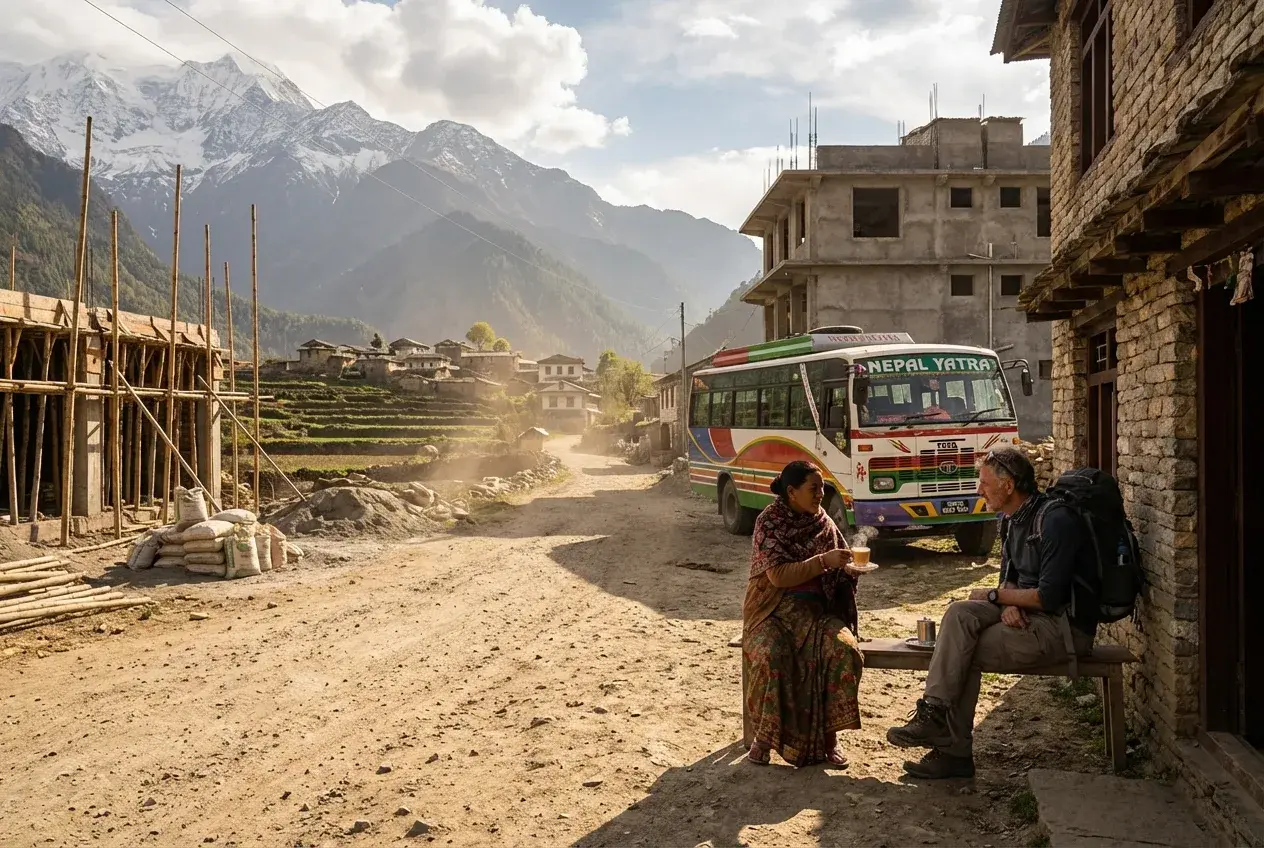
Nepal has long been a geographically isolated country, and for decades, it was among the poorest in the world. In rural areas, where the majority of the population lives, there were no schools, roads, or hospitals. Development remains slow today, but the country is undergoing rapid transformation, opening up at full speed to international tourism.
Visitors primarily come from neighboring countries, particularly India, to explore the major Hindu and Buddhist sites in the Kathmandu Valley. The destination also attracts many trekkers from Europe, the United States, and Japan, drawn by the allure of the Himalayas. For several years, tourism has become a pillar of the national economy. Despite the devastating 2015 earthquake (nearly 8,800 deaths) and the Covid-19 pandemic, the country has gradually regained its tourism vitality. In 2025, Nepal welcomed over 1.15 million international visitors, confirming the sector’s essential role in economic recovery.
The main obstacle to any trip to Nepal remains the country’s limited air connectivity. Tribhuvan International Airport in Kathmandu, the country’s main gateway, serves around forty international destinations across about twenty countries. Travelers often transit through Istanbul, Abu Dhabi, Kuwait City, or New Delhi via airlines such as Turkish Airlines, Etihad Airways, Kuwait Airways, or Air India.
Safe Travel on the Ground
On the ground, acclimatization to altitude and caution on routes are essential for a successful stay. To travel safely, especially in the Kathmandu Valley, it is advisable to use a local tour operator or a specialized French travel agency. Several French travel agencies offer tailor-made itineraries, including trekking. Among them, Comptoir des Voyages stands out for its expertise in the region and its responsible travel approach, offering customized itineraries that combine cultural discovery, trekking, wellness stays, and immersion in local life. The agency emphasizes safety, the quality of French-speaking guides, and respect for communities and the environment.
Other well-known French tour operators offering organized trips to Nepal include Terres d’Aventure (specializing in guided tours and treks), Nomade Aventure (adventure travel and responsible hiking), Atalante (treks with French-speaking local teams), Tirawa, Shanti Travel (a local agency in Kathmandu), and Tamera, which offers a wide range of treks in the Himalayas. These operators typically focus on small-group travel, experienced guides, and more sustainable tourism.
Persistent Structural Weaknesses
Despite the lively and warm atmosphere evident in the daily lives of its people, their accounts of the country’s situation are far from optimistic when the conversation turns to politics. Nepalese people lament the glaring lack of infrastructure capable of transforming the country into a truly modern state. The rise to power of the Maoists after the civil war (1996-2006) led to notable progress in healthcare and education, but it also left a bitter taste due to entrenched corruption, clientelism, and nepotism. Many infrastructure projects aimed at improving transport or energy networks have been abandoned, further straining public finances.
A journey by road to Pokhara quickly reveals the state’s inability to maintain decent roads, which severely damages the country’s tourism reputation. Potholes and the absence of safety barriers alarm passengers peering out of bus windows, pushing many visitors to prefer flying. Yet even here, infrastructure is lacking. Pokhara’s international airport, located in an area prone to persistent fog due to the surrounding mountains, struggles to develop to accommodate more tourists. Equipped with a single runway and lacking an ILS (Instrument Landing System), it frequently faces cancellations, both on arrival and departure, often complicating stays. It is not uncommon to wait four or five hours for a flight in the small terminal, which has almost no amenities beyond a kiosk selling water. Whether by road or air, the connection between Pokhara and Kathmandu remains difficult.
Dependence on International Connections
This raises the question of expanding Tribhuvan International Airport and diversifying international routes. Nepal is heavily reliant on transit connections linking Europe via Gulf hubs. The suspension of many flights since the start of the US-Israeli war against Iran has highlighted the country’s strong dependence on these transit partners. Its connections with Istanbul and major Indian airports (New Delhi, Mumbai, Bangalore…) nevertheless help maintain exchanges between Europe and Nepal, albeit at significantly higher prices, as is the case across much of Asia.
The creation of a direct air link between Europe and Nepal is therefore a priority for Nepalese authorities, especially since European tourists make up a significant share of foreign visitors. A Paris-Kathmandu route existed in the 1990s before being discontinued due to profitability concerns. Today, the trend is toward opening routes with the rest of Asia. Asia’s strong economic growth allows an increasing number of travelers to move around each year, and countries are forging new connections: Tokyo, Seoul, Singapore, Kuala Lumpur, Hong Kong, and several Chinese cities now have direct air links with Kathmandu.
An Ongoing Transformation
The aircraft begins its gradual descent toward Tribhuvan International Airport in Kathmandu. Through the window, the traveler already glimpses the urban jungle into which the plane is descending, surrounded by the mountains encircling the valley. The Kathmandu agglomeration had around 400,000 to 500,000 inhabitants in the 1990s; today, it has nearly 1.7 million (and the broader valley, including Patan and Bhaktapur, around 3 million). The cities of Patan, Kathmandu, and Bhaktapur, once three distinct and rival kingdoms separated by vast rice fields, are now merging due to urban sprawl.
Hardly have suitcases been dropped off at the hotel than a stroll through the historic center of Bhaktapur reveals cohorts of boys and girls leaving brand-new schools, close to modern restaurants and cafes aimed at tourists. The city’s UNESCO World Heritage Site status has enabled successful redevelopment of its historic center, now entirely pedestrianized, where the atmosphere feels suspended in time despite the new signage. It is around the sanctuaries that Newar culture, that of the valley’s ancestral people, comes alive. To mark the entry into adulthood for young men, celebrations often blend traditional music, dance, and Raksi, the rice alcohol considered a divine offering in Hinduism. Do not hesitate to sit nearby to observe the festivities: the guests will gladly invite you to share a cup of this drink or even dance with them.
What Future for Tourism?
Elected in early March in the first elections since the violent insurrection of September 2025, the new government, backed by Nepalese youth, will it seek to strengthen the tourism sector? While the question may seem secondary, tourism accounts for around 7-8% of national GDP and is a major source of foreign currency, essential for a country dependent on imports. The extreme popularity of the new Prime Minister, Balendra “Balen” Shah, a 35-year-old former rapper, offers hope for stability conducive to tourism development. His stated ambition to modernize the country and make it a regional development model could indeed boost arrivals in the coming years.
In conversations with locals, the question of Nepal’s image comes up repeatedly. One of them, met on a bus, offers a telling comparison with Southeast Asia: “When you see the number of tourists in Thailand or Indonesia, and what it brings them, you realize we need to become just as attractive. But for that, many things must change. Everyone must take responsibility for the image we project to the rest of the world.”
The Dilemma of Prices and Attractiveness
But increased attractiveness inevitably leads to higher prices. In a country where a large portion of the population earns barely three dollars a day, what would be the consequences for locals? Especially since one of Nepal’s main assets remains its unbeatable prices: 100 to 200 rupees for a plate of noodles (chowmein), or between 60 cents and €1.20, hotels in Pokhara around €7 per night, and guides charging €30 per day to accompany trekkers in the Himalayas. These are just some of the reasons why Nepal remains a top destination, especially for European trekking enthusiasts.
This issue illustrates a dilemma shared by many developing countries: how to balance tourism growth with long-term socio-economic stability? Nepal offers a prime example. Since the arrival of the first tourists in the 1960s, the country has experienced a turbulent history that has hindered its development. Yet the enthusiasm of visitors remains almost universally positive: whether they come from Europe or Asia, all leave enchanted by a country of rare hospitality, breathtaking beauty, and a unique atmosphere in the world.
Be the first to comment on this article