Ryanair crushed by Austrian justice: 14 illegal fees and €55 airport check-in charge at risk
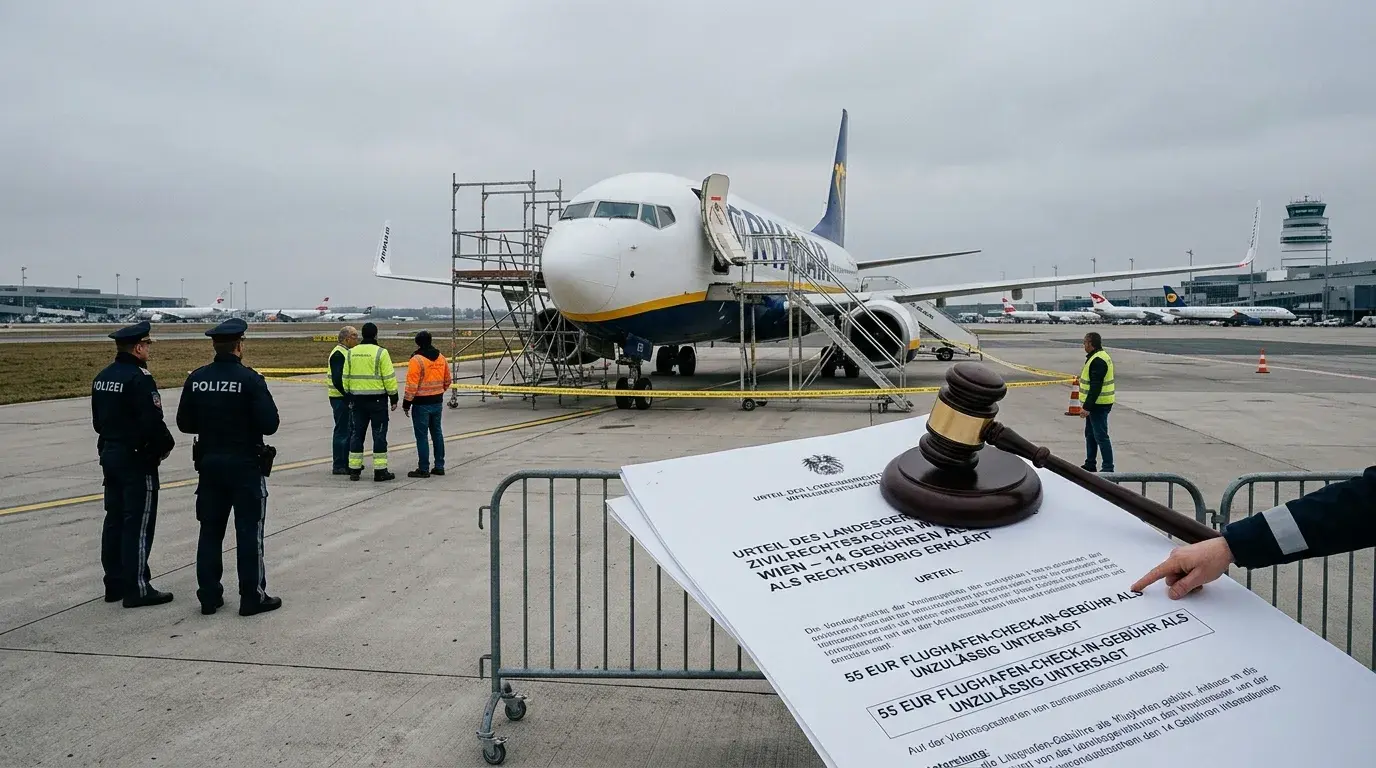
The Austrian Supreme Court has delivered a landmark ruling against Ryanair, invalidating fourteen clauses in its general transport conditions concerning additional fees. Among the most contested surcharges are the €55 charged for airport check-in when a passenger fails to complete online check-in, the €15 for printing a boarding pass at the counter, and the €25 demanded for infants traveling on an adult’s lap. The Austrian judiciary has given the Irish low-cost carrier three months to adapt its practices or face penalties.
This decision is based on a significant imbalance to the detriment of passengers, according to the Verein für Konsumenteninformation (VKI), Austria’s consumer protection association. The judges ruled that fees presented as “optional” by Ryanair could still apply even in cases of technical malfunctions attributable to the airline, violating European and Austrian transparency requirements.
Transparency now mandatory
The VKI welcomes a ruling that marks a turning point in the fight against hidden fees in air transport. “The Supreme Court has clearly indicated that additional fees must be transparent and must not unjustly disadvantage consumers,” explains Petra Leupold, head of the association’s legal department. The Austrian Ministry of Social Affairs summarizes this philosophy with the slogan “Transparency, not deception,” emphasizing that the practice of breaking down ticket prices into multiple ancillary fees must no longer mask the true cost of travel.
This jurisprudence aligns with a series of European rulings on optional surcharges, particularly following the C‑28/19 case opposing Ryanair to the Italian Competition Authority. Austrian judges also relied on the Austrian Civil Code, which sanctions surprising or incomplete clauses in adhesion contracts.
Ryanair downplays the ruling’s impact
Despite this legal setback, the Irish airline is attempting to downplay the significance of the decision. In a statement, a Ryanair spokesperson notes that the Court did not declare its entire “pricing model” illegal nor order systematic retroactive refunds. The low-cost carrier insists that the contested surcharges, in its view, comply with European rules on optional pricing. However, Ryanair must adjust its general conditions in Austria within three months or face penalties. The ruling also mandates the publication of the decision on the airline’s website and in the Austrian press to inform consumers of their rights.
Possible refunds for passengers
The VKI believes this decision paves the way for refund requests from passengers who paid fees deemed illegal. The association cites a legal precedent: an Austrian court had upheld the right to a refund of a €55 airport check-in fee charged when a passenger was unable to check in online due to a technical issue attributable to Ryanair. “Passengers should now review their old tickets and contact the airline to obtain refunds for unduly collected sums,” the VKI advises.
Growing regulatory pressure on low-cost carriers
This Austrian ruling comes amid a tightening of European regulations targeting opaque pricing practices in air transport. In 2025, the European Union adopted a regulation strengthening transparency obligations for ancillary fees, requiring airlines to display the total ticket price from the first booking page. Ryanair, often criticized for its additional fees deemed abusive, may now be forced to fundamentally revise its pricing policy across all its European markets.
What should passengers do?
Travelers who flew with Ryanair in Austria since early 2026 are advised to check their invoices and contact the airline’s customer service to request refunds for contested fees. The VKI provides a template letter on its website to facilitate the process. Meanwhile, European consumer associations are calling for harmonized rules across the continent to prevent airlines from shifting abusive practices to less scrutinized countries.
This decision marks a significant step in protecting the rights of air passengers, but its real impact will depend on the effective implementation of refunds and Ryanair’s adaptation of its practices in other markets. One thing is certain: the era of hidden fees in commercial aviation may well be coming to an end.
Ryanair fees now in the crosshairs of justice
The Austrian Supreme Court ruling covers a wide range of surcharges frequently complained about by passengers:
- The €55 charged for airport check-in when a passenger fails to complete online check-in;
- The €15 for printing a boarding pass at the counter;
- The €25 fee for infants traveling on an adult’s lap;
- Name change fees of up to €160;
- Certain booking modification fees and “mandatory family seats.”
According to the VKI, these fees are deemed “opaque or grossly disadvantageous” to consumers because they prevent a clear anticipation of the total travel cost at the time of booking.
A victory for transparency in air transport
This decision is part of a broader trend of strengthening passenger rights in Europe. For several years, regulators and consumer associations have intensified actions against abusive pricing practices by airlines, particularly low-cost carriers. In 2024, the European Commission had already sanctioned several carriers for non-compliance with transparency rules, imposing fines of up to several million euros.
The Austrian ruling could set a precedent and encourage other European countries to tighten their legislation. Passengers, for their part, now have a concrete tool to challenge fees deemed illegal, provided they are aware of their rights and take action to seek redress.
How to contest your Ryanair fees in Austria
If you paid any of the fees contested by Austrian justice, follow these steps:
- Review your old tickets and invoices to identify the contested fees;
- Contact Ryanair’s customer service by email or via the online form on their website;
- Send a copy of your invoice and a refund request, citing the Austrian Supreme Court ruling;
- If refused, escalate to the VKI or a local consumer association for legal support;
- If necessary, initiate legal proceedings, as an Austrian passenger previously did to obtain a refund of €55 in check-in fees.
This process could extend to other European countries, where transparency rules for fees remain inconsistent.
The economic impact for Ryanair: a model at risk?
Ryanair has long championed its low-cost model, built on aggressive pricing and significant ancillary revenue. In 2025, additional fees accounted for nearly 20% of the group’s total revenue, according to sector estimates. The elimination of fourteen clauses deemed illegal could therefore have a significant impact on the airline’s margins, especially as other European countries may follow Austria’s lead.
The Irish low-cost carrier will need to rethink its pricing strategy to remain competitive while complying with new legal requirements. This adaptation may take time and require structural adjustments, particularly in terms of transparency and communication with customers.
What comes next for Austria? Toward European harmonization?
The Austrian ruling could serve as a catalyst for harmonized rules across the continent. Several European countries, including France and Germany, have already strengthened controls on ancillary fees, but no uniform legislation exists to date. The European Commission has announced it is studying the possibility of extending transparency rules to all member states to avoid competitive distortions between airlines.
In this context, passengers could soon benefit from stronger protection across Europe, allowing them to travel with greater peace of mind and without unexpected price surprises.
Be the first to comment on this article