Korean Air reduces CO2 emissions through operational efficiency and a modern fleet
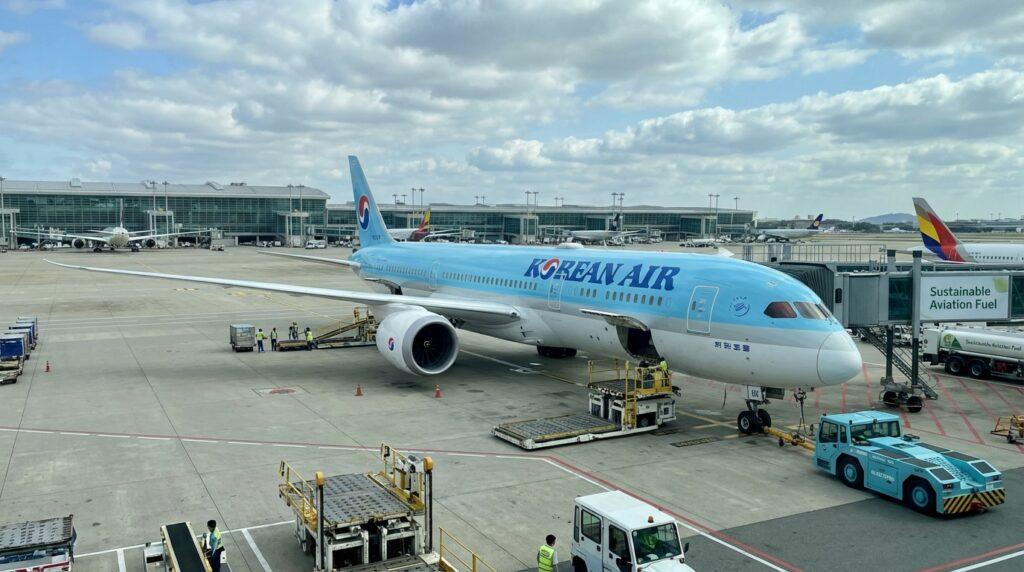
Korean Air recorded a significant reduction in its CO2, emissions to over 420,000 tonnes by 2025, despite a 2.6 % increase in flight activity. The South Korean airline thus reduced its carbon emissions by 3.3 % compared with the previous year. This performance is the fruit of rigorous fuel management and the ongoing integration of a more modern, energy-efficient fleet. These efforts are in line with international commitments such as ICAO's CORSIA program, underlining the company's strategy for more sustainable aviation.
Consolidated data from the Fuel Management Steering Committee, covering the first quarter of 2026, reveal that Korean Air's total flight-related CO2 emissions reached 12,184,169 tonnes in 2025, compared with 12,604,224 tonnes in 2024. This saving of 420,055 tonnes is all the more remarkable given that the total number of flights operated rose by 2.6 % to 189,851 operations.
Fleet modernization and operational optimization: the keys to fuel savings
Fleet renewal is a major lever in this emissions reduction strategy. New-generation aircraft, such as the Boeing 787-9 and 787-10, as well as the Airbus A350 and A321neo, deployed since 2017, accounted for 41.6 % of total flights in 2025. Their superior fuel efficiency contributes directly to lower fuel consumption. As part of its merger with Asiana Airlines, SkyTeam alliance member Korean Air is accelerating this transition with major orders, including 103 Boeing aircraft ordered by 2025, aimed at standardizing its fleet around high-performance aircraft families such as the 777, 787, 737, A350 and A321neo.
In addition to the rolling stock, precise operational optimizations are implemented. These include adjusting cost index (CI) parameters to find the best balance between cruising speed and fuel consumption. Finer predictions of zero fuel weight (ZFW) and optimization of the center of gravity help reduce aerodynamic drag. Negotiating more direct routings with air traffic controllers and choosing optimized alternative airports reduce fuel reserve requirements. In addition, limiting the use of the auxiliary power unit (APU) on the ground and regular engine maintenance through periodic washing and fine-tuning also contribute to savings. These initiatives, coordinated by a quarterly committee, foster essential inter-departmental collaboration between flight, maintenance and passenger services teams.
Artificial intelligence and governance: innovation for environmental performance
Korean Air is actively integrating artificial intelligence to improve the accuracy of its operational calculations. In particular, AI is used to predict baggage weights and water consumption, thus reducing unnecessary overloading and, consequently, fuel consumption. This innovative approach earned the company the «Data Insight & Pioneer» award in SkyTeam's ’Aviation Challenge 2025«, a competition for sustainable initiatives in the airline industry. The company also encourages suggestions from its employees, rewarding ideas for reducing carbon footprints.
A Korean Air spokesperson said: « This reduction was achieved thanks to the collaboration of all our operating sectors and the participation of our employees. We remain committed to achieving our carbon reduction targets and our path towards sustainable aviation. "
@Incheon Airport
Be the first to comment on this article
On the same topicairbus a350
- Emirates launches its Premium Economy class on Montreal with the Airbus A350
- United Airlines: a crucial decision to come on the integration of the Airbus A350 into its long-haul fleet
- SWISS trains pilots and cabin crew for Airbus A350 integration
- Turkish Airlines presents its new Crystal business class
- Qatar Airways copes with turbulence incident, hopes to fly Airbus A350 QSuite to Scotland