Air Congo Launches Kinshasa-Brussels Route on July 1: What Travelers Need to Know
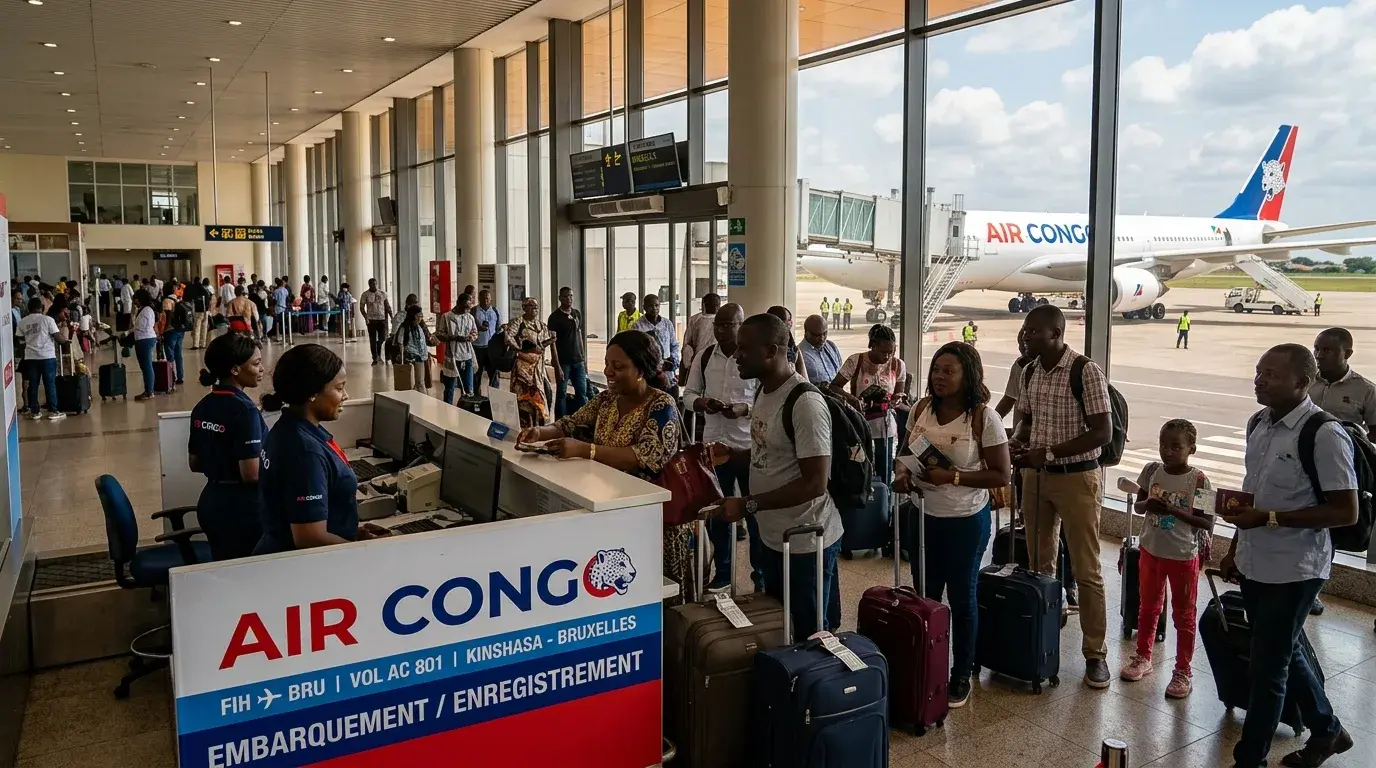
A new chapter in connectivity between Central Africa and Europe is about to begin. Starting July 1, 2026, Air Congo will launch its first direct long-haul route between Kinshasa and Brussels, operated five times weekly with a Boeing 787-8 Dreamliner provided by Ethiopian Airlines under an ACMI agreement. This initiative marks a major milestone for the Democratic Republic of the Congo, which is seeking to reposition Kinshasa as a regional hub and strengthen ties with Europe.
This move comes as African air transport undergoes a profound transformation. Founded in 2024 as a joint venture between the Congolese government (51%) and Ethiopian Airlines (49%), Air Congo began operations with domestic flights before gradually expanding its network. With an average load factor of 70% on its domestic routes, the airline has a clear ambition: to conquer major intercontinental routes. Brussels is just the first step in a more ambitious plan that includes Paris and Dubai, according to Congolese Minister of Transport Jean-Pierre Bemba.
For travelers, this new route offers a direct alternative to existing connections, which are often indirect or operated by third-party airlines. The Kinshasa-Brussels flight, scheduled five times a week, will allow passengers to reach the Belgian capital in a single journey, avoiding cumbersome layovers. This strategic choice is based on the strong presence of a Congolese diaspora in Belgium, historical traffic between the two cities, and growing demand for business and institutional travel.
The Congolese authorities present this launch as a concrete response to the country’s connectivity needs. Kinshasa, experiencing rapid demographic and economic growth, is becoming an air crossroads for Central Africa, with ambitions to serve Johannesburg, Luanda, or Dar es Salaam. The airline plans to build a fleet of at least eight Boeing 737s and two Boeing 787s to cover these destinations while consolidating its domestic network before expanding into major international routes.
However, this expansion is taking place in a context where health and security risks must be closely monitored. The Democratic Republic of the Congo is facing a new Ebola outbreak, with several hotspots under enhanced surveillance. The World Health Organization and the International Civil Aviation Organization confirm that flights remain safe, but enhanced health measures could be implemented for passengers traveling to or from Kinshasa.
For travelers planning to use this new route, several practical considerations should be anticipated. Bookings are already open, and the airline is focusing on a gradual upscale strategy to differentiate itself from other African operators. With the support of Ethiopian Airlines, Air Congo aims to offer an in-flight experience that meets international standards while capitalizing on demand in an underserved market.
A strategic route for Central Africa
The launch of the Kinshasa-Brussels route is part of a broader strategy to reposition Central Africa on the global air transport map. After years without a structured national carrier, the DRC is seeking to revive the legacy of Air Zaïre, a once-prominent airline before its demise. Air Congo aims to become a key player in this renaissance, leveraging a technological and operational partnership with Ethiopian Airlines, one of the continent’s most dynamic airline groups.
The choice of Brussels as the first European destination is no coincidence. The Belgian capital is home to a large Congolese community, estimated at over 200,000 people, and has a long-standing traffic connection with Kinshasa. This route meets both emotional and economic demand while offering an alternative to passengers who currently transit through Paris, Addis Ababa, or Nairobi to reach Europe from Kinshasa.
For business travelers, this new route represents an opportunity to reduce travel time and improve productivity. European institutions and Congolese companies will now be able to organize trips without the constraints of layovers—a significant advantage in a context where time is often a critical factor. Congolese authorities also highlight the tourism potential of this route, particularly for Europeans wishing to discover the natural and cultural riches of the DRC.
Air Congo is focusing on a gradual upscale strategy. After consolidating its domestic network, the airline plans to expand its offering to Paris and Dubai, two key destinations for strengthening the DRC’s connectivity with Europe and the Middle East. These projects remain contingent on the evolution of security and regulatory conditions but illustrate the Congolese authorities’ commitment to making Kinshasa a regional hub.
A win-win partnership with Ethiopian Airlines
The success of Air Congo largely depends on its partnership with Ethiopian Airlines, a major player in African air transport. This partnership, structured as a joint venture, allows Air Congo to benefit from the operational and commercial expertise of a group that has rapidly expanded in recent years. Ethiopian Airlines holds 49% of Air Congo’s capital, while the Congolese state controls 51%. This hybrid structure aims to combine the strengths of the public and private sectors to ensure the airline’s sustainability.
For Ethiopian Airlines, this partnership represents an opportunity to strengthen its presence in Central Africa, a region where the group is already well established. By providing two Boeing 787-8 Dreamliners under an ACMI agreement, Ethiopian Airlines enables Air Congo to launch long-haul operations without waiting to acquire its own aircraft. These Dreamliners, renowned for their fuel efficiency and comfort, offer an in-flight experience tailored to discerning travelers.
The two airlines are closely collaborating to optimize connections between Kinshasa and other destinations served by Ethiopian Airlines. Addis Ababa, the group’s main hub, serves as a connecting platform to Europe, the Americas, and Asia. Air Congo passengers will benefit from competitive fares and integrated services, enhancing the appeal of the new Kinshasa-Brussels route.
This partnership aligns with Ethiopian Airlines’ Vision 2035 strategy, which aims to position the group as one of the world’s leading air transport players. By relying on a modern fleet and an expanding network, Ethiopian Airlines seeks to consolidate its leadership in Africa while developing strategic alliances with other continental carriers. Air Congo is a concrete example of this dynamic, demonstrating that cooperation between African airlines can be a growth driver for the entire sector.
Challenges ahead for Air Congo
Despite the enthusiasm surrounding the launch of the Kinshasa-Brussels route, Air Congo faces several challenges to ensure its success. The first is managing health and security risks, particularly in a context where the DRC is grappling with epidemiological challenges. Congolese authorities and airlines must work closely to implement appropriate protocols to avoid any disruptions or health restrictions that could deter passengers.
Another major challenge is competition in the African market. Several airlines, including Air France, Brussels Airlines, and Ethiopian Airlines, already operate routes between Central Africa and Europe. To stand out, Air Congo must offer a competitive proposition in terms of pricing, frequency, and service quality. The airline is focusing on a gradual upscale strategy, with modern aircraft and an in-flight service tailored to passenger expectations.
Operational management will also be critical. Air Congo must prove its ability to maintain regular and reliable operations despite the logistical constraints inherent in a developing airline. The partnership with Ethiopian Airlines should facilitate this transition by providing technical and commercial support to the young Congolese carrier.
Finally, environmental sustainability cannot be ignored. Like all airlines, Air Congo must commit to reducing its carbon footprint, particularly by modernizing its fleet and adopting more environmentally friendly operational practices. Transitioning to more efficient aircraft, such as the Boeing 787 Dreamliner, is a first step in this direction. The airline must also explore initiatives to offset its CO₂ emissions to meet growing passenger expectations regarding environmental responsibility.
These challenges should not overshadow the opportunities offered by this new route. For travelers, Air Congo represents a credible alternative to existing airlines, with an offering tailored to the specific needs of the Africa-Europe market. For the DRC, this launch marks an important step in its ambition to open up to the world and strengthen its position on the international stage.
How to book and what to expect
Bookings for the Kinshasa-Brussels route are already open on Air Congo’s website. The airline offers competitive fares with flexible options for business and leisure travelers. Passengers can choose between different service classes tailored to their needs and budget. The airline emphasizes an in-flight experience that meets international standards, with attentive service and meals inspired by Congolese and African cuisine.
For travelers looking to combine their trip with connections, Air Congo offers partnerships with other airlines, particularly Ethiopian Airlines. These collaborations allow passengers to benefit from competitive fares and integrated services, making it easier to organize their travel. Passengers can also take advantage of loyalty programs designed to reward their loyalty and offer exclusive benefits.
Travelers are advised to book in advance to secure the best fares and availability. The airline also recommends checking health conditions and any restrictions in place before departure to avoid any issues at boarding. Congolese authorities and airlines are working closely to ensure the safety and comfort of passengers in compliance with international standards.
With the launch of this new route, Air Congo is set to write a new chapter in the history of air transport in Central Africa. For travelers, this opening represents a unique opportunity to discover a region rich in culture and opportunities while benefiting from improved connectivity with Europe. One thing is certain: this route is poised to become a major axis for travel between Africa and Europe.
Brussels: A gateway to Europe
Brussels, the capital of the European Union, is a strategic destination for Air Congo. The city offers exceptional connectivity to major European cities thanks to its well-developed airport hub. Air Congo passengers will easily reach Paris, Amsterdam, Frankfurt, or London in just a few hours of flight. The Belgian capital is also a crossroads for travelers from Africa, with connections to Addis Ababa, Nairobi, or Johannesburg.
For business travelers, Brussels offers an opportunity to develop contacts with European institutions and international companies. The city hosts numerous headquarters and international organizations, making it an essential destination for professional meetings. Air Congo passengers will be able to use their stopover in Brussels to organize meetings or business visits in a pleasant and cosmopolitan setting.
For tourists, Brussels boasts a wealth of cultural and historical attractions. The Grand Place, museums, art galleries, and lively neighborhoods attract millions of visitors each year. Air Congo passengers can discover these treasures during their stopover before continuing their journey to other European or African destinations. The airline highlights special offers for tourists, including guided tours and discounts at partner hotels.
Finally, Brussels is a multicultural city where African influences are prominent. Congolese or Central African travelers will find a familiar atmosphere while discovering the richness of European culture. This diversity makes Brussels an ideal destination for Air Congo passengers, who can experience a unique blend of tradition and modernity.
With the launch of its Kinshasa-Brussels route, Air Congo is positioning itself within a dynamic of connectivity and development for Central Africa. This new route offers a credible alternative to existing airlines while strengthening ties between Africa and Europe. For travelers, it represents an opportunity to explore a region rich in opportunities under optimal conditions of comfort and safety.
Be the first to comment on this article