
Saint-Pierre-et-Miquelon: Between Aerial Fears and Geopolitical Ambitions
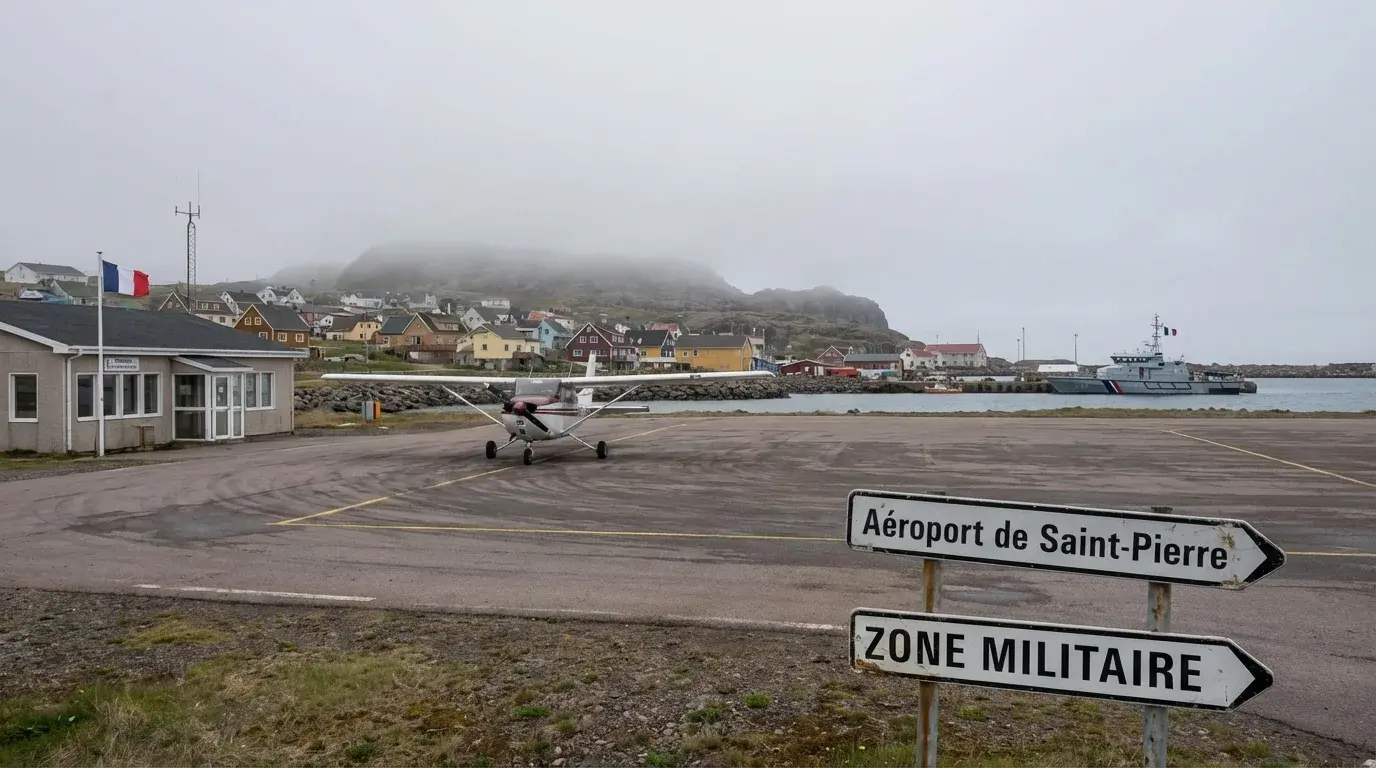
The archipelago of Saint Pierre and Miquelon, French Overseas Territory, nestled off the coast of Newfoundland, finds itself at the heart of a sensitive debate concerning the sovereignty and safety of its airspace. A plan to transfer control of part of this airspace to Canada is causing deep concern among the inhabitants, rekindling fears of an abandonment of sovereignty in an already tense geopolitical context. These concerns are all the more acute given Donald Trump's stated ambitions in the subarctic region, which add an extra dimension of uncertainty about potential foreign takeover.
A divisive transfer of air traffic control
The discussion concerns the possibility of entrusting a Canadian organization with the management of Saint-Pierre-et-Miquelon's airspace below 6,000 feet. Officially, this move would be motivated by « administrative and technical »The aim is to rationalize resources and ensure continuity of service in this isolated area with limited resources. Canada, with its high-performance control centers like Gander, already has the infrastructure and expertise to handle heavier traffic.
However, this prospect is strongly criticized by local political figures such as Senator Annick Girardin. She denounces a « manifest abandonment »of sovereignty, arguing that ’.« you can't outsource your sovereignty ». In her view, such a transfer would send a «clear message" that the« give-up signal »This is particularly true in a region where the balance of power is shifting.
Technical arguments versus sovereignty
France's Direction Générale de l'Aviation Civile (DGAC) highlights the benefits of the Canadian solution in terms of air safety and reduced management costs. Canada, with its modern control centers, could provide optimum service for a small, isolated airspace.
Despite these arguments, concern remains. Senator Girardin insists on the « major political and strategic risk »the project, especially in a region where the « imperialisms »It calls on the French government to It calls on the French government to « stand tall in your boots »and to refuse any devolution of airspace control to a third country.
The geopolitical context: the shadows of Donald Trump
Local concerns are not limited to the technicalities of airspace management. They are part of a climate of geopolitical uncertainty, in which the ambitions of the great powers are felt as far away as the Arctic and sub-Arctic.
Statements that make us fear the worst
The people of Saint-Pierre-et-Miquelon are following with apprehension the statements made by Donald Trump, who has in the past expressed an interest in acquiring Greenland and increasing Canada's influence. These ambitions fuel a feeling of insecurity about the territory's future.
" Everything that's happening scares us. We don't know what he's capable of doing. Tomorrow, it could be Saint-Pierre-et-Miquelon. »A local resident confides, summing up a widespread concern about the potential appetites of the United States in the region. Senator Girardin sees it as « wrong signal »It's all part of a «weakening of the French position", while the American president seems to be appointing himself as the "French leader".« sole head of the subarctic and arctic zone ".
Strengthening the French presence, a strategic imperative
In this context, the question of sovereignty takes on an even more critical dimension. France is called upon to be naïve and to consolidate its presence in North America. The archipelago awaits a clear decision in favor of maintaining French control, to avoid a symbolic setback with potentially far-reaching consequences.
In response to these challenges, strong political initiatives involving Denmark and Greenland are suggested to reinforce the place of France and the European Union in the Arctic and sub-Arctic space. The aim is to consolidate French sovereignty and reassure its inhabitants in the face of geopolitical uncertainties.
Current airspace management and outlook
Saint-Pierre-et-Miquelon's airspace is currently managed by the archipelago's civil aviation department for the low zone (up to 6,000 feet), in close coordination with the Gander center for higher airspace and international routes. This cooperation guarantees flight safety while maintaining French sovereignty.
The debate over the transfer of control is therefore not just technical, but profoundly political and strategic. It raises the question of France's perception of its sovereignty and its ability to maintain its influence in regions where geopolitical dynamics are constantly evolving.
The outcome of this debate will have important repercussions for Saint-Pierre-et-Miquelon, where attachment to French sovereignty is an essential component of the local identity. The final decision will have to strike a balance between technical imperatives and considerations of national sovereignty.
Be the first to comment on this article
On the same topic
- Emirates reinvents its fleet: Why the 777X could replace 35 Dreamliners
- Emirates Weighs Swapping Boeing 787s for 777Xs: A Strategic Shift That Could Transform Long-Haul Travel
- China Finally Validates Its Order for 200 Boeing Aircraft: What This Means for Your Next International Flights
- Air France-KLM struggles amid fuel shock: How the airline withstands a 71% profit plunge
- Flybondi: March Salaries Unpaid as Argentine Low-Cost Airline Faces Pressure
- Rising Fuel Costs: Delta Air Lines Posts Loss, Cuts Capacity, and Raises Fares