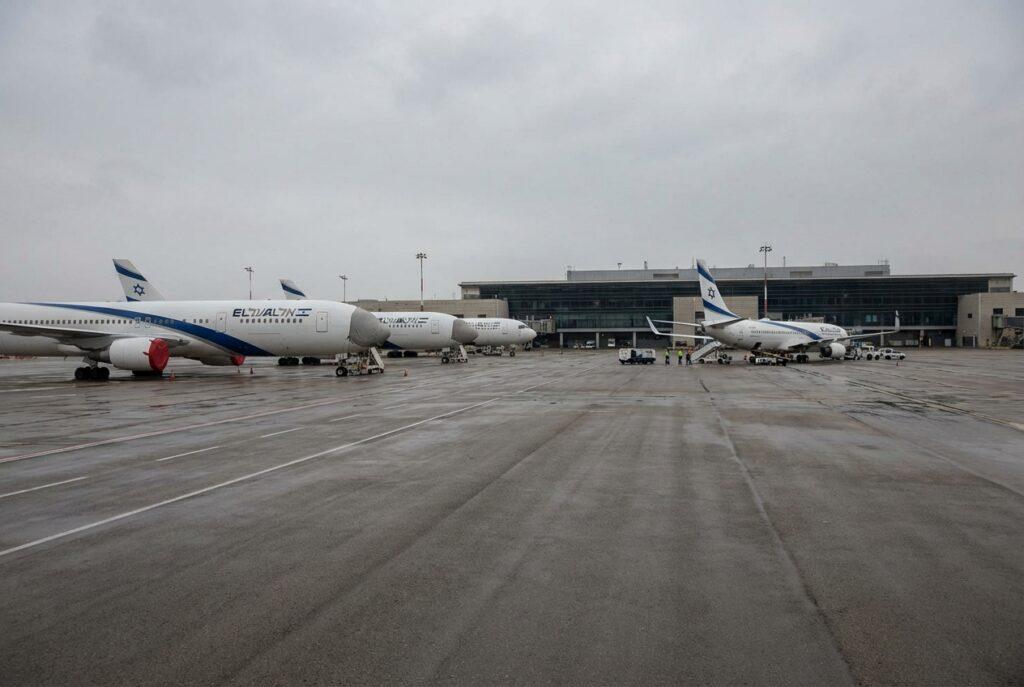
After a new safety assessment, the Israeli Ministry of Transport almost paralyzed traffic at Ben Gurion airport, close to Tel Aviv, The new system limits movements to one inbound and one outbound flight per hour, with a ceiling of 50 boarding passengers.
The national company El Al announces a program reduced to the bone, refocused on a few international routes deemed essential, while’Arkia relocates a large part of its operations to Jordan and Egypt. These measures mark a turning point for Israeli air transport, already weakened by the war with Iran at the end of February 2026.
Ben Gurion in slow motion, Israeli skies under duress
The new restrictions came into force on March 23, 2026, following a security assessment by Transport Minister Miri Regev, against a backdrop of Iranian missile strikes and Hezbollah threats in Lebanon. According to several media, including Reuters and the Israeli press, two failed intercepts during Iranian attacks on March 21, causing damage and injuries in the south of the country, weighed heavily in the decision.
In practical terms, Ben Gurion is now limited to one inbound and one outbound flight per hour. Incoming flights are not capped in terms of passenger numbers, but each departure is restricted to a maximum of 50 passengers, de facto reducing the airport's capacity to a fraction of its normal level. «In order to preserve human lives, I have decided to temporarily reduce the number of take-offs, landings and passengers at Ben Gurion airport.», said Miri Regev, quoted by the local press.
El Al reduced to essentials
For El Al, These limitations are equivalent to reducing its offer to around 5% of its usual seat capacity. The company, which has already been engaged in repatriation flights in connection with the conflict between the United States and Israel and Iran since the end of February, is now talking about a network reduced to only those routes deemed vital.
El Al explains that these constraints «This means operating only essential flights, with the aim of maintaining the air bridge between Israel and the rest of the world.», by giving a «special priority to humanitarian and medical cases».», according to statements reported by Reuters. The airline plans to maintain a handful of key destinations from Ben Gurion, including New York, Los Angeles, Miami, London, Paris, Rome and Athens, operated with heavily under-capacity flights from Israel.
In this context, El Al calls on the authorities to open Ramon airport, near Eilat, as a complementary alternative to Ben Gurion, in order to preserve a minimum of international service and offer passengers another option. Located more than four hours' drive from Tel Aviv, close to Israel's borders with Jordan and Egypt, Ramon has the advantage of being far from the main urban centers targeted by the missiles.
Arkia goes into exile in Aqaba and Taba
The consequences are not limited to the national carrier. Operational pressure is also driving other Israeli carriers to reorganize urgently. Arkia Israeli Airlines, the market's second largest carrier, has announced the transfer of the majority of its international operations to Jordan and Egypt.
The company plans to shift the bulk of its long-haul flights - notably to New York, Bangkok and Hanoi - to the airports of Aqaba, Jordan, and Taba, Egypt, where aircraft can take off without the 50-passenger cap. Arkia will maintain minimal activity at Ben Gurion, concentrated on a few regional routes such as Larnaca (Cyprus) and Athens (Greece), mainly for humanitarian needs or minimum service continuity. According to Arkia CEO Oz Berlowitz, the current limits effectively close the Israeli skies to normal traffic. «With the latest restrictions, it is not possible to maintain regular air activity, and in practice this amounts to the closure of Israel's skies.», he denounced, quoted by Israeli business media and by Reuters.
An airline system under structural strain
These new measures are part of a gradual tightening of Israel's flight regime since the start of the military campaign against Iran at the end of February 2026. Even before Miri Regev's decision, civil aviation officials had recommended the immediate closure of Israeli airspace in the run-up to Passover and in the face of increased missile fire.
For the time being, the government has opted for an intermediate solution that maintains a net of international connectivity while reducing the risk of civilian aircraft being on threatened flight paths. However, this strategy comes at a high cost: fewer seats, more complex itineraries, transfers by road to alternative bases such as Ramon, Aqaba or Taba, and permanent uncertainty for passengers and airlines alike.
Be the first to comment on this article