Russia affected by the closure of Gulf hubs, impacting connecting flights
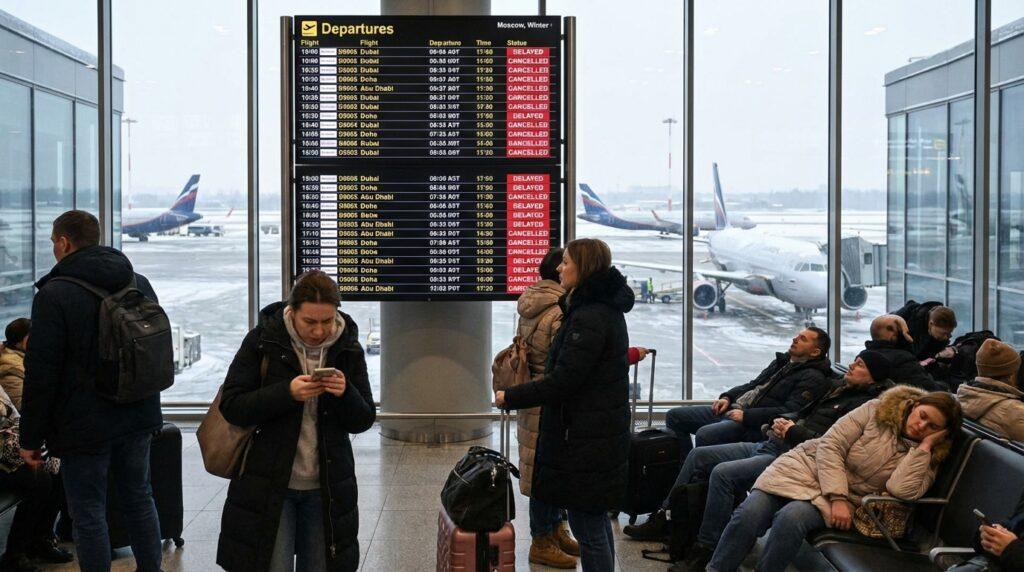
While the Middle East conflict enters its third week, airspace closures are not only disrupting traffic between Europe and Asia, but also Russia's air connectivity with the rest of the world. Already limited by Western sanctions since 2022, the possibility of international air travel is shrinking even further. The Gulf hubs, essential for connections, have become inaccessible to Russian travelers.
According to the Association of Tour Operators of Russia (ATOR), the number of countries accessible by direct flights for tourism purposes has fallen by a third since the start of the disruption in the Middle East. Only 11 main destinations remain operational for the Russian market: Turkey, Egypt, Thailand, Vietnam, China, Jordan, Indonesia, Morocco, Maldives, Sri Lanka and Seychelles.
ATOR even speaks of a « air blockade »This has deprived Russian tourists of many options. Of the 31 countries still linked by direct flights to Russia in March 2026, only a handful are really suitable for mass tourism. Ticket prices to Asia and Africa have already risen by 10-20 % due to the suspension of flights by Gulf airlines (flydubai, Air Arabia, Emirates, Qatar Airways).
Gulf hubs, vital hubs for connecting flights
The Gulf countries (United Arab Emirates, Qatar, Oman) used to serve as an essential bridge to destinations without direct connections from Russia, notably in Europe. With the partial or total closure of airspace over Iran, Iraq, the United Arab Emirates and Qatar, these connections have become impossible or very complicated.
Since March 1, no fewer than 62 flights between Russia and the Middle East have been cancelled (38 by Russian airlines and 31 by foreign carriers). More than 75 %s involved the United Arab Emirates. Thousands of transit passengers, including Russians stranded in third countries (Maldives, Sri Lanka, Tanzania, Thailand), are struggling to return home. ATOR estimates that 5,000 Russian tourists are still waiting for repatriation solutions.
Cuba, already lost due to fuel shortage
The situation comes on top of a recent painful loss: Cuba. In February 2026, Rossiya (an Aeroflot subsidiary) and Nordwind both suspended their flights to the Caribbean island due to a severe shortage of kerosene in the country. They had to charter empty aircraft to repatriate Russian tourists, before cancelling their program altogether. The Russian Ministry of the Economy has even advised against all travel to Cuba until further notice.
This suspension, linked to the Cuban energy crisis and US sanctions, has already deprived Russians of a popular and inexpensive destination.
Financial losses and an uncertain future for Russian tourism
Russian tour operators have already lost the equivalent of 37 million dollars (3 billion rubles) in the first ten days of the Middle East conflict. Cascading cancellations and emergency repatriations are taking a heavy toll on a sector that relied on Gulf destinations and connecting flights to maintain a modicum of openness to the world.
ATOR warns that Russian outbound tourism could fall by 1 to 8 % over the full year 2026 if the situation persists. Travelers are urged to check their bookings regularly and favor the few remaining stable routes (via Istanbul, China or Uzbekistan), even if these alternatives mean longer journeys and higher airfares.
On the fifteenth day of the conflict, Russians, like many other international travellers, discovered the extent to which their mobility depended on the Gulf hubs. Today, this dependence is turning into a veritable air trap for travel from Russia, already severely curtailed by Western sanctions since the war in Ukraine.
@Domodedovo International Airport
Be the first to comment on this article